“Though true repentance be never too late, yet late repentance is seldom true. Millions are now in hell, who have pleased themselves with the thoughts of after-repentance. The Lord has make a promise to late repentance, but where hath he made a promise of late repentance.” —Thomas Brooks, Apples of Gold
Poetic Justice (Jeremiah 4:5–31)
Declare in Judah, and proclaim in Jerusalem, and say,
“Blow the trumpet through the land;
cry aloud and say,‘Assemble, and let us go
into the fortified cities!’
Raise a standard toward Zion,
flee for safety, stay not,
for I bring disaster from the north,
and great destruction.
A lion has gone up from his thicket,
a destroyer of nations has set out;
he has gone out from his place
to make your land a waste;
your cities will be ruins
without inhabitant.
For this put on sackcloth,
lament and wail,
for the fierce anger of the LORD
has not turned back from us” (Jeremiah 4:5–8)
Jeremiah 4:5–31 is certainly poetry, but it isn’t love poetry. This isn’t even like the poetry of scorned love that has preceded. Now the theme is judgment. Here is verse that would make Poe wince, or so it should, for this is no fiction. The terrors here are real.
God commands his people (the verbs of 3:5 are plural) to tell the themselves to tell themselves (nope, no stuttering) that disaster is coming out of the north. Judah is to flee to Jerusalem, the fortified city.
God’s intent isn’t that there is any hope of withstanding the siege, he simply means to tell them to get ready. If Judah puts on armor instead of sackcloth she has missed the point (4:8). God isn’t warning them as an ally, but as their enemy. He is telling his people to get ready for Him. God uses no stealth. He broadcasts His blow knowing there is no possible way it can be blocked.
When the Babylonians draw their bows, God has drawn the Babylonians. He has sharpened His arrows. He is soon to let them fly.
More than Judah needs to be saved from the Babylonians, she needs to be saved from God. The fear of Yahweh is the beginning of all wisdom, for it is folly to fear the mosquito when the lion is bearing down on you. It is folly to fear the sword and not the warrior who wields it.
God’s justice is poetic. The judgment of man will rhyme perfectly with His sin. The lovers Judah turned to, are now her murderers. Our sin is against an infinitely holy God; it is with an infinitely holy God that we will have to deal.
The only possible refuge from God is God. Know that His salvation is as poetic as His judgment. At the cross God made judgment and salvation to rhyme as His Son bore judgment for the salvation of sinners.
A Drink from the Brooks: Ask for Directions
Well! young men, remember this: he that will not at the first-hand buy good counsel cheap, shall at the second-hand buy repentance over dear. —Thomas Brooks, Apples of Gold
Humming the Tune of Song of Solomon while Singing the Song of Sodom in Your Head (Jeremiah 3:19–4:4)
A voice on the bare heights is heard,
the weeping and pleading of Israel’s sons
because they have perverted their way;
they have forgotten the LORD their God.“Return, O faithless sons; I will heal your faithlessness.”
“Behold, we come to you, for you are the LORD our God.
—Jeremiah 3:21–22
In Jeremiah 3:19–4:4 we have something of the inverse of that poetic dialogue between lovers, The Song of Songs. There, covenant love is in bloom; here, as regards God’s bride, it has rotted. While there is some tension in Solomon’s Song, it is the lover’s mutual adoration that comes to the fore. Here, the tension is stressed and you are left longing for the relationship to be resorted, for Israel to return to Yahweh.
 Israel speaks of returning, but we are left wondering if her “return” is like the presumptuous return of Judah (3:1), done in pretense (3:10). There is no resolution. God clarifies what true repentance involves in 4:1–2 but then turns from the north to the south, commanding Judah to break up her fallow ground and circumcise her heart, to repent. The dialogue between Yahweh and Israel in 3:19–4:2 is imaginative. It is something of a vision, like the boiling pot of chapter 1. Though fictional, it is true. It isn’t a recording of Israel; it is pedagogical for Judah. It is meant to teach presumptuous Judah what true repentance is.
As we study this passage, we are left, like Judah, with the command to repent lying on us. The aim isn’t that we become morbidly introspective, questioning whether or not we’ve repented enough. This is a call for hypocrites who vow fidelity with their mouths but prove adulterous with with bodies to repent, not perfectly, but truly.
God is no hopeless romantic. This is no cliche romance novel or cheesy romantic comedy. Israel’s tears and pleas are not met with instant embrace and reconciliation. Yahweh is indeed merciful and gracious, slow to anger, abounding in steadfast covenant love and faithfulness, forgiving iniquity and transgression and sin, but He is no fool. Israel’s pleas are met not with pardon, but with further pleas. True repentance will find the Father’s arms open wide, but only true repentance. God recognizes a fake cry. Such a cry doesn’t move Him to compassion, but wrath.
Repentance means turning with disgust from idolatrous lovers to vow fidelity to the Bridegroom, loving Him with all one’s heart, soul, mind, and strength. There should be no lustful glances cast aside wondering if others desire you. The eyes of repentance are fixed on Christ; they don’t look back to Sodom. You may be able to sing the song of Sodom to the tune of the Song of Solomon, but the Bridegroom knows when you’re just humming the tune, feigning loyalty while longing for others.
A Drink from Brooks: The Devil Didn’t Make You Do It
“The whole frame of man is out of frame. The understanding is dark, the will cross, the memory slippery, the affections crooked, the conscience corrupted, the tongue poisoned, and the heart wholly evil, only evil, and continually evil. Should God chain up Satan, and give him no liberty to tempt or entice people to vanity or folly, yet they could not but sin against him, by reason of that cursed nature that is in them, that will still be a-provoking them to those sins that will provoke and stir up the anger of God against them (Jude 15, 16). Satan has only a persuading sleight, not an enforcing might. He may tempt us—but without ourselves he cannot conquer us; he may entice us—but without ourselves he cannot hurt us. Our hearts carry the greatest guilt in every sin. Satan can never undo a man without himself; but a man may easily undo himself without Satan. Satan can only present the golden cup—but he has no power to force us to drink the poison that is in the cup; he can only present to us the glory of the world, he cannot force us to fall down and worship him, to enjoy the world; he can only spread his snares, he has no power to force us to walk in the midst of his snares. Therefore do the devil so much right, as not to excuse yourselves, by your accusing him, and laying the load upon him, that you should lay upon your own hearts.” —Thomas Brooks, Precious Remedies Against Satan’s Devices
Never and Always (Jeremiah 3:1–18)
“If a man divorces his wife and she goes from him and becomes another man’s wife, will he return to her? Would not that land be greatly polluted? You have played the whore with many lovers; and would you return to me? declares the LORD” (Jeremiah 3:1).
Following the opening prosecution of Judah for her marital infidelity (chapter 2) God leads the witness asking if there is any hope to restore relationship? While leading questions are forbidden in our courts of law, here the Prosecutor is the Judge. Lawyers may wickedly use leading questions to establish false evidence; God righteously uses them to expose the truth we deny. With this question God draws from His law.
“When a man takes a wife and marries her, if then she finds no favor in his eyes because he has found some indecency in her, and he writes her a certificate of divorce and puts it in her hand and sends her out of his house, and she departs out of his house, and if she goes and becomes another man’s wife, and the latter man hates her and writes her a certificate of divorce and puts it in her hand and sends her out of his house, or if the latter man dies, who took her to be his wife, then her former husband, who sent her away, may not take her again to be his wife, after she has been defiled, for that is an abomination before the LORD. And you shall not bring sin upon the land that the LORD your God is giving you for an inheritance” (Deuteronomy 24:1–4).
 Several questions arise in out mind, but in light of this, what is the obvious answer to God’s question? An undoubted and resolute “No!” And yet, everything established here will seemingly be flipped on its head by the end of this passage—seemingly.
Initially there seems no hope of return, but then vv. 11–18 give way to two pleas for Israel to return accompanied by a plethora of promises. Topsy-turvy? No, note two things. The pleas and the promises are made to Israel, not Judah, although there is a glimmer of hope as Judah is included as part of the promise made to Israel (v. 18). It appears subtly assumed in this is that Judah will have to first face the same judgment that has befallen Israel.
Second, there’s returning and then there’s returning. The returning spoken against in v. 1 is a presumptuous returning. Following the question, God commands Judah to lift up her eyes and see her whoredom (v. 2). Judah may not return without seeing her sin. Judah’s pious words are empty, but her wicked acts are full (v. 5). Her return is not with her whole heart, but in pretense (v. 10).
So may the whore return? God’s covenant name is His vow. He explained His name and revealed His glory to Moses saying that YHWH is a God “merciful and gracious, slow to anger, and abounding in steadfast love and faithfulness, keeping steadfast love for thousands, forgiving iniquity and transgression and sin” (Exodus 34:6–7). May the unfaithful bride return to her Husband? Never and always; it depends on what you mean by return.
The Tools You Use Tell Me What You’re Building
“WHEREAS, Concerns have been raised by some evangelicals over the use of frameworks such as critical race theory and intersectionality; and
WHEREAS, Critical race theory is a set of analytical tools that explain how race has and continues to function in society, and intersectionality is the study of how different personal characteristics overlap and inform one’s experience… be it…
RESOLVED, That critical race theory and intersectionality should only be employed as analytical tools subordinate to Scripture—not as transcendent ideological frameworks…” —Resolution 9, On Critical Race Theory and Intersectionality
The permitted is certain to be utilized. This is what frightens me.
Yes, God’s common grace pervades the world and grows in unexpected soils, but this is no reason to promote the nutritional value of radioactive apples grown in Chernobyl. Some fields devoid of saving grace are ripe with common grace. I don’t think that’s where we’re gleaning. While Paul did quote a few pagans, he didn’t commend Stoicism or Epicureanism themselves as useful tools. I may have quoted Freud once but I’m certain I’ve never commended Freudian psychoanalysis. Critical race theory has tools within it but is itself is a theory, not a tool. Trying to use it as a tool is like trying to use abortion as a tool for life. Intersectionality as a tool for racial reconciliation is about as valuable as using the morning-after pill as a prenatal vitamin. Wrecking balls make poor hammers when you want to drive nails and build something good.

But what about demo work? Racism, injustice, and tyranny are evils, but critical race theory and intersectionality are not the tools the saints should use to tear them down. When you use the devil’s tools to tear down the devil’s works, you’re still playing in his toolshed. Taking over a racist Nazi regime with a revolutionary Communist one is not the answer. Instead of destroying strongholds, we’ve built new ones and now labeled them safe playgrounds, with the qualifying fine print of playing by the rules of Scripture of course. We’ve traded our DeWalt tools for those of Playskool because we’ve been told they’re “safe” and cannot be used for oppression. This is just a ploy of Big Brother to keep potential usurpers under control. Also, these toy tools are likely coated in toxic paint.
Some tools are custom made for evil jobs such that the tool cannot be separated from the designated task. Further, to seek some redeeming use of such tools is folly when we already have that through which God is building up a new creation. He has promised to supply the power, we need only pick up the tool. Our task is simply to be faithful. The gospel is the tool. The Word is sufficient. If you want an analytical tool, it pierces and divides. If you want to build unity, it’ll do it and it alone. Why buy a dusty pagan stone axe when you’ve got a chain saw?
If I am told that such tools can help me in using or applying the tool, yes, perhaps the abortionist may have some information that can help a doctor deliver a baby. Common grace can indeed grow in such places. But the worldview ain’t that tool and that is what it seems I’m being permitted to pick up. I don’t feel as though I’m being asked to sniff the flower of God’s common grace so much as the manure pile it grew out of. The Word itself is the best lens by which to read both the Word and the world. When I breathe in the Word, I notice more clearly the stink of the world and am better able to spot and appreciate a flower when I find one growing there.
True, God’s big book of natural revelation does help in understanding His small book of special revelation, but it’s one thing to pick up a flower, another to pick up forceps. Look at the build date and the manufacturer. Creation was made good by our good God. Intersectionality was crafted by man post-fall (for some background on its forging, listen to this episode of Al Mohler’s The Briefing). It is an idol. I don’t need to learn from Baal to understand how YHWH liberates his people. A study of Baal may help me understand sinners, and in this way, what God is communicating to them; it might serve as a dark backdrop, contrasting God’s truth with this world’s lies; it cannot, however, in itself, serve as a tool in the way of righteousness.
Where others see permissible “analytical tools” I see a hammer and sickle: a hammer that cannot build but only tear down the church and a sickle that can only gather weeds and not wheat. Let us lay them down and take up again the sword of the Word.
When God Takes You to Court (Jeremiah 2:1–37)
“The priests did not say, ‘Where is the Lord?’ Those who handle the law did not know me; the shepherds transgressed against me; the prophets prophesied by Baal and went after things that do not profit.” —Jeremiah 2:8 (ESV)
When God takes you to court, beware, for the Prosecutor is your Judge. Further, the apostate church should realize that the one prosecuting is the one she claims as her husband. The visible church’s infidelity is obvious, yet she claims innocence.
When God brings forth the charges, the only sensible plea is “Guilty, your Honor.” His questions pierce and expose. You have no shot at injustice by fooling the system. Make no countersuit. Hang you head in shame or He will bow it. Repent or perish.
In this court everyman has to give account for his own sin, but God lays primary responsibility where responsibility lies. As when man sinned in the garden, God first questioned Adam, so now, when His bride has been unfaithful, God explicitly brings forth the sins of the priests, shepherds, and prophets.
The church today is full of infidelity. Woe to the pastors, who as priests, have falsely comforted us that all is well. Woe to the overseers, who as kings, have led us into idolatry. Woe to elders, who as prophets, have called evil good and good evil. The church has been unfaithful, because of our Hophni and Phineases who dip into the pot to feed their own bellies. The church has been unfaithful, because our Solomons have many wives leading their hearts astray. The church has been unfaithful, because our Zedekiahs strike any Micaiahs speaking God’s judgment on the cheek, while proclaiming a false message of triumph.
An Empowering Reply to an Encouraging Inquiry
Dear Sister,
For the message you recently sent me I am downright grateful.. It was encouraging. I pray that you will find this empowering.
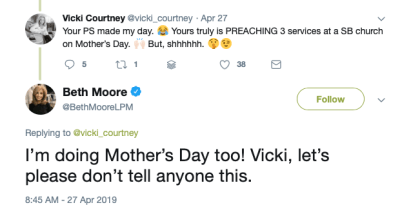 Regarding women preaching, you’re correct, the current quake finds its epicenter in Beth Moore’s tweet that she would be preaching on Mother’s Day (reportedly at North Point Church where Andy Stanley is). On the heels of this, was news of her invitation to Truett Seminary for their “National Preaching Conference”, being listed as a “Guest Preacher.” Many have been supportive of Moore, even out of reformed camps.
Frankly, I’m glad the cat is out of the bag and that she isn’t pretending to do anything otherwise than preach. She’s been flying under the radar for far too long. Calling a missile a bird might fool some, but now there is no excuse. Will we stand on the side of Biblical orthodoxy or join those attacking it?
Additionally, I would add that my biggest concern with Moore isn’t that she is a woman. She would be disqualified if she were a man. Mysticism, emotionalism, and poor exegesis permeate her teaching. You mentioned your past experience in the heretical Word of Faith movement and how this all sounds eerily familiar. I believe the Charismatic movement has been subtly making major inroads in Baptist circles for decades (i.e. the soft prosperity of The Prayer of Jabez). We came to a fork in the road way back and chose the wrong path. This is just the latest incident demonstrating that we haven’t turned around. Another disconcerting mark of her teaching noted way back was the use of word studies to find the broad semantic range of a word as leverage for eisegesis, that is, reading her desired meaning into a text. I don’t think Moore’s intent is to be unfaithful to the text, but that is the result.
Regarding the trajectory of the denomination, my biggest concern is how deeply this is tied to feminism, #MeToo, cultural marxism, and intersectionality as driving forces in the culture. The current is strong, and I’m afraid we’re not acting like salmon anymore. I agree, we need to hate all evil acts of abuse, but when you use the devil’s tools to destroy the devil’s works, you need to know you’re just playing around in his toolshed. We’ve come to another fork, and I think the disaster is going to be more severe. If at first fork we chose a path leading to false teaching, we’re now pondering one that leads to apostasy.
Yes, historically it has always been the orthodox belief that the office of elder is limited to qualified men. The main “Biblical” argument for including women is to recall the small number of prophetesses we find in the Scriptures. While there obviously are female prophets, we never find a woman who is “king.” Though Athaliah makes a run as queen and Jezebel is essentially pulling all the strings, these are not exactly positive role models. Nor do we find women acting as priests. The function of teaching is tied to the priests and Levites more than the prophets. The prophets preeminently spoke God’s word, rather than teach it. Also, in this vein, when Paul gives instructions concerning women prophesying in the New Testament, she is to do so manifesting that she is under a head, (cf. 1 Corinthians 11:2–16). This connects to Paul’s prohibition of a woman teaching men or exercising authority over a man in the church (1 Timothy 2:12).
The novel spin being put on 1 Timothy 2:12 today, making room for women preachers, is that it should be read as a hendiadys, that is, two words joined by a conjunction to express a single idea. If what was banned was a woman “teaching and exercising authority over a man” as a single idea, then a woman could be permitted to exercise the function of an elder, teaching, while being denied the office. This is what some are calling “soft complementarianism.” I think it’s rather a hardened compromise.
But this anticipates the question you asked, what of those men who teach in the assembly who are not elders? While it’s understandable that the question arises, as it is deployed by opponents of the Biblical view, it is a smoke screen. When a non-elder preaches he isn’t violating any prohibition. Let me demonstrate with a question. How is one to know if a man is qualified when one of those qualifications is being “apt to teach” if he is never able to teach until he is an elder?
Truly, all teaching in the church should be under the elder’s oversight, as part of his promoting truth and guarding against false teaching. When the elders permit a woman to preach, then automatically, in the very act, they and the woman involved have already violated the Scriptures, however orthodox the sermon may be.
I thank God for your recognizing the rightness and goodness of God’s order and recognizing the lies of the world and your desire to mortify them as they seek to take root in your own heart. “Feminism” is a peculiar word for that which is an attack on the feminine, saying that if womanhood is to have any value, it must be equivalent to manhood. I’ll allow Douglas Wilson to colorfully reiterate the point: “Ironically, we call this attempt by some women to be more like men “feminism,” which is a bit like calling an attempt by cats to be like dogs felinism.” And thus we have already tilted the hat to gender confusion in the church.
In reply to the accusation of belittling women, I believe the Biblical view bebigs them. Womanhood, motherhood, and sisterhood are glorious things in which women are immeasurably superior to men. Chesterton nailed the disparity when he said, “Nothing can ever overcome that one enormous sex superiority, that even the male child is born closer to his mother than to his father. No one, staring at that frightful female privilege, can quite believe in the equality of the sexes.” Equal in value, dignity and worth? Certainly. In roles? Heaven forbid!
Yes, the serpent is whispering in Eve’s ear again as you suggest, and the blame still lies with Adam, but at least in the Garden his sin was one of passivity. Now he is actively inciting his wife with snake’s crafty lies. “Become like me, and you’ll be like God.”
Dear sister, I thank God that you are feeding on that which is far more nourishing and empowering, the Word of truth.
“I Never Understood a Single Word He Said” (Jeremiah 1:1–19)
For the unaware or the novice to these parts, most of these posts, notably the ones with a Biblical text pinned on the title, are an overflow of my preaching ministry at my local church. That’ll explain some things as you proceed.

“Why Jeremiah?” one might ask. The best reply might be, “Why not? Is not this too the Word of the Living God? Why would we think this, or any portion of God’s Word odd?” But perhaps the question is less a prideful indictment and more a humble inquiry. Perhaps the sheep queries the shepherd, with a mouth full of grass, “May I ask why you have now led us to this particular pasture?”
“Yes you may.” I am an undershepherd. I don’t presume to know exactly which portion of God’s Word would be best for us, but I know do takes the whole Word to make whole Christians. Because of limitations of time, the elder’s aim and method is simple. We want you to have a balanced diet. If we just started preaching straight through, some of you would hear nothing but law during your time here. Thus, we chew on some Old and then some New. We munch on poetry and then prose. We devour an epistle, then a prophet. After a bite of the historical, we chomp on some wisdom.
This being said, perhaps there is no genre of Holy Writ more neglected today than the prophets. Oh, they are certainly cherry picked, but when you see the tree as a whole you cannot but notice how very little fruit has been picked. The prophets contain much bitter medicine that would do our souls good, but we have been fed only the most sugary portions. If a poll were taken in the average Evangellyfish church to cite passages from Jeremiah, I’m certain Jeremiah 29:11 would be to most cited and nearly the only cited portion.
There is likely no genre more neglected, and also, none more needed. Not merely because our diets have been imbalanced, but because disease is rampant, and the prophets shout the cure—repentance. The whole of God’s Word is enduringly relevant for the church, but when the church has apostatized and committed adultery with the world in unfaithfulness to her Betrothed, then we had best go to Jeremiah and not Philippians, for such is a time to mourn and not rejoice.
Here we have not only medicine, but a lot of it. What is the longest book in the Bible? Perhaps you answered Psalms, and by chapter count that is correct. But man inserted the chapter divisions (though in the case of the Psalms their work was simply one of counting the divisions already there). If we count by God’s inspired words in the original languages, the Psalms fall to third place, behind Genesis in second place and Jeremiah in first.
There is not only much medicine, but there is potent medicine. The American church is riddled with cancer. Jeremiah is chemo for those who would receive it.
“But are not we as a church celebrating a time of health?” Yes, but we are not immune from nor are we innocent concerning the sickness we see around us. Further, my zeal and hope is that our fellowship have a prophetic voice, speaking God’s Word into the nonsense that pervades in the American Church.
 No Other Boast