As to myself, if I were not a Calvinist, I think I should have no more hope of success in preaching to men, than to horses or cows. —John Newton, Works
Tag: Evangelism
Tolle Lege: Evangelism
Readability: 1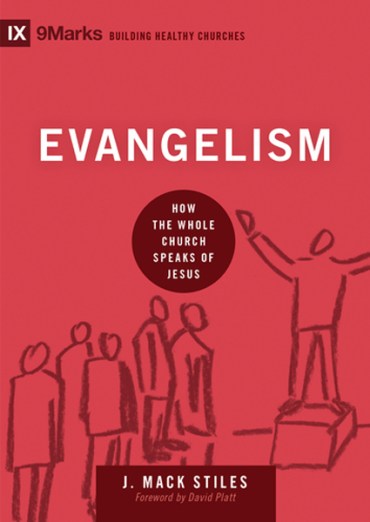
Length: 114 pp
Author: Mack Stiles
Here is an excellent book on evangelism for the whole church, which is the only kind of evangelism that should be. The church is God’s program for evangelism and the gospel is the power of God to salvation. In Evangelism you’ll find simplicity and sanity concerning what has too often, unnecessarily, been complicated and done insanely.
Evangelism is teaching the gospel (the message from God that leads us to salvation) with the aim to persuade. If a church does not understand biblical evangelism, over time that church will be subverted. If we don’t practice healthy evangelism, the dominoes start to fall:
- The focus of preaching and teaching turns to living a moral life, not a gospel-centered life.
- Non-Christians are lulled into thinking that they are okay in their lost state.
- Christians think that non-Christians are believers because they made a superficial outward commitment.
- The church baptizes those who are not believers.
- The church allows non-Christians into membership.
- Eventually, non-Christians become leaders in the church.
- A church becomes a subculture of nominalism.
Unbiblical evangelism is a method of assisted suicide for a church, so there is much at stake in getting evangelism right.
WTS Books: $11.16 Amazon: $11.73
The Gospel Sandwich (Matthew 28:16-20)
Matthew 28:16–20 is made like a sandwich where it’s the bread that excites you more than the stuffings. More than the meat, cheese, sauce, or anything else in-between, it’s the bread-brackets that make this sandwich so delicious. Take away the bread and the meat is unpalatable, but with it, it’s unsurpassed.
Jesus said that His meat was to do the will of the Father. The meat, the will of the Father we are given to do in this text is known as the Great Commission, but it is surrounded by bread. Take away the bread and you can’t handle this sandwich, it all falls apart. Without the bread this task is beyond you, but with the bread, the Great Commission becomes doable and a delight. The bread is the Bread of Life, Jesus Christ.
The Great Commission is surrounded by the great declaration (“All authority in heaven and on earth has been given to me”) and the great promise (“I am with you always, to the end of the age”)—the only bread that can hold this sandwich together. If the Great Commission were not sandwiched by the great declaration and the great promise it would be the great impossibility.
Actually this sandwich is Bread all the way through; Jesus from top to bottom. Jesus is on top as the authority, He is underneath empowering, and He is all through the middle. He is the gospel we declare—the Savior we call for them to trust, the Rabbi we call for them to follow, the King we call them to obey. This isn’t a sandwich, it’s a loaf; it’s Jesus all the way through. Let us eat with joy and let us tell others of this all-satisfying Bread. The eating will lead to the telling.
The Gospel Needs No Slick Spokesman (Matthew 27:62–28:15)
Some Christians get as sinfully giggly and giddy as a teenybopper over the latest boy band coming to town when the latest celebrity professes Christ. When a celebrity, as when any person comes to Christ, we should rejoice like the angels in heaven, but we shouldn’t be so naive as to think that now the gospel will have some cred before the masses. We should rejoice when a professional athlete converts to Christ, not because they will make the gospel acceptable before men, but because the gospel makes them acceptable before God. They don’t dress up the gospel; the gospel dresses them up.
When Jesus rose from the dead it was first witnessed by women. They were at His cross, they were at His burial, and they were the first to see the empty tomb and witness the resurrection. Compiling the gospels we learn that Salome and Joanna were also with Mary Magdalene and the other Mary. Matthew emphasizes only two women though. Why? The number two has a legal sound to the Jewish ear. The law required two or three witnesses to establish testimony, but women were not considered credible witnesses. If the apostles were making this stuff up, these are details they would never have fabricated. If this were a hoax, then the gospel writers would have men, strong credible men of repute, being the first witnesses. Man wouldn’t make something like this up, but God would ordain it so. God chooses the weak to shame the strong.
The power of the gospel is not in those who testify, but in the One testified of. You don’t have to be cool enough, intelligent enough, suave enough, convincing enough, or charismatic enough to share the gospel. You don’t have to be great to share the gospel because the gospel is great enough all on its own.
Matthew 14:13-21 & Mediate the Miracle
When the disciples come to Jesus and tell Him to send the crowds away, Jesus flips the table around on them and tells them to put food on it. Does Jesus really mean for them to feed the crowds? Absolutely, and they will. Their failure is that they come to Jesus seeking to be wise when they should come seeking a miracle. They come seeking to give an answer, instead of seeing the Answer. Do they think Jesus less concerned about the crowd’s need for food? Jesus is not only more compassionate, He is more capable. No sin of selfishness makes Him unwilling. No lack of power leaves Him unable. No lack of knowledge leaves Him in the dark.
The disciples think they have only five loaves and two fish. They have infinitely more than that, they have the Bread from heaven. John MacArthur writes, “They are like a person who stands in front of Niagara Falls and asks where he can get a drink.”
Jesus tells them to bring the bread, “to Me.” In all of this the disciples are active yet passive. They will distribute the bread, but Jesus does the miracle. Jesus means not only to be Bread for us, but to be Bread through us. Jesus means for His disciples to mediate the miracle. The task of ministry is impossible for us. We cannot regenerate. We cannot sanctify. We cannot create spiritual appetites. But as we obey, God mediates the miracle through us. We preach, God saves. Jesus is the Host and the Fare, we are waiters. The task is impossible for us, but we do not go it alone. The Great Commission is accompanied by the Great Promise; “I am with you always.”
Truly, he who writes this comment has often felt as if he had neither loaf or fish; and yet for some forty years and more he has been a full-handed waiter at the King’s great banquet. -C.H. Spurgeon
Matthew 10:32-42 & Increase the Tension by Alleviating It
Jesus is not afraid of being misunderstood. For instance, Jesus, the Prince of Peace, will say, “I have not come to bring peace, but a sword.” He will say something shocking, something meant to make you think, something that we may think contradictory to something else He has said, and then leave you with it. He feels no necessity to qualify and explain away all of the difficulties. Gospel ministers should do the same. Their are times when we should try to explain the difficulties, more often this will be in regards to doctrinal truths. There are often other times when we should just let the tension be, and let sheep wrestle with the text.
Jesus says that if we acknowledge Him, He will acknowledge us. If we deny Him, He will deny us. I will ease tension as to how this does not contradict justification by faith, but I will not seek to ease tension for one who is apprehensive to share Jesus by assuring them that they must be saved despite that fact.
1 John 2:23 is illuminating to our text, “No one who denies the Son has the Father. Whoever confesses the Son has the Father also.” Notice it does not say that if you confess you will have the father, but if you confess you have the Father. If you possess the Father you profess the Son. If you do not profess Jesus, you do not possess the Father. This confession is not meritorious towards salvation, but resultant from salvation.
This does not alleviate tension for the apprehensive soul timid to share Jesus. Explaining the doctrine rightly increases conviction rightly.
A hard soul might instantly object, “But Peter denied him!” Indeed Peter did, but ultimately and most often Peter boldly professed Him.
And when they had brought them, they set them before the council. And the high priest questioned them, saying, ‘We strictly charged you not to teach in this name, yet here you have filled Jerusalem with your teaching, and you intend to bring this man’s blood upon us.’ But Peter and the apostles answered, ‘We must obey God rather than men. The God of our fathers raised Jesus, whom you killed by hanging him on a tree. God exalted him at his right hand as Leader and Savior, to give repentance to Israel and forgiveness of sins. And we are witnesses to these things, and so is the Holy Spirit, whom God has given to those who obey him.’ -Acts 5:27-32
Don’t quickly comfort yourself by looking at Peter’s failures, challenge yourself by looking at his courage. I leave you with the exclamatory, Christ-like, tension-creating question of Thomas Brooks:
Ah, souls, you can easily sin as the saints, but can you repent with the saints! Many can sin with David and Peter, that cannot repent with David and Peter, and so must perish for ever.
 No Other Boast