“Now, I say there can be no greater mistake than to suppose that the great controversy of our times is a mere question of vestments and ornaments; of chasubles and copes; of more or less church decorations; of more or less candles and flowers; of more or less bowings and turnings and crossings; of more or less gestures and postures; of more or less show and form. The man who fancies that the whole dispute is a mere aesthetic one, a question of taste, like one of fashion and millinery, must allow me to tell him that he is under a complete delusion. He may sit on the shore, like the Epicurean philosopher, smiling at theological storms, and flatter himself that we are only squabbling about trifles; but I take leave to tell him that his philosophy is very shallow, and his knowledge of the controversy of the day very superficial indeed.
The things I have spoken of are trifles, I fully concede. But they are pernicious trifles, because they are the outward expression of an inward doctrine. They are the skin disease which is the symptom of an unsound constitution. They are the plague spot which tells of internal poison. They are the curling smoke which arises from a hidden volcano of mischief. I, for one, would never make any stir about church millinery, or incense, or candles, if I thought they meant nothing beneath the surface. But I believe they mean a great deal of error and false doctrine, and therefore I publicly protest against them, and say that those who support them are to be blamed.” —J.C. Ryle, Light from Old Times
2 Now there is in Jerusalem by the Sheep Gate a pool, in Aramaic called Bethesda, which has five roofed colonnades. 3 In these lay a multitude of invalids—blind, lame, and paralyzed. 5 One man was there who had been an invalid for thirty-eight years.
—John 5:2–5
Jesus, unlike modern faith healers, visited the sick ward. Joni Erickson Tada, after becoming a quadriplegic at 17, went to a Kathryn Kuhlman healing service where she was taken to the wheelchair section. The spotlight shone over the crowd, highlighting the many attesting to be healed, but Joni said the spotlight never shone on the wheelchair section. Kuhlman never visited the wheelchair section. Justin Peters, who has cerebral palsy, also went to faith healers at a young age and has a similar testimony. Jesus, unlike Benny Hinn, Todd White, or Bill Johnson, often went to the sick ward. He wasn’t afraid of being discredited or exposed as a fraud.
From this multitude, John singles out one man in particular. John singles him out because Jesus singled him out, (v. 5). This is no easy case. Here is a man who has been an invalid, suffering likely from some form of paralysis or extreme weakness, for 38 years. Jesus, seeing this man and knowing that he had been there a long time, doesn’t pass him by, but engages him, (v. 6). The Son shines a spotlight on this man in the wheelchair section.
Some manuscripts explain that an angel would visit the pool and something supernatural would follow (see vv. 3b–4 in the KJV). Instead of “Last one in is a rotten egg!” it was a game of “First one in gets a healed leg.” This explanation appears to be a later editorial gloss as it is only in some manuscripts and varies markedly among those that do contain it. I don’t believe it tells us why the pool was stirred so much as it tells us why they believed the pool was stirred. These poor souls had gathered for a healing service, and Jesus visited the wheelchair section. The multitude gathered here says the pool is inefficient at best or, more likely, that it is ineffective all together.
Jesus singled this man out. This man who has his poor-man’s pallet with him. He heals him and tells him not simply to rise and walk, but to “get up, take up your bed, and walk.” The seemingly benign phrase “take up your bed” would stir the pool of Jewish leadership. This would lead to Jesus stirring things up more by explaining that the reason He is working is because His Father is working. This work doesn’t count as work because it is a divine work. When Jesus cleansed the temple, they demanded a sign. Now, they have one, and they want to kill Him for it.
These signs were written so that we might believe that Jesus is the Christ, the Son of God (John 20:30–31). The spotlight fell on this man so that the spotlight might fall on Christ. He is the Christ, the one who can deal with the curse of sin because He will deal with the sin of the curse. He is the Son of God, the only begotten, the eternally begotten, who was in the beginning with God and was God, and remaining what He was, became flesh.
“At first it was fully expected that he [John Hooper] would suffer in Smithfield with Rogers. This plan, for some unknown reason, was given up, and to his great satisfaction Hooper was sent down to Gloucester, and burnt in his own diocese, and in sight of his own cathedral. On his arrival there, he was received with every sign of sorrow and respect by a vast multitude, who went out on the Cirencester Road to meet him, and was lodged for the night in the house of a Mr Ingram, which is still standing, and probably not much altered. There Sir Anthony Kingston, whom the good bishop had been the means of converting from a sinful life, entreated him, with many tears, to spare himself, and urged him to remember that ‘Life was sweet, and death was bitter.’ To this the noble martyr returned this memorable reply, that ‘Eternal life was more sweet, and eternal death was more bitter.'” —J.C. Ryle, Light from Old Times
“After the two days he departed for Galilee. (For Jesus himself had testified that a prophet has no honor in his own hometown.) So when he came to Galilee, the Galileans welcomed him, having seen all that he had done in Jerusalem at the feast. For they too had gone to the feast.”
—John 4:43–45
Here, a puzzling statement makes the following statement puzzling. Unfortunately, we’re tempted to grab the hammer and make the pieces fit instead of doing the hard work of finding out how they fit. Rather than knocking off the rough edges of the first piece, it is after connecting its oddity to the second piece (a piece that initially didn’t seem to go with it) that it comes to make sense.
Jesus departs for Galilee because, as He has testified, a prophet has no honor in his hometown. That’s puzzling. To hammer the piece in place, a number of clunky explanations are suggested. The most reasonable of these is that, as in the synoptic gospels, “hometown” refers specifically to Nazareth. Jesus goes to Galilee, but once there, He doesn’t go to that place He is shown no honor—Nazareth. My problem with this explanation is that Nazareth is nowhere in view, the context doesn’t give the slightest hint of Nazareth.
Instead, I believe that what was true of Nazareth is being expanded to apply to the region of Galilee. Galilee, alongside Judea, is being set in contrast to Samaria. What we see in both Judea and Galilee is the truth John introduced in John 1:11, “He came to his own, and his own people did not receive him.”
But the Galileans have a peculiar way of not honoring Jesus. They welcome Him. This isn’t puzzling in itself. It is puzzling in how it fits with the last piece. There is a way of welcoming Jesus that does not honor Him. The key word to unlocking what a dishonoring welcome consists of is the word “seen.” The Samaritans, we were told repeatedly, believed because of the testimony of the woman and the word of Christ (4:39–42). But these Galileans, like the Judeans, “believe” because of what they see.
“Now when he was in Jerusalem at the Passover Feast, many believed in his name when they saw the signs that he was doing. But Jesus on his part did not entrust himself to them, because he knew all people and needed no one to bear witness about man, for he himself knew what was in man” (John 2:23–25).
Not all welcoming is welcoming. Not all believing is believing. Not all receiving is receiving. And what distinguishes the true from the false is that in the false the eye is elevated above the ear. Marvel takes precedence over meaning.
And so it is that Jesus is welcomed in many churches today where the eye is awed while ears remain deaf as the word of the gospel which is the power of God unto salvation is not proclaimed. Charismatic churches provide wonders. Evangelical churches have fog and lights. Even much of the young, restless, and reformed crowd has frequently proven to be more about hype than hearing. Such welcoming isn’t excited to receive the King, but the parade of gifts that come in His train. That this is so, that this is the correct interpretation I take to be clear in Jesus rebuff, “unless you see signs and wonders you will not believe.”
Sinner, you do not need to see a sign for faith to be. You need to see the significance of the signs that are and believe. Jesus is the Christ, the Son of God. John records these signs so that you may believe this truth and that by believing you may have life in His name.
“Which are the Churches on earth which are producing the greatest effect on mankind? The Churches in which the Bible is exalted. Which are the parishes in England and Scotland where religion and morality have the strongest hold? The parishes in which the Bible is most circulated and read. Who are the ministers in England who have the most real influence over the minds of the people? Not those who are ever crying ‘Church! Church!’ but those who are faithfully preaching the word. A Church which does not honour the Bible is as useless as a body without life, or a steam engine without fire. A minister who does not honour the Bible is as useless as a soldier without arms, a builder without tools, a pilot without compass, or a messenger without tidings.” —J.C. Ryle, Light From Old Times
“He was a burning and shining lamp, and you were willing to rejoice for a while in his light. But the testimony that I have is greater than that of John.”
—John 3:30; 5:35–36
O what paradoxical glory! As this lamp fades, he shines brightest. John was not the Light, but he was a lamp. It is when the lamp exclaims “I am not the Light” that it shines brightest. When John says “I am not the Christ” it is then that he radiates with Christ-like glory. Edward Klink comments, “It was only at the point of his ‘not’ that the Baptist could truly be who he was supposed to be, a messenger for the message and a witness to the true ‘I AM.’”
When a loyal herald announces the coming of the King, he isn’t downcast when people then move to the side and look down the street. That’s the point! If John were a fish, this is water. John, as one sent before the Lord, heralds, “Behold the Lamb of God who takes away the sin of the world.” And when the crowd then turns their eyes from him to the bridegroom, he “rejoices with joy.”
When all eyes look down the street for the king, that is when the herald is greatest and gladdest. Saints, this is oxygen, to use our lungs to say, “We are not! He is! Do not look to us. Look to Christ! We are just a voice. Jesus is the Word.” Saints, do you truly want to live? Then fill your longs with John’s exclamation, “He must increase, but I must decrease.”
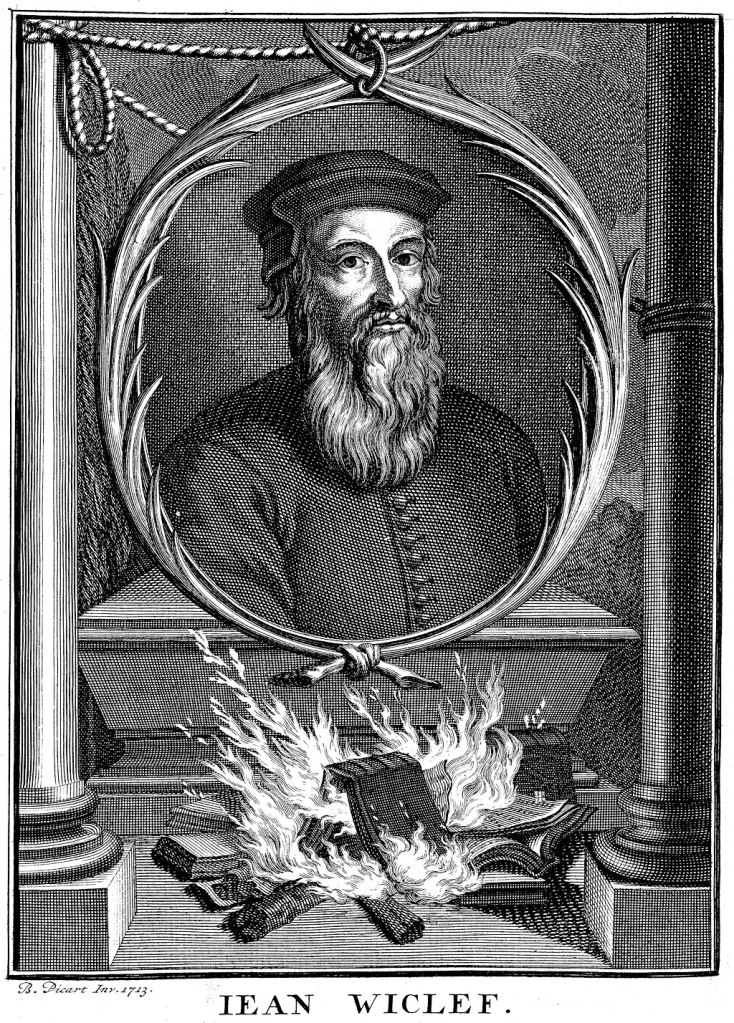
“The importance of this great principle can never be overrated. It lies at the very foundation of Protestant Christianity. It is the backbone of the Articles of the Church of England and of every sound Church in Christendom. The true Christian was intended by Christ to prove all things by the word of God, all churches, all ministers, all teaching, all preaching, all doctrines, all sermons, all writings, all opinions, all practices. These are his marching orders. Prove all by the word of God; measure all by the measure of the Bible; compare all with the standard of the Bible; weigh all in the balances of the Bible; examine all by the light of the Bible: test all in the crucible of the Bible. That which can abide the fire of the Bible, receive, hold, believe, and obey. That which cannot abide the fire of the Bible, reject, refuse, repudiate, and cast away. This is the standard which Wycliffe raised in England. This is the flag which he nailed to the mast. May it never be lowered!” —J.C. Ryle, “John Wycliffe” in Light from Old Times
9 Nicodemus said to him, “How can these things be?” 10 Jesus answered him, “Are you the teacher of Israel and yet you do not understand these things? 11 Truly, truly, I say to you, we speak of what we know, and bear witness to what we have seen, but you do not receive our testimony. 12 If I have told you earthly things and you do not believe, how can you believe if I tell you heavenly things? 13 No one has ascended into heaven except he who descended from heaven, the Son of Man. 14 And as Moses lifted up the serpent in the wilderness, so must the Son of Man be lifted up, 15 that whoever believes in him may have eternal life.
John 3:9–15
In the first part of the conversation with Nicodemus, Jesus speaks of what must be done to Nicodemus. In the second part of the conversation, Jesus speaks of what must be done for Nicodemus. Man must be born from above. The Son of Man must be lifted up. The Spirit must cause regeneration. The Son must accomplish redemption.
The transition from the work of the Spirit in Nicodemus to the work of the Son for Nicodemus happens with Nicodemus’ clumsy question, “How can these things be?” Jesus both rebukes and then answers Nicodemus’ question.
“You must be born again.”
“How can these things be?”
“The Son of Man must be lifted up.”
The lifting up of the Son of Man is the how behind man’s being born from above. Regeneration is the Spirit’s application of the redemption accomplished by the Son. Because of the dying of the Son of Man, the Spirit makes men alive.
For man’s salvation, man needs the work of Christ for Him, and the work of the Spirit in Him. The Spirit must renew. For the Spirit to renew, the Son must be lifted up. The Son of Man was lifted up. Thus, the Spirit causes men to be born from above. And behind both the sending of the Son to redeem and the sending of the Spirit to renew is the love of the Father.
Here is how Paul spoke of these things in Titus 3:4–7.
“But when the goodness and loving kindness of God our Savior [referring to the Father] appeared, he saved us, not because of works done by us in righteousness, but according to his own mercy, by the washing of regeneration and renewal of the Holy Spirit, whom he poured out on us richly through Jesus Christ our Savior, so that being justified by his grace we might become heirs according to the hope of eternal life.”
“Mark what I say. If you want to do good in these times, you must throw aside indecision, and take up a distinct, sharply cut, doctrinal religion. If you believe little, those to whom you try to do good will believe nothing. The victories of Christianity, wherever they have been won, have been won by distinct doctrinal theology, by telling men roundly of Christ’s vicarious death and sacrifice, by showing them Christ’s substitution on the cross and His precious blood, by teaching them justification by faith and bidding them believe on a crucified Savior, by preaching ruin by sin, redemption by Christ, regeneration by the Spirit, by lifting up the bronze serpent, by telling men to look and live, to believe, repent and be converted. This, this is the only teaching which for eighteen centuries God has honored with success, and is honoring at the present day both at home and abroad. Let the clever advocates of a broad and undogmatic theology—the preachers of the gospel of earnestness and sincerity and cold morality—let them, I say, show us at this day any English village or parish or city or town or district, which has been evangelized without “dogma,” by their principles. They cannot do it, and they never will. Christianity without distinct doctrine is a powerless thing. It may be beautiful to some minds, but it is childless and barren. There is no getting over facts. The good that is done in the earth may be comparatively small. Evil may abound and ignorant impatience may murmur, and cry out that Christianity has failed. But, depend on it, if we want to “do good” and shake the world, we must fight with the old apostolic weapons, and stick to “dogma”. No dogma, no fruits! No positive evangelical doctrine, no evangelization!” —J.C. Ryle, Holiness
“This man came to Jesus by night and said to him, “Rabbi, we know that you are a teacher come from God, for no one can do these signs that you do unless God is with him.”
—John 3:12
What are we to make of Nicodemus’ statement? He says nothing disagreeable. He says much that is true. He seems to be on the right trail. He is different from the other leaders. Yet, at this point, it is not enough.
He addresses Jesus as “Rabbi,” an honorable term for a teacher that means “master.” But compare his use of “Rabbi” to that of Andrew and the disciple who was likely John, “Rabbi, where are you staying?” (1:38). Andrew and John address Jesus as Rabbi, wishing to be His disciples. Nicodemus does so, as one who believes he is His peer. This can be seen in his next statement.
“We know you are a teacher,” Nicodemus continues. Who is this “we”? The rulers, the Sanhedrin, the Pharisees and the Sadducees. The fisherman’s approach to the Savior, having received John’s testimony, expressed humility. Nicodemus however, lets Jesus know that they know. How nice it must have been to have their recognition, as though the brambles said to the tree, “Cousin Oak, we recognize you as a woody plant.”
Further, they know He is “come from God.” He is God-sent. And the reason they know this is, Nicodemus says, is because no one can do the signs that Jesus does unless God is with him. Instead of demanding a sign, as his infuriated colleagues did earlier, this Pharisee say that the signs Jesus is doing, they see them, and they testify that Jesus is “a teacher come from God.”
But when you begin to listen to Jesus’ reply, you sense something is wrong, but what exactly is it? I believe there are basically two things. First, Nicodemus is a man. Pause. Back up. Read this passage again, but beginning with 2:24 and then ignoring helpful, yet intrusive man-manufactured address markers.
“But Jesus on his part did not entrust himself to them, because he knew all people and needed no one to bear witness about man, for he himself knew what was in man. Now there was a man of the Pharisees named Nicodemus, a ruler of the Jews.”
Jesus doesn’t entrust Himself to Nicodemus. Yes, he speak to Him differently than He does the other rulers, Still, He also speaks to Nicodemus differently than He does Andrew or Peter or Philip or Nathanael. Something is wrong. Nicodemus is a man. Jesus knows what is in man. John has given us subtle clues that something is wrong inside Nicodemus. Light may be shining without, but there is still darkness within.
Second, Jesus is more than a man. Nicodemus confesses true things about Jesus, but he doesn’t confess Jesus. John wrote this book so that you might believe, not just select true things about Jesus as you might perceive them, but so that you might perceive the truth of who Jesus is and what He has done and thus believe in Him. John wrote for this purpose and thus the events that He records were for this purpose: so that you might believe that Jesus is the Christ the Son of God.
Nicodemus’ statement is really a question. The very question that was put to John the Baptist in 1:19–23. The same question that was essentially put to Jesus when they demanded a sign. “Who are you?” Nicodemus recognizes Jesus as “a teacher come from God.” He fails to recognize Him as the Christ, the Son of God.
Know this, it is not enough to sincerely compliment Jesus with truth. Nicodemus is notably different, but he isn’t different enough. He must be born again. There is a way of complimenting and praising Jesus with truth, that falls flat. Nicodemus’ compliment falls flat, like that of another ruler. “And a ruler asked him, ‘Good Teacher, what must I do to inherit eternal life?’ And Jesus said to him, ‘Why do you call me good? No one is good except God alone’” (Luke 18:18–19). It does no good for a man to compliment Jesus as a man. You must worship Him as God.







 No Other Boast