Aimless movement in time will produce an ordered world! You might as well suppose that if you stir up a mass of type with a stick long enough, the letters will be found to have arranged themselves in the order in which they stand on the printed pages of Dante’s Inferno. It will never happen — though you stir for an eternity. And the reason is that such effects do not happen, but are produced only by a cause adequate to them and directed to the end in view. . . . Assuredly, what chance cannot begin to produce in a moment, chance cannot complete the production of in an eternity. . . . What is needed is not time, but cause. -B.B. Warfield, from The Theology of B.B. Warfield by Fred Zaspel
Author: Josh King
Tolle Lege: Rid of My Disgrace
 Readability: 1
Length: 209 pp
Author: Justin and Lindsey Holcomb
Statistics say one in four women, and one in six men have been sexually assaulted. If you are one of those women or men buy this book. If you know one of those women or men, buy two copies, one for yourself and one for them. The damage of sexual assault is often intensely compounded by friends and relatives who don’t know how to respond appropriately. As a pastor I am so profoundly thankful to have such a Biblical and therefore, grace-filled resource as Rid of My Disgrace at hand.
Sin and the effects of sin are similar to the laws of inertia: a person (or object) in motion will continue on that trajectory until acted upon by an outside force. If one is devastated by sin, a personal failure to rise above the effects of sin will simply create a snowball effect of shame. Hurting people need something from the outside to stop the downward spiral. Fortunately, grace floods in from the outside at the point when hope to change oneself is lost. Grace declares and promises that you will be healed. One-way love does not command “Heal thyself!” but declares “You will be healed!”
The cross is God’s solidarity with and compassion for the assaulted, and the resurrection is this promise that he can heal and redeem your suffering.

The Pugilist: How to do Systematic Theology
The systematic theologian is pre-eminently a preacher of the gospel; and the end of his work is obviously not merely the logical arrangement of the truths which come under his hand, but the moving of men, through their power to love God with all their heart and their neighbors as themselves; to choose their portion with the Savior of their souls; to find and hold him precious; and to recognize and yield to the sweet influences of the Holy Spirit whom he has sent. With such truth as this he will not dare to deal in a cold and merely scientific spirit, but will justly and necessarily permit its preciousness and its practical destination to determine the spirit in which he handles it, and to awaken the reverential love with which alone he should investigate its reciprocal relations. For this he needs to be suffused at all times with a sense of the unspeakable worth of the revelation which lies before him as the source of his material, and with the personal bearings of its separate truths on his own heart and life; he needs to have had and to be having a full, rich, and deep religious experience of the great doctrines with which he deals; he needs to be living close to his God, to be resting always on the bosom of his Redeemer, to be filled at all times with the manifest influences of the Holy Spirit. The student of systematic theology needs a very sensitive religious nature, a most thoroughly consecrated heart, and an outpouring of the Holy Ghost upon him, such as will fill him with that spiritual discernment, without which all native intellect is in vain. He needs to be not merely a student, not merely a thinker not merely a systematizer not merely a teacher – he needs to be like the beloved disciple himself in the highest, truest, and holiest sense, a divine. – B.B. Warfield, Studies in Theology
Matthew 13:47-50 & Perform No Appendectomy!
If these parables formed a body, would the parable of the dragnet be the appendix? Seemingly all it does is repeat part of the parable of the weeds. Does this parable contribute anything unique?
I think this parable, while teaching the same truths seen in the parable of the dragnet, does contribute something unique. While there unity among all these parables, they are all parables about the kingdom, there is also diversity and progression; with that being the case why repeat an earlier theme? Also, while there are other parables that build on each other and repeat the same idea, such as the parables of the mustard seed and leaven and the parables of the treasure and the pearl, notice how these follow one another. If the parable of the dragnet is meant to do nothing more than repeat the truths of the parable of the weeds why insert so many other parables in between them?
There are two things that make this parable unique, its emphasis and its context.
Whereas the parable of the weeds stresses the delay between the inauguration of the kingdom in sowing the good seed of salvation and the consummation of the kingdom bringing full salvation and judgment, the parable of the dragnet the emphasizes judgment alone. The parable of the weeds answers the question, “Why if the kingdom has come is there still evil present?” The parable of the dragnet warns of certain judgment. D.A. Carson points out the different emphasis saying, “Whereas the parable of the weeds focuses on the long period of the reign of God during which tares coexist with the wheat and the enemy has large powers, the parable of the net simply describes the situation that exists when the last judgment takes place.” In the parable of the weeds we are told of the state of both the weeds and the wheat at the close of the age (vv.42-43), here we are told only of the state of the bad fish. The first parable is an explanation, this one is a warning.
But it is the context that I think makes this parable most distinct and powerful. I think the word that makes it explode with power is the first one, “again”. Initially I thought of this word as nothing more than connective tissue. I read some great commentators who made much of the “again” in v. 45 as indicating the close connection between the parables of the treasure and pearl. I agree there is a close connection, but was bothered by their ignoring the “again” in v. 47. Then I thought what if the “again” is meant to show the relation of all three parables? I believe it is.
How do they relate? It’s like this, the kingdom of heaven will eternally be for you either treasure or torment. The kingdom brings both salvation and judgment, so it will either be your greatest delight or your greatest fright. All that God is will either be for you to enjoy, or for you to fear. God is holy, infinite, sovereign, incomprehensible, self-sufficient, immutable, omnipotent, omniscient, omnipresent, eternal, righteous, and faithful. Will you know all that God is as your eternal and deepest delight or dread?
Tolle Lege: Future Grace
 Readability: 3
Length: 401 pp
Author: John Piper
Here is savory truth, slow cooked to intensify flavor over thirty-one days. Here are thirty-one meditations that are deeply theological and deeply practical. With all of the contemporary discussions concerning the gospel, law, and sanctification, this book written more than a decade earlier is now even more helpful and needed. Piper shows that we are sanctified by faith, but that we must fight for faith, and that specifically the faith that we fight for is faith in future grace. Future Grace will show you the God-glorifying nature of faith, the promises it leans into, and give instruction on how to fight for faith in those promises. Most helpful are the smattering of chapters that deal with fighting the specific sins of pride, anxiety, shame, impatience, covetousness, bitterness, despondency, and lust. This will prove to be a hard read for some. I’ll give you Piper’s own words why you should read this book anyway:
Every book worth reading beckons with the words, “Think over what I say.” I do not believe that what I have written is hard to understand – if the person is willing to think it over. When my sons complain that a good book is hard to read, I say, “Raking is easy, but all you get his leaves; digging is hard that you might find diamonds.”
There are diamonds here. Here are a few:
Sin is what you do when your heart is not satisfied with God. No one sins out of duty. We sin because it holds out some promise of happiness. That promise enslaves us until we believe that God is more to be desired than life itself (Psalm 63:3). Which means that the power of sin’s promise is broken by the power of God’s. All that God promises to be for us in Jesus stands over against what sin promises to be for us without him.
I conclude that the New Testament teaches us to obey the commandments of God – the law of Christ – by faith in future grace. The commandments of Christ are not negligible because we are under grace. They are doable because we are under grace.
Hell will not be able to blackmail heaven into misery. God’s judgment will be approved, and the saints will experience the vindication of truth as a great grace.
The test of whether our faith is the kind of faith that justifies is whether it is the kind of faith that sanctifies.
WTS Books: $10.00 Amazon:$10.87

The Pugilist: Convictions
No convictions, no Christianity Scanty convictions, hunger-bitten Christianity. Profound convictions, solid and substantial religion. -B.B. Warfield, in The Theology of B.B. Warfield by Fred Zaspel
Matthew 13:44-46 & Happy Hobos
If these two parables were Americanized they would end with the “man”, perhaps a tenant farmer, being vindicated as he now lives in a plush mansion with tricked-out camels, and the merchant being famous, having sold the pearl for many times what he bought it. But neither the man, nor the merchant sell their treasure to buy other things, rather, they sell all other things to buy the treasure. The merchant doesn’t buy the pearl to sell it; he sells all to buy the pearl. The kingdom of heaven is not a means to an end, it is the end.
Some today buy stunning pieces of art and rare artifacts, not to profit from them, but to simply enjoy them. Still its unheard of for a lavishly wealthy person to go for broke to own a single piece of art.
Merchants were extremely wealthy and powerful, and this merchant was certainly so, searching only for fine pearls (likely the most valued jewel of the time by Romans). Imagine hearing that a Bill Gates joyfully liquidated every asset to own one piece of art. There is video of footage of the former business magnate now gone hobo standing on the street corner with a grin on his face staring at his piece of art.
I think you would conclude either one of two things must be true. Your first impulse is that he must be nuts. But then you grow curious. You haven’t seen the work of art. What if glory and beauty exist that are really worth that price tag? Wouldn’t it be wonderful?
There is a glory this stunning. It is a glorious mystery revealed to some (13:11). They see the hidden treasure others don’t. To others their actions look absurd, but if you have seen the value of the kingdom, you know it’s worth sacrificing everything for. That’s the way we ought to live, as hobos with a smile on our face enjoying a treasure others can’t see, making them think, “What if a glory like that really exists? I don’t know that it does, but wouldn’t it be wonderful if it did?”
The Pugilist: It Is Not Faith that Saves…
It is not faith that saves, but faith in Jesus Christ: faith in any other saviour, or in this or that philosophy or human conceit (Col. 2:16, 18, 1 Tim. 4:1), or in any other gospel than that of Jesus Christ and Him as crucified (Gal. 1:8, 9), brings not salvation but a curse. It is not, strictly speaking, even faith in Christ that saves, but Christ that saves through faith. The saving power resides exclusively, not in the act of faith or the attitude of faith or the nature of faith, but in the object of faith; and in this the whole biblical representation centres, so that we could not more radically misconceive it than by transferring to faith even the smallest fraction of that saving energy which is attributed in the Scriptures solely to Christ Himself. -B.B. Warfield, The Biblical Doctrine of Faith
Matthew 13:31-35 & Marvel at the Shrub
No good Jew doubted that the Kingdom would be glorious, that was expected. What was a shocking stumbling-block, and what Jesus was communicating here, is that it would grow from the smallest, most humble and insignificant of beginnings.
I am not an optimist in regards to history or the future. I don’t suspect that humanity is steadily progressing, nor that the kingdom will ultimately win over the world before Jesus’ return, but I am not a pessimist either. What can we expect in the future? I think things will get both better and worse. The parable of the weeds reminds us that the kingdom hasn’t come in all its fullness yet; and that until the end of the age, evil will grow and our salvation will not be complete. But the parables of the mustard seed and the yeast remind us that the kingdom is growing, and that God’s mission is global.
Our Western eyes too often look on the 20th century as a time of decline for the church; as though she has lost her power and influence. We are missionally myopic judging the whole of Christianity in light of ourselves. I think our arrogance is displayed when speak in such ways as this, “Things are so bad here – Jesus must be coming soon!” Indeed He may come soon, but from a global perspective Christianity has flourished as never before. Consider the following figures (taken from Let the Nations be Glad by John Piper and Operation World by Jason Mandryck):
- At the beginning of the twentieth century, Europeans dominated the world church, with approximately 70.6 percent of the Word’s Christians. By 1938, on the eve of World War II, the apparent European domination of Protestantism and Catholicism remained strong. Yet by the end of the twentieth century, The European percentage of world Christianity had shrunk to 28 percent of the total; Latin America and Africa combined provided 43 percent of the world’s Christians.
- In 1900, Africa had 10 million Christians, representing about 10 percent of the population; by 2000, this figure had grown to 360 million, representing about half the population. Quantitatively, this may well be the largest shift in religious affiliation that has ever occurred, anywhere.
- The number of African Christians is growing at around 2.36 percent annually, which would lead us to project a doubling of the continent’s Christian population in less than thirty years.
- “This past Sunday more Anglicans attended church in each of Kenya, South Africa, Tanzania, and Uganda than did Anglicans in Britain and Canada and Episcopalians in the United States combined.”
- “The number of practicing Christians in China is approaching the number in the United States.”
- “Last Sunday . . . more Christian believers attended church in China than in all of so-called ‘Christian Europe.’”
- ‘Live bodies in church are far more numerous in Kenya than in Canada.”
- “More believers worship together in Nagaland than in Norway.”
- “More Christian workers from Brazil are active in cross cultural ministry outside their homelands than from Britain or from Canada.”
- Last Sunday “more Presbyterians were in church in Ghana than in Scotland.”“The survival and growth of the Church in China are two of the decisive events of our generation. The staggering recent growth of the Chinese Church has no parallel in history – from 2.7 million evangelicals in 1975 to over 75 million in 2010.”
Some look at these figures and say, “Yeah, but they’re not all truly regenerate.” I agree, but many are sons of the kingdom; and oh how sad it is if you don’t have eyes to see the glory of the kingdom and rejoice in it.
We need to be aware, and we need to praise God. We need to be kingdom-minded people. The mustard seed is a shrub – marvel at it!
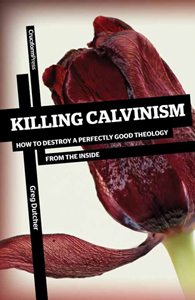
Tolle Lege: Killing Calvinism
 Readability: 1
Length: 105 pp
Author: Greg Dutcher
Douglas Wilson has written about the YRR (Young, Restless, and Reformed) becoming the OSR (Old, Settled, and Reformed), and how this could be a good thing. Restlessness is not always a virtue. Growing old is not an evil. Old, settled wisdom will trump young, restless zeal any day. Give me Gandalf over Pippin. Restlessness is a virtue when folly rules, otherwise is it is the folly.
I rejoice in the recovery of reformed theology by my peers, but many of us, self included, do need to grow up, and settle down. Many wise men have called for young Calvinists to be locked up for the first years after they believe the doctrines of grace. Greg Dutcher calls them cage stage Calvinists. They are ready to fight, and with purpose, but so were Simeon and Levi. Zeal without wisdom is dangerous. It can be as dangerous as the untruth that opposes the doctrines we love. If Satan can’t get you to preach a lie, he will be content if you preach the truth in a hellish way.
Greg Dutcher has done all the YRR a favor in Kiling Calvinism. I believe it will be an ent-draught to many a zealous Pippin who took the palantír, growing them up into the Peregrin Took who cleansed the shire of orc-men.
(If you don’t understand any of this YRR talk, good for you. If I lost you with all of the LOTR (Lord of the Rings) references, shame on you!)
Windshields are one of those technological wonders we have all gotten used to. In fact, they work best when you don’t notice them, when they are invisible so that all you can see is what they reveal.
I am concerned that many Calvinists today do little more than celebrate how wonderfully clear their theological windshield is. But like a windshield, Reformed theology is not an end in itself. It is simply a window to the awe-inspiring universe of God’s truth, filled with glory, beauty, and grace. Do we need something like a metaphorical windshield of clear, biblical truth to look through as we hope to marvel at God’s glory? Absolutely. But we must make sure that we know the difference between staring at a windshield and staring through one.
While all true disciples are theologians, not all theologians are true disciples. If knowing the Bible and understanding theology were reliable measures of discipleship, Satan would be the greatest disciple ever. After all, his knowledge of Scripture is exceptional and he’s been observing the spiritual realm for quite a long time.

 No Other Boast