Grieving for the Loss of Hope

“But we do not want you to be uninformed, brothers, about those who are asleep, that you may not grieve as others do who have no hope. For since we believe that Jesus died and rose again, even so, through Jesus, God will bring with him those who have fallen asleep.”

1 Thessalonians 4:13–14

I grieve that we (the saints) have forgotten how to grieve. Death is a loss. Yes, it is gain for the departed, but for we who remain, experientially, it is loss (Philippians 1:21). We have tried to transform funerals into festivals. There is a time to mourn. We are not the healthier for ignoring that time.

I grieve that we have forgotten to grieve, but I grieve all the more that this often means we have forgotten how to hope. We rejoice in the life lived (on earth) instead of the life being lived and the life to be lived (in heaven). We look back when we should look forward. We exercise our memory of the past more than we do our longing for the future. We look to past photos more than future promises. We watch a video instead of reading the Bible. We listen to a favorite song of the departed instead of lifting up a song to the eternal Son who rose from the grave.

The remembrances are not for rejoicing. They are for grieving the loss and expressing gratitude for gifts enjoyed. Remember. Laugh. Smile. Give thanks. Yes! But do not anchor your joy or comfort there. The memories are for mourning. The promises are for praise. It is not as we look back that we find solace for our sorrow. It is as we look forward that we find hope to illumine our grief. Death is an enemy. He has dealt his blow. But there is victory in Christ. It is because we don’t grieve that we fail to lament “Come Lord Jesus!” Paradoxically, is because we are short on grief and lament that we are short on hope and joy.

I do grieve for the loss of hope, but more so, I have hope for the loss of all grief. Every tear will be wiped away. One reason I shed tears now is because I want others to know such hope in the midst of the grief they try to ignore. The storm is real. The rock is just as real. Don’t ignore the storm. Cherish the rock.

I love you, O LORD, my strength. 
The LORD is my rock and my fortress and my deliverer, 
     my God, my rock, in whom I take refuge, 
     my shield, and the horn of my salvation, my stronghold. 
I call upon the LORD, who is worthy to be praised, 
     and I am saved from my enemies. 

The cords of death encompassed me; 
     the torrents of destruction assailed me; 
the cords of Sheol entangled me; 
     the snares of death confronted me. 

In my distress I called upon the LORD; 
     to my God I cried for help. 
From his temple he heard my voice, 
     and my cry to him reached his ears.

—Psalm 18:1–6 (ESV)

“Your Witness Is Invalid… Who Are You?” (John 8:12–31)

12 Again Jesus spoke to them, saying, “I am the light of the world. Whoever follows me will not walk in darkness, but will have the light of life.” 13 So the Pharisees said to him, “You are bearing witness about yourself; your testimony is not true.”

25 So they said to him, “Who are you?” Jesus said to them, “Just what I have been telling you from the beginning.

John 8:12–13, 25

The judgment-witnesss-testimony themes first introduced in chapter 5 and dominating chapter 7 are sustained throughout chapter 8 as well. The first portion of which, divides into two scenes. In the first there is a movement from who to where (8:12–20). In the second there is a movement from where back to who (8:21–30). In each section they ask a question by which they seek to invalidate Jesus but which really masterfully serves to invalidate themselves.

In the first instance, they ask “Where is your father?” Indicating that they don’t know who has sent Jesus (7:28–29), they don’t know from whence He has come (8:14), they have judged before learning anything about Jesus (7:51). They have judged according to appearances (7:24). They have judged according to the flesh (8:15).

But it is the second question in the second portion that is really the most glorious. The first builds toward the second. Look back. Jesus has opened the “trial” with this opening statement as to who He is: “I am the light of the World.” They say this testimony is invalid. He is bearing witness to himself. But now, in this second round of arguments, here they are asking Jesus to do just that. “Who are you?” Just as He has been telling them from the beginning. He is the I Am.

I am the Light of the World” (8:12; cf. Psalm 27:1).

“I told you that you would die in your sins, for unless you believe that I am he you will die in your sins” (8:24; emphasis mine; the “he” is supplied by the translators).

“When you have lifted up the Son of Man, then you will know that I am he, and that I do nothing on my own authority, but speak just as the Father taught me” (8:24; emphasis mine; the “he” is supplied by the translators).

The Bishop: People Generally Die Just as They Have Lived

“I know well that many do not believe what I am saying, because they think there is an immense quantity of deathbed repentance. They flatter themselves that multitudes who do not live religious lives will yet die religious deaths. They take comfort in the thought that vast numbers of persons turn to God in their last illness and are saved at the eleventh hour. I will only remind such persons that all the experience of ministers is utterly against the theory. People generally die just as they have lived. True repentance is never too late:-but repentance deferred to the last hours of life is seldom true.” —J.C. Ryle, Old Path

Judge Rightly that You Be Not Judged (John 7:1–24)

“Do not judge by appearances, but judge with right judgment.”

—John 7:24

Many have submitted that Matthew 7:1 has usurped John 3:16 as the most known and quoted verse of the Bible. “Judge not that you be not judged.” The irony is, the verse is quoted in bad judgment. Jesus there was a warning against hypocritical judgment. Any other use of the text is a misjudgment.

“Judge not, that you be not judged. For with the judgment you pronounce you will be judged, and with the measure you use it will be measured to you. Why do you see the speck that is in your brother’s eye, but do not notice the log that is in your own eye? Or how can you say to your brother, ‘Let me take the speck out of your eye,’ when there is the log in your own eye? You hypocrite, first take the log out of your own eye, and then you will see clearly to take the speck out of your brother’s eye,” (Mathew 7:1–5).

Jesus doesn’t recommend altogether ignoring the speck in your brother’s eye, but a hypocritical judgment thereof. Further, Jesus follows that admonition with a judgment-necessitating command: “Do not give dogs what is holy, and do not throw your pearls before pigs, lest they trample them underfoot and turn to attack you,” (Matthew 7:6). Jesus is not anti-judgment. Judgment is inevitable.

While we shouldn’t presume to act as a god, standing in judgment, dealing out condemnation where we are given no authority, we must recognize that a creaturely discernment kind of judgment is necessary on a variety of levels every day. Try drinking milk from this point forward without ever making judgment beforehand. If you don’t judge it before you drink, I’m certain you will once it is in your mouth. Judgment is inevitable. Sour milk is bad.

In this text, Jesus calls for the crowds, and us along with them, to make right judgment. Astonishingly, He calls for us to make a right judgment about Him. This is not to say that we are the judge of Jesus. It is to say that in the courtroom of our soul we do make a judgment, a determination. You discern and decide. Discern rightly. Judge rightly.

If you judge rightly you will realize this: you don’t stand over Jesus to condemn Him; you stand under Jesus as one condemned. Right judgment about Jesus comes to this conclusion: He is the eternally begotten Son of God, the Christ who took on flesh, who was crucified for sinners, who rose conquering death, who is seated in the heavens at the right hand of the Father, and who will come again to judge the living and the dead.

How do we make right judgment? We must not judge according to appearances (7:24). We are short-sighted. We cannot trust our perception. We need the testimony of another. We need the testimony of an authority. The greatest judgment we will every make must be determined by the greatest authority. Because we are making judgment about the ultimate authority, we need the testimony of none other than that ultimate authority. Our triune God has born witness to Himself. Do not trust your perception. Receive His revelation.

Judge wrongly who Christ is, and you will be truly judged. Judge rightly who Christ is and you will never face judgment, for Christ has born it in your stead.

The Bishop: The Bible Is The Word of God

“From all these views I totally and entirely dissent. They all appear to me more or less defective, below the truth, dangerous in their tendency, and open to grave and insuperable objections. The view which I maintain is that every book, and chapter, and verse, and syllable of the Bible was originally given by inspiration of God. I hold that not only the substance of the Bible, but its language,—not only the ideas of the Bible, but its words,—not only certain parts of the Bible, but every chapter of the book,—that all and each are of divine authority. I hold that the Scripture not only contains the Word of God, but is the Word of God. I believe the narratives and statements of Genesis, and the catalogues in Chronicles, were just as truly written by inspiration as the Acts of the Apostles. I believe Ezra’s account of the nine-and-twenty knives, and St Paul’s message about the cloak and parchments, were as much written under divine direction as the 20th of Exodus, the 17th of John, or the 8th of Romans. I do not say, be it remembered, that all these parts of the Bible are of equal importance to our souls. Nothing of the kind! But I do say they were all equally given by inspiration.” —J.C. Ryle, Old Paths

Rejecting Jesus for a Little Truth (John 6:41–59)

41 So the Jews grumbled about him, because he said, “I am the bread that came down from heaven.” 42 They said, “Is not this Jesus, the son of Joseph, whose father and mother we know? How does he now say, ‘I have come down from heaven’?”

—John 6:41–42

Very often truths can be the worst of lies. Partial truths can be twisted into whole lies. Yes indeed they know His parents. Joseph is indeed His father, but He is His adoptive earthly father. Mary is indeed His mother, but hers was a virgin conception of the Christ child. They know his parents. This is the “come down” part. It is absolutely and marvelously true, but it is gloriously true because it is not all the truth.

Jesus has come down as He who is from heaven. “In the beginning was the Word, and the Word was with God, and the Word was God. …And the Word became flesh and dwelt among us, and we have seen his glory, glory as of the only Son from the Father, full of grace and truth,” (John 1:1, 14). Jesus is God the Son incarnate. Remaining what He was He became what He was not. He is Yahweh tabernacling among us in a tent of flesh. He is the bread that came down from heaven.

Knowing a little truth about Jesus can be dangerous. It can result in grumbling instead of gratitude. It can mean the difference between feasting with gratitude and enjoying eternal life, and grumbling about the bread of heaven to know spiritual famine eternally. Beware a little knowledge of Jesus. How often the atheist or the pagan rejects Jesus as the bread come down from heaven for a little truth about Jesus which they then regard as the whole truth. How many find out a little about Jesus, a little about Bible manuscripts, a little about creation, a little about science, a little about history, a little about the church, and then they draw big conclusions and make big decisions with big consequences all for that little knowledge.

The Lord Jesus Christ, because He is God the Son, is incomprehensible. You cannot exhaustively know Him. You cannot ever master Him. Eternity is not enough to plumb infinity. It is folly for the finite to try do so in time. But do not fail to be thoroughly acquainted either. Strive to know the Lord Jesus Christ as He has revealed Himself in the word as much as you can. Do not reject Jesus for a little truth. Zealously seek out He who is the Truth.

The Bishop: Don’t Trade Truth for Peace

“Controversy and religious strife, no doubt, are odious things; but there are times when they are a positive necessity. Unity and peace are very delightful; but they are bought too dear if they are bought at the expense of truth. There is a vast amount of maundering, childish, weak talk nowadays in some quarters about unity and peace, which I cannot reconcile with the language of St Paul. It is a pity, no doubt, that there should be so much controversy; but it is also a pity that human nature should be so bad as it is, and that the devil should be loose in the world. It was a pity that Arius taught error about Christ’s person: but it would have been a greater pity if Athanasius had not opposed him. It was a pity Tetzel went about preaching up the Pope’s indulgences: it would have been a far greater pity if Luther had not withstood him. Controversy, in fact, is one of the conditions under which truth in every age has to be defended and maintained, and it is nonsense to ignore it.” —J.C. Ryle, Light from Old Times

No Appetite for a Hot Cross Bun (John 6:22–40)

34 They said to him, “Sir, give us this bread always.” 

35 Jesus said to them, “I am the bread of life; whoever comes to me shall not hunger, and whoever believes in me shall never thirst. 36 But I said to you that you have seen me and yet do not believe.

—John 6:34-36

In John 6 we see a crowd that goes from eating miraculous bread (vv. 1–15), to asking for the wrong bread (vv. 21–40), to grumbling against the right bread (vv. 41–66). This is how close one may get to the bread of heaven only to hunger eternally in hell. You may graciously receive bread from the hand of Christ, earnestly seek and inquire after Him, and fail to truly come to Him, receive Him, and believe Him.

This is because while the natural appetite of sinful man does hunger, it hungers wrongly. While the crowd does go from eating miraculous bread to asking for the wrong bread to grumbling against the right bread, we mustn’t think that their sin developed; rather it was made manifest. Their craving was wrong from the beginning. They were following Jesus, we were told, “because they saw the signs that he was doing on the sick,” (v. 2). They were following Jesus. This sounds like discipleship, like the disciples who followed Jesus in chapter 1. But this crowd follows because they saw the signs. This sounds like the Jews Jesus refused in chapter 2 and the Galileans He rebuked in chapter 4.

“Now when he was in Jerusalem at the Passover Feast, many believed in his name when they saw the signs that he was doing. But Jesus on his part did not entrust himself to them, because he knew all people and needed no one to bear witness about man, for he himself knew what was in man,” (John 2:23–25).

“Unless you see signs and wonders you will not believe,” (John 4:48).

This is set in contrast to the Samaritans who “believed because of his word,” (John 4:39–42). 

This crowd was sign-seeking, and after not simply seeing a mighty sign, but eating their fill of one, they are also king-making. They are a sign-seeking and king-making people, (v. 15).

They rightly see that they are in a wilderness; a desolate place Mark calls it (Mark 6:32). They see the bread. They perhaps notice the twelve baskets left over. They are organized as a camp around Jesus as Israel was encamped around her king in the wilderness. And thus they rightly exclaim, “this is indeed the Prophet who is to come into the world” (v. 14). They refer to the Prophet like Moses spoken of by Moses in Deuteronomy 18:18–19. But kingship is neither theirs to grant nor Jesus’ to lack. Like Satan, they offer Jesus a crown without a cross but in exchange they want a king on a string. Here is their major failure, here is essence of their sinful appetite: they want Jesus for bread, but they don’t want Jesus as the Bread. They want Him to break bodies. They don’t want His broken body.

The Bishop: Take True Christians as They Are

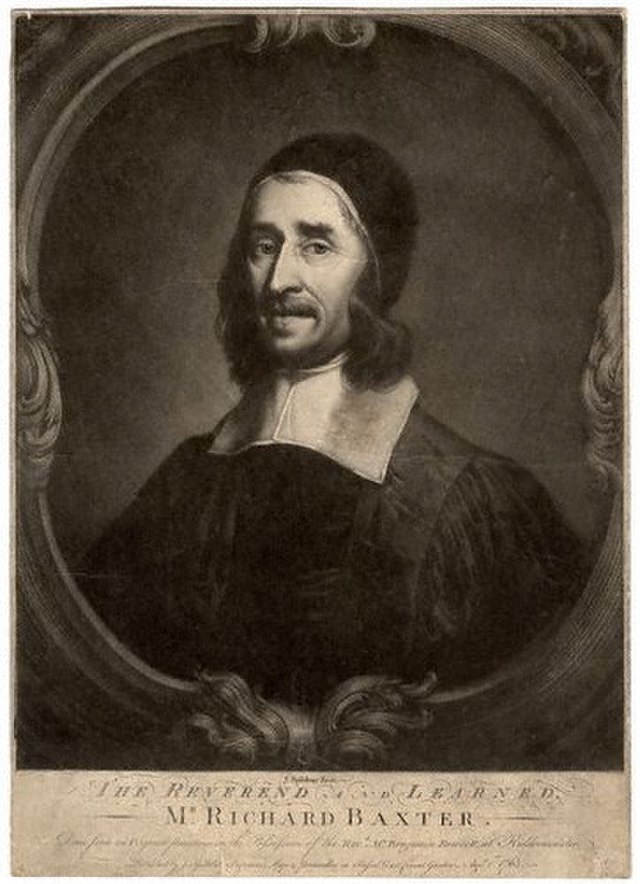
Richard Baxter was a minister at Kidderminster for seventeen years in the 17th century. While Baxter’s views on justification depart from reformed orthodoxy, he was an exemplary model of pastoral care and faithfulness.

“I do not ask men to regard him as a perfect and faultless being, any more than Cranmer, or Calvin, or Knox, or Wesley. I do not at all defend some of Baxter’s doctrinal statements. He tried to systematise things which cannot be systematised, and he failed. You will not find such a clear, full gospel in his writings as in those of Owen, and Bridge, and Traill. I do not think he was always right in his judgment. I regard his refusal of a bishopric as a huge mistake. By that refusal he rejected a glorious opportunity of doing good. Had Baxter been on the episcopal bench, and in the House of Lords, I do not believe the Act of Uniformity would ever have passed.

But in a world like this we must take true Christians as they are, and be thankful for what they are. It is not given to mortal man to be faultless. Take Baxter for all together, and there are few English ministers of the gospel whose names deserve to stand higher than his. Some have excelled him in some gifts, and some in others. But it is seldom that so many gifts are to be found united in one man as they are in Baxter. Eminent personal holiness, amazing power as a preacher, unrivalled pastoral skill, indefatigable diligence as a writer, meekness and patience under undeserved persecution, all meet together in the character of this one man. Let us place him high in our list of great and good men. Let us give him the honour he deserves. It is no small thing to be the fellow countryman of Richard Baxter.” —J.C. Ryle, Light from Old Times

The Walking Is Not a Speed Bump (John 6:1–21)

John 6:5–7 (ESV)

Lifting up his eyes, then, and seeing that a large crowd was coming toward him, Jesus said to Philip, “Where are we to buy bread, so that these people may eat?” He said this to test him, for he himself knew what he would do. Philip answered him, “Two hundred denarii worth of bread would not be enough for each of them to get a little.”

—John 6:5–7

As the fourth sign of feeding the five thousand coasts along from the sign itself (6:1–15) towards its significance (6:22ff), we may feel that the fifth sign of Jesus walking on the water is an unnecessary speed bump. Why it is here? Yes, it is chronologically sequential and explains how we get from one side of the sea to the other with the same crowd. This is true, but we’ve only relocated the question. This tells us something of why John wrote the story this way, but why does the Father write it this way? Why does the Father ordain that the walking happen now? Why does he pave the road from here to there with what seems to be a speed bump in between? Why didn’t Jesus in this instance just get into the boat and go to the other side with the disciples and retire to a solitary place thereafter?

If there is one word that more than any other links the feeding to the walking and the talking, it is the word “test” (v. 6). Jesus said this to test him. Only in John is the question directly directed to Philip, who hailing from the nearby town of Bethsaida, would best know where bread could be procured for such a crowd. In the Synoptics, this problem is put to all the disciples. You can see that here too as Andrew feels free to pipe in and as all the disciples are given commands to deal with the need. Jesus tests Philip. Philip stands in for all the disciples. Jesus is testing them. What is Jesus testing? Mark spells it out for us as he links the walking with the feeding. 

“And he got into the boat with them, and the wind ceased. And they were utterly astounded, for they did not understand about the loaves, but their hearts were hardened.”

—Mark 6:51–52

They did not understand the feeding, but after the walking the lesson begins to set in. Their tested faith being found lacking, is now tested by water, and comes out cleaner on the other side. Matthew tells us, “And when they got into the boat, the wind ceased. And those in the boat worshiped him, saying, ‘Truly you are the Son of God’” (Matthew 14:32–33).

Does John really intend to demonstrate that the faith that faltered in the feeding is strengthened by the storm? On the other side of the sea, when many depart from Jesus as He unpacks the significance of the feeding, Jesus turns to the twelve and asks, “Do you want to go away as well?” This time it is Peter who speaks for the twelve. He replies, “Lord, to whom shall we go? You have the words of eternal life, and we have believed, and have come to know, that you are the Holy One of God.”

John tells us that this gospel is written to put these signs before us that we might believe that Jesus is the Christ, the Son of God and that by believing, we might have life in His name. These signs are for faith. They are not only for sowing faith in the barren hearts of unbelievers. They are for strengthening the established faith of those who believe. These signs are both for the budding and the blooming of faith.

The walking is no speed bump in-between the feeding and the talking. It is wind in the sails of the disciples’ faith bringing them to the other side.