When God Flips Creation (Jeremiah 32:1–44)

 “And I bought the field at Anathoth from Hanamel my cousin, and weighed out the money to him, seventeen shekels of silver. 10 I signed the deed, sealed it, got witnesses, and weighed the money on scales. 11 Then I took the sealed deed of purchase, containing the terms and conditions and the open copy. 12 And I gave the deed of purchase to Baruch the son of Neriah son of Mahseiah, in the presence of Hanamel my cousin, in the presence of the witnesses who signed the deed of purchase, and in the presence of all the Judeans who were sitting in the court of the guard. 13 I charged Baruch in their presence, saying, 14 ‘Thus says the LORD of hosts, the God of Israel: Take these deeds, both this sealed deed of purchase and this open deed, and put them in an earthenware vessel, that they may last for a long time. 15 For thus says the Lord of hosts, the God of Israel: Houses and fields and vineyards shall again be bought in this land.’ —Jeremiah 32:9–15

The Book of Consolation is like the one great win in a season that otherwise seems a total wash. There have been some great plays, some scattered promises here and there, but here is their solitary “W.” Chapter 32 opens the second half of this four quarter game, and like the first chapter (chapter 30), though immediate judgment is confirmed, still final restoration is promised. They’re going to take some devastating hits, but they shouldn’t doubt they’ll come out ahead in the end.

In the second half, the approach changes. We move from poetry to prose, and in that prose we have a narrative concerning another sign-act. What is a sign-act? Let’s review. In chapter 13 Jeremiah was commanded to purchase a linen loincloth and make a long journey (somewhere in the ballpark of 600 miles) to the Euphrates and bury it there. Likely he then returned home only to sometime later be told to go back and retrieve the loincloth. We won’t take the time to rehearse the meaning of this sign-act, but suffice it to say it spoke of Judah’s judgment and it was a costly act for Jeremiah and thus acted like a bullhorn, magnifying his message. In chapter 16 Jeremiah was forbidden a family. Again, this was a costly act and one that foretold judgment. In Chapter 19, Jeremiah was to purchase a clay pot and smash it. While not as costly as some of the other acts, this was far from a great investment and again foretold judgment. Most recently, in chapters 27–28, Jeremiah makes yoke bars, only for the false prophet Hananiah to take them from his neck and break them. Jeremiah made his craft project and brought it to show and tell where a bully breaks it so that he has nothing to bring home.

As we are now in the Book of Consolation, you may well expect the sign-act not to speak of judgment, but of grace. Indeed it does. And so, instead of this act resulting in a personal loss for Jeremiah, you might expect some gain. Instead, this sign act appears to be his worst investment yet. Jeremiah receives insider trading advise, but it doesn’t play out how you’d expect. It’d been one thing if Jeremiah had been told to buy some property in and around Babylon at the beginning of his ministry. Instead he’s purchasing property in Judah on the eve of her destruction. This is like investing in a French Chateau in 1940 when the German Blitzkrieg has already breached the Maginot Line.

house-2169650_1280The plot of land is in enemy occupied territory. Jeremiah is in jail. He has preached the fall of Judah and a seventy year exile to follow. He has no family or offspring to inherit the land. All this is clearly on the table when Hanamel seemingly comes insisting Jeremiah redeem the land. Hanamel strikes one as that cousin that comes to the funeral to sell Amway. Family reunions to him are a business opportunity. In this, God’s hot tip isn’t “Be on your guard. Get ready. Don’t fall for it.” but instead, “Buy! Buy! Buy!”

Our puzzlement betrays our American eyes. The point of acting as a redeemer wasn’t to benefit you personally, but to honor Yahweh who allotted the land by family and love your kin so that they keep an inheritance in Israel (Leviticus 25:23–28). Jeremiah’s obedience to the covenant law is a sign that God is not through with His people. He is their Redeemer. Because God won’t pull up short on His promises, we need not pull short on obedience. Righteousness doesn’t always make sense as an investment in this life, but if you live unto God, this is not your concern. It isn’t short term temporal gain, but long term eternal reward that is your aim.

Jeremiah here made the best deal ever, not because of what he got on this earth, but because of what God promised in the next. As Derek Kidner comments, “Seventeen shekels of silver were surely never better spent.”

Meridian Church · Jeremian 32:1–44 || Redemption of the Land || Josh King

The Don: If You Only Go for Second, You Lose the Game

baseball-1634500_1280.jpg

“Of course this law has been discovered before, but it will stand rediscovery. It may be stated as follows: every preference of a small good to a great, or a partial good to a total good, involves the loss of the small or partial good for which the sacrifice was made.

Apparently the world is made that way. If Esau really got the pottage in return for his birthright (Genesis 25), then Esau was a lucky exception. You cant get second things by putting them first; you can get second things only by putting first things first. From which it would follow that the question, ‘What things are first?’ is of concern not only to philosophers but to everyone.

It is impossible, in this context, not to inquire what our own civilisation has been putting first for the last thirty years. And the answer is plain. It has been putting itself first. To preserve civilisation has been the great aim; the collapse of civilisation, the great bugbear. Peace, a high standard of life, hygiene, transport, science and amusement—all these, which are what we usually mean by civilisation, have been our ends. It will be replied that our concern for civilisation is very natural and very necessary at a time when civilisation is so imperilled. But how if the shoe is on the other foot—how if civilisation has been imperilled precisely by the fact that we have all made civilisation our summum bonum? Perhaps it can’t be preserved in that way. Perhaps civilisation will never be safe until we care for something else more than we care for it.” —C.S. Lewis, “First and Second Things” in C.S. Lewis Essay Collection & Other Short Pieces (HarperCollins Publishers, 2000), p. 655

Behold! Days Are Coming! (Jeremiah 31:27–40)

clouds-3400094_1280.jpg

“Behold, the days are coming…

Behold the days are coming…

Behold the days are coming…”

—Jeremiah 31:27, 31, 38

Saints, behold, days are coming. Days are coming when Yahweh “will sow the house of Israel and the house of Judah with the seed of man and the seed of beast,” (v. 27). Days are coming when Yahweh “will make a new covenant with the house of Israel and the house of Judah,” (v. 31). Days are coming when “the city shall be rebuilt for the LORD,” (v. 38). These days are the focus of what is called “The Book of Consolation” (running from Jeremiah 30–33). The Book of Consolation is a bright star in the dark night of Judah’s judgment. Jeremiah has long warned Judah of the darkness of exile, but here, he tells them that they do not go into exile without a light of hope.

The same key phrase introduces the book in 30:3: “For behold, days are coming, declares the LORD, when I will restore the fortunes of my people, Israel and Judah, says the LORD, and I will bring them back to the land that I gave to their fathers, and they shall take possession of it.” Later in our text, the same hope is expressed with the phrases, “it shall come to pass” (v. 28), and “in those days,” (v. 29). Jeremiah 30:24, after speaking of the fierce judgment that is soon to break upon them, promises, “In the latter days you will understand this.” In Jeremiah 31:1 we read, “At that time, declares the LORD, I will be the God of all the clans of Israel, and they shall be my people.” In 31:6 God tells them, “For there shall be a day when watchmen will call in the hill country of Ephraim: ‘Arise, and let us go up to Zion, to the LORD our God’ ” (all emphasis mine). These coming days are the fulfillment of that frequently mutilated promise of Jeremiah 29:11, “For I know the plans I have for you, declares the LORD, plans for welfare and not for evil, to give you a future and a hope.” This future, this hope, is so much more epic than what many make of it.

These days, all these promises of restoration, the fullness of the consolation held out for the people of God—all this is to be realized in the Christ, God’s king, the Son of David.

“And it shall come to pass in that day, declares the LORD of hosts, that I will break his yoke from off your neck, and I will burst your bonds, and foreigners shall no more make a servant of him. But they shall serve the LORD their God and David their king, whom I will raise up for them” (30:8–9; emphasis mine).

Though “The Book of Consolation” is theologian speak, a label invented by men for this distinct portion of Scripture, it is a near perfect one, for these promises and the comfort extended therein are exactly what Simeon looked forward to.

“Now there was a man in Jerusalem, whose name was Simeon, and this man was righteous and devout, waiting for the consolation of Israel, and the Holy Spirit was upon him. And it had been revealed to him by the Holy Spirit that he would not see death before he had seen the Lord’s Christ. And he came in the Spirit into the temple, and when the parents brought in the child Jesus, to do for him according to the custom of the Law, he took him up in his arms and blessed God and said, “Lord, now you are letting your servant depart in peace, according to your word; for my eyes have seen your salvation that you have prepared in the presence of all peoples, a light for revelation to the Gentiles, and for glory to your people Israel” (Luke 2:25–32; emphasis mine).

So then, these days have come and they are coming. They are here now, but not fully here yet. The eschatological promises were inaugurated with the first advent of Christ and will be consummated at His second advent. This age is fading away, and the age to come is breaking into the present. John Mackay opens commentary on this passage writing, “The clause begins with ‘Behold!’ … , probably to emphasize the reality and imminence of what is being talked about. The significance of the time reference in this phrase is much debated, but it seems to point to a future scene, the precise time of which is not revealed, but which is certain because the coming events are already rising out of present circumstances (30:3). What will happen will be a development of factors that are already at work. Therefore those who by faith accept the divine analysis of the situation can be confident that what is foretold will come to pass.”

Judah could be sure of these future promises because of how they arise out of the present. If Judah could be confident and take comfort in these promises, as they saw them arising out of God’s present doings, how much more may we?

Because these days have come, we may be certain they will come. The Christ was born the Second Adam. The Christ lived to be our righteousness. The Christ died bearing our sins. The Christ rose conquering our foes. The Christ ascended and is seated at the right hand of the Father with all things being put under His feet. The Christ will certainly come again. Oh how much of the comfort promised here has already come in part and so how much more may we take comfort that the fullness certainly lies ahead? Oh saints, let us now with the eyes of faith behold! days are coming!

Meridian Church · 7.5.20 Jeremiah 31.27–40 Days Are Coming Josh King

The Don: When You Allow Some to be “Left Behind,” All Come Out Ahead

aaron-burden-6jYoil2GhVk-unsplash.jpg

“A truly democratic education—one which will preserve democracy must be, in its own field, ruthlessly aristocratic, shamelessly ‘high-brow’. In drawing up its curriculum it should always have chiefly in view the interests of the boy who wants to know and who can know. (With very few exceptions they are the same boy. The stupid boy, nearly always, is the boy who does not want to know.) It must, in a certain sense, subordinate the interests of the many to those of the few, and it must subordinate the school to the university. Only thus can it be a nursery of those first-class intellects without which neither a democracy nor any other State can thrive.

And what,’ you ask, ‘about the dull boy? What about our Tommy, who is so highly strung and doesn’t like doing sums and grammar? Is he to be brutally sacrificed to other peoples sons?’ I answer: dear Madam, you quite misunderstand Tommys real wishes and real interests. It is the aristocratic system which will really give Tommy what he wants. If you let me have my way, Tommy will gravitate very comfortably to the bottom of the form; and there he will sit at the back of the room chewing caramels and conversing sotto voce with his peers, occasionally ragging and occasionally getting punished, and all the time imbibing that playfully intransigent attitude to authority which is our chief protection against England’s becoming a servile State. When he grows up he will not be a Porson; but the world will still have room for a great many more Tommies than Porsons. There are dozens of jobs (much better paid than the intellectual ones) in which he can be very useful and very happy. And one priceless benefit he will enjoy: he will know he’s not clever. The distinction between him and the great brains will have been clear to him ever since, in the playground, he punched the heads containing those great brains. He will have a certain, half amused respect for them. He will cheerfully admit that, though he could knock spots of? them on the golf links, they know and do what he cannot. He will be a pillar of democracy. He will allow just the right amount of rope to those clever ones.” —C.S. Lewis, “Democratic Education” in C.S. Lewis Essay Collection & Other Short Pieces (HarperCollins Publishers, 2000), p. 599

The Patristic Interpretation: A Maternal Mystery (Jeremiah 31:22)

“How long will you waver,
O faithless daughter?
For the LORD has created a new thing on the earth:
a woman encircles a man.” —Jeremiah 31:22

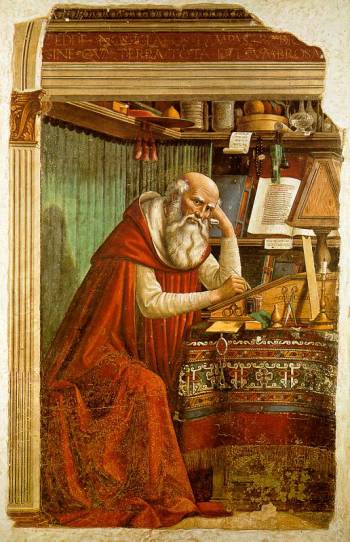
Domenico_Ghirlandaio_-_St_Jerome_in_his_study.jpg
St. Jerome in His Study (1480), by Domenico Ghirlandaio

That the promises of restoration given in the “Book of Consolation” (a name given to Jeremiah 30–33; cf. Jeremiah 30:1) involve more far more than was realized with the return to Zion under Cyrus is made plain in that the “new thing” spoken of here is soon unfolded as the new covenant (Jeremiah 31:31–34). Now that’s a whopper of a sentence to open with but it’s good prep for what’s to come. We’re dealing with something enigmatic here.

Israel is not to waver in receiving the comfort her God extends because of the new thing He is doing. As to what this new thing is, I want us to look not to DC Talk, but to an ancient interpretation that has been widely disregarded by contemporary scholars. As this “new thing” is only briefly explained, and then with a mysterious metaphor, there are interpretations aplenty. I think the best modern opinion is that striking language is used by Yahweh to speak of the virgin Israel now clinging to Him in covenant love. Though this image flips the relational roles between husband and wife (“encircles” has connotations of protection) I can go with this interpretation, but I still don’t think it best.

Perhaps another enigmatic statement can help us make sense of this one—another instance where startling masculine language is used of a woman. In Genesis 3:15 man’s hope is to be found in the seed of the woman. The ESV can obscure this a bit, but note the little footnote explaining that the word for offspring is “seed.” The King James’ wins points for more than elegance at this point. Compare the ESV with the KJV.

“I will put enmity between you and the woman, and between your offspring and her offspring; he shall bruise your head, and you shall bruise his heel (ESV).”

“And I will put enmity between thee and the woman, and between thy seed and her seed; it shall bruise thy head, and thou shalt bruise his heel (KJV).”

A woman’s seed! That’s not something to gloss over with “offspring.” Though the Biblically astute student may meditatively stop here, recalling that “offspring” in the Scripture are always recorded in reference to the father, “seed” makes the point emphatic. Something surprising, miraculous, mysterious is afoot.

Further, the “new thing” Yahweh does is not just any doing. A peculiar word is used for God’s doing. He creates. That falls a bit flat in translation as well, but no English translation can do justice in this instance. In the Hebrew tongue, God gets his own verb. There is a kind of doing God does that only He can do. He is the only one that does this kind of creation. The identical verb is used in Genesis 1:1. This new thing is new creation, and it involves a woman on earth. See where this is going?

The work of the Holy Spirit in the conception of our Lord is spoken of in terms that recall Genesis 1:1 where we are told that “the Spirit of God was hovering over the face of the waters.” When Mary asked “How will this be since I am a virgin?” the angel answered, “The Holy Spirit will come upon you, and the power of the Most High will overshadow you; therefore the child to be born will be called holy—the Son of God” (Luke 1:34–35).

New creation begins with the Second Adam, conceived in the womb by the Holy Spirit, made out “nothing”—the seed of the woman. A women encircles a man. Mysterious? Enigmatic? You betcha. But for those very reasons, this old interpretation doesn’t seem a bit out of date to me.

“Concerning her we read of a great miracle in the same prophecy—that a woman should compass a man, and that the Father of all things should be contained in a virgin’s womb” (Jerome, Against Jovinianus).

Meridian Church · Jeremiah 31:1–26 || Rest || Josh King

The Don: Bulverism Anyone?

In other words, you must show that a man is wrong before you start explaining why he is wrong. The modern method is to assume without discussion that he is wrong and then distract attention from this (the only real issue) by busily explaining how he became so silly. In the course of the last fifteen years I have found this vice so common that I have had to invent a name for it. I call it Bulverism. Someday I am going to write the biography of its imaginary inventor, Ezekiel Bulver, whose destiny was determined at the age of five when he heard his mother say to his father – who had been maintaining that two sides of a triangle were together greater than the third – ‘Oh you say that because you are a man.’ ‘At that moment’, E. Bulver assures us, ‘there flashed across my opening mind the great truth that refutation is no necessary part of argument. Assume that your opponent is wrong, and then explain his error, and the world will be at your feet. Attempt to prove that he is wrong or right, and the national dynamism our age will thrust you to the wall.’ That is how Bulver became one of the makers of the Twentieth Century. —C.S. Lewis, “Bulverism” in C.S. Lewis Essay Collection & Other Short Pieces (HarperCollins Publishers, 2000), p. 587

Restoration vs. Reconstruction (Jeremiah 30:1–24)

rome-974294_1920

“And it shall come to pass in that day, declares the LORD of hosts, that I will break his yoke from off your neck, and I will burst your bonds, and foreigners shall no more make a servant of him. But they shall serve the LORD their God and David their king, whom I will raise up for them” (Jeremiah 30:8–9).

I’m no Rushdoony Reconstructionist, nor a Bahnsen Theonomist but I do believe the law of God informs the Christian concerning justice and truth. It tells us, with absolute authority, what to advocate for and what to protest against. Still, and here’s the kicker, the cultural mandate is a mandate, not a promise. So, if you’ve got a few of those fancy five dollar theology words in your back pocket, you might venture I’m not a postmillennialist. Roger that. But don’t then libel me a pessi-millennialist. I am opti-millennialist. I am optimistic; fully believing that the kingdom has broken in and will fully come. This age is fading away like a mist. The age to come is raining down and a deluge is coming. God will gather every soul which the blood of Christ has ransomed and not lose one. His glory will cover the earth as the waters cover the sea and His praises will be sung in every language. Nothing happens but that which advances His kingdom according to His plan. Our God never sounds retreat. His strategies may confound us, but we privates shouldn’t doubt the strategy of the general. After all, He did deal the deceive blow by clothing Himself in weakness and dying on the cross. In other words, I’m not optimistic about man’s obedience to the cultural mandate. I’m optimistic concerning the church’s obedience to the great commission, though not because of the church herself, but because all authority has been given to Christ who has promised to be with her.

This world is a Babylon and it is doomed. Whist we remain, let us seek her welfare, for in it, we will find our own. Our hope is not in a Babylon built up, but torn down. Our hope is not in Babylon redeemed, but destroyed. Our hope is not Babylon lifted up, but Jerusalem coming down (Jeremiah 29:10).

When the bonds of Babylon are burst, we then serve Yahweh our God and the Son of David, our King, whom He has raised up for us. These burst bonds do not result in any Bolshevik Revolution. The tyranny of the one is not to be replaced with the anarchy of the many. Neither is the hope a democratic republic founded on God’s law. No, the hope Jeremiah speaks of is a monarchial theocracy. Our hope is neither that of Animal Farm, nor Manor Farm, but of Narnia. As Trufflehunter explained to the irascible Nikabrik,

“I’m a beast, I am, and a Badger what’s more. We don’t change. We hold on. I say great good will come of it. This is the true King of Narnia we’ve got here: a true King, coming back to true Narnia. And we beasts remember, even if Dwarfs forget, that Narnia was never right except when a son of Adam was King.”

Yes, our King sits at the right hand of the Father ruling the nations, but things will not be made fully right until those nations are ultimately broken with a rod of iron, Zion descends, and His throne is manifestly established on earth. Then, things will be put to right. Then, all will be restored. This mountain is built, not by the nations, but on top of their crushed rubble. Our part is to be faithful to God’s law within the city of man, preaching His gospel, our hope—the gospel of Christ and the city of God ruled by His King.

Meridian Church · Jeremiah 30:1–24 || Restoration || Josh King

The Don: An Apology for Philosophy

lafayette-college-80476_1280

“If all the world were Christian, it might not matter if all the world were uneducated. But, as it is, a cultural life will exist outside the Church whether it exists inside or not. To be ignorant and simple now—not to be able to meet the enemies on their own ground—would be to throw down our weapons, and to betray our uneducated brethren who have, under God, no defence but us against the intellectual attacks of the heathen. Good philosophy must exist, if for no other reason, because bad philosophy needs to be answered. The cool intellect must work not only against cool intellect on the other side, but against the muddy heathen mysticisms which deny intellect altogether. Most of all, perhaps, we need intimate knowledge of the past. Not that the past has any magic about it, but because we cannot study the future, and yet need something to set against the present, to remind us that the basic assumptions have been quite different in different periods and that much which seems certain to the uneducated is merely temporary fashion. A man who has lived in many places is not likely to be deceived by the local errors of his native village: the scholar has lived in many times and is therefore in some degree immune from the great cataract of nonsense that pours from the press and the microphone of his own age.” ——C.S. Lewis, “Learning in War Time” in C.S. Lewis Essay Collection & Other Short Pieces (HarperCollins Publishers, 2000), p. 584

Drinking out of the Mug Auntie Gertrude Bought You (Jeremiah 29:1–32)

71bZP4JW7tL._AC_SL1200_
Would you buy one?

What is that thing that you like or want to like, but you can’t admit it because you know that person likes it? This isn’t the same thing as a guilty pleasure. There, the thing itself embarrasses you; like a dude admitting he enjoys the music of a particular boy band. What I’m speaking of is shame felt because of who or what is associated with the thing. It isn’t that you like the boy band; it’s that you don’t want to like the thing that the boy band likes. Or, perhaps you’d like to buy a certain product, but you don’t, not because of the product itself, but because liberals are known for endorsing it.

Say you are in a small group and folks are mentioning passages that are dear to them. No one wants to say Psalm 23 because everybody knows and loves that one. No one picks that one because they want to be unique and original. That is one kind of sin. I’m aiming at another. The exact same reasoning might happen with Jeremiah 29:11 if you were in a prosperity gospel preaching church. Frequent flyers over these skies probably don’t visit such destinations. Still, Jeremiah 29:11 will go unmentioned because it is so associated with that movement. In the first instance, when you mention Psalm 23, people may think, “He said that because it’s the only [eye roll] passage he knows.” In the second instance, when you mention Jeremiah 29:11, people suspect you’re a heretic.

Prosperity gospel preachers are guilty of ignoring huge chunks of the Bible. Though less dangerous, let us not ignore the few—oh the very few—that they have picked up as if they are guilty by association. All Scripture is God-breathed and profitable, even the parts that those guys seem to really like. How clever of the enemy: if he cannot get you to forfeit the truth for love of a lie, he may get you to forfeit the truth for fear of the lie.

And thus we have distanced ourselves from this promise. Some have tried to justify the distance by arguing that this text has nothing to do with us. But is this so? This kind of relegating of Old Testament promises to the wastebasket smells dispy-ish. The specifics of the promise do sound very Jewish and ancient. “It happened to them; it happened back then,” so we reason. Yes, but did it fully happen?

This chapter transitions from false prophets to true promises. Chapters 26–29 record a number of showdowns between Jeremiah and the false prophets. In stark contrast, Chapters 30–33 are known as the “Book of Consolation.” Here, some of the sweetest promises in all of Scripture are recorded, the very “plans” Jeremiah is speaking of. What are these plans? The apex of them is spoken of as a “new covenant” or “everlasting covenant” (Jeremiah 31:31–34; 32:36–41). Do these verses have anything to do with you? The author of Hebrews thinks so (Hebrews 8–9). Read all the promises of restoration held out here and see if the new covenant is not what ties them all up with a bow.

So then, when you’re afraid to drink out of that coffee mug with Jeremiah 29:11 printed on it that your auntie Gertrude gifted you, know that you already drink of the cup of Jeremiah 29:11. It is the cup of the new covenant of Christ’s blood poured out for the forgiveness of your sin.

The exiles who returned to Jerusalem only came to the hills of this promise. We have come to the heavenly Zion. We have come to the mountain, but yet, we are only at the base. And so it is that we look back, or should, to the shadows cast by this mountain, so that we might better know the peak that awaits us in Christ. Jesus is gathering the exiles from all over the earth. They are His people. He is their God. He has redeemed us out of captivity and He will restore all that was lost by sin and its curse. He will bring us home where He will dwell in our midst forevermore. This is our hope. This is our future. This is His plan.

Meridian Church · Jeremiah 29:1–32 || True Promises And False Prophets || Josh King

The Don: The Lion Pulled the Whole Story Together


lion-3576045_1280

“One thing I am sure of. All seven of my Narnia books, and my three science fiction books, began with seeing pictures in my head. At first they were not a story, just pictures. The Lion [meaning The Lion, the Witch, and the Wardrobe] all began with a picture of a faun carrying an umbrella and parcels in a snowy wood. This picture had been in my head since I was about sixteen. Then one day, when I was about forty, I said to myself: ‘Lets try to make a story about it.’

At first I had very little idea how the story would go. But then suddenly Aslan came bounding into it. I think I had been having a good many dreams of lions about that time. Apart from that, I don’t know where the Lion came from or why he came. But once He was there He pulled the whole story together, and soon He pulled the six other Narnian stories in after him.” —C.S. Lewis, “It All Began with a Picture” in C.S. Lewis Essay Collection & Other Short Pieces (HarperCollins Publishers, 2000), p. 529