Tolle Lege: How People Change

Readability: 1

Length: 223 pp

Author: Timothy Lane and Paul David Tripp

Can people really change? Can you? Do you desire to change? Are you tired of self-help books that fell like a hamster wheel? Here you will find no superficial solutions to your behavior. Lane and Tripp go to the heart of the problem – the problem of the human heart. They realize that for real change to occur a miracle must happen – the new birth. Behavior springs from the heart. If behavior is to be changed, the heart must be changed. How People Change is an excellent resource for pastors, counselors, leaders, and for those desiring to change.

But is Jesus my therapist or my Redeemer?  If he is my therapist, then he meets my needs as I define them.  If he is my Redeemer, he defines my true needs and addresses them in ways far more glorious than I could have anticipated.

It is always tempting to find fullness in something other than Christ. Often I opt for peace and comfort rather than Jesus. When I do, I can move in two opposite but equally sinful directions. If I am irritated with you because you get in the way of the things that comfort me, I may lash out at you and keep you from taking what I think I need. But I can also fake “godly” behavior to get the same result. I may choose to “be nice” in order to extract some kindness from you.

On several occasions I have had arguments with my wife, knowing that a good baseball game was about to air on TV. Watching a game is a time of peace and comfort for me. Because I want that experience, I may apologize to my wife and even ask her to forgive me for the way I sinned against her. From the outside, this may look godly, but on the inside, I was simply faking godliness to get what I wanted. If I consciously live in light of the fact that I am full in Christ, I will ask for forgiveness whether or not I get to watch the game. The most obvious way to determine if my actions were sincere is to look at my behavior when the game comes on and I am interrupted again. If I become agitated, my confession and request for forgiveness were most likely a subtle way of manipulating my wife to get what I wanted.

Paul says that we have been given fullness in Christ. If I act on this truth, nothing can empty me of what is already mine. Baseball game or no baseball game, I can live peaceably with my wife and family. This simple illustration may not be all too impressive, but if the blessings of Christ do not change us in little moments like these, the chances that they will change us in more difficult moments are slim. It is in the everyday details that the grace of Christ must be applied.

WTS Books: $12.23              Amazon:$12.23

Tolle Lege: Community

Readability: 1

Length: 228 pp

Author: Brad House

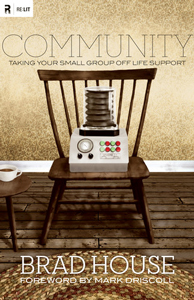
Community is a great book for ministers and community group leaders. Here you will find plenty of good practical answers to the “How?” of community groups, but the great value of this book is that House first solidly lays a foundation by answering the “Why?” of community groups. It doesn’t matter how “successful” your small groups are if you are not asking why they exist. If you are not asking “Why?” you won’t know what real success means. I don’t agree with all of House’s answers to the how and why questions (mainly I disagree with such language as “incarnational ministry”), but I agree with the main answer as to their existence – to magnify Christ. This solid theologizing concerning community groups makes the book worth reading alone. I plan on going through it will all of our life group leaders. So if you are a life group leader at FBCM you may as well go ahead and click a link below and order it.

[Commenting on 1 Corinthians 1:2-4] Paul is concerned with the legacy of the church in Corinth. He is not satisfied with them merely hearing or knowing the gospel. But it is not that Paul wants the church to do more. He wants them to be more. I am convinced that he is not disappointed with the church as much as he desires to see them live abundant lives that reflect what Jesus has already done.

I endeavor to affirm community as a gift of God’s grace for the purpose of exalting the Son and making him known. In other words, community is not about us; it is about God. Community is an instrument of worship, a weapon against sin, and a tool for evangelism—all for the exaltation of Jesus.

If you want to inspire people to the mission of God, you must lift up the Son. [When we don’t it is] like trying to inspire a painter with a tube of paint. It isn’t the paint that is inspiring – it is the sunset.

When we are afraid to share ownership of our vision with others, we make a statement about the sovereignty of God. We say that although God is trustworthy and faithful, I am pretty sure that if I stop running on this hamster wheel, then it will all fall apart. An unwillingness to share leadership is as much about doubt in God and others as it is about confidence in one’s own ability.

WTS Books: $9.28               Amazon:$9.37

Tolle Lege: Christless Christianity

Christless ChristianityReadability: 2

Length: 259 pp

Author: Michael Horton

Michael Horton loves and fights for the gospel, the message of sola fide.  In Christless Christianity he shows how the American church, thinking itself to be so smart and innovative, has really swallowed ancient heresies that are contrary to the gospel.  Pelagianism and Gnosticism have infiltrated the church.  Pelagianism is the message of self salvation by works.  From the social gospel, to the emergent church, to Joel Osteen what is emphasized is not the work of Christ, but our works.  In Gnosticism experience is salvific.  The Gnostics sought superior knowledge experientially.  What matters is not what you do, but if you have had some experience.  It is not faith in an objective gospel but a subjective experience that makes you a Christian according to this scheme.

If you think you are immune from American culture, read this book!  If you realize you are not, I take it for granted that you have already clicked the picture and purchased this book.

Imagine two scenarios of church life. In the first, God gathers His people together in a covenantal event to judge and to justify, to kill and to make alive. The emphasis is on God’s work for us – the Father’s gracious plan, the Son’s saving life, death, and resurrection, and the Spirit’s work of bringing life to the valley of dry bones through the proclamation of Christ. The preaching focuses on God’s work in the history of redemption from Genesis through Revelation, and sinners are swept into this unfolding drama. Trained and ordained to mine the riches of Scripture for the benefit of God’s people, ministers try to push their own agendas, opinions, and personalities to the background so that God’s Word will be clearly proclaimed. In this preaching, the people once again are simply receivers – recipients of grace.  Similarly in baptism, they do not baptize themselves; they are baptized.  In the Lord’s Supper, they do not prepare and cook the meal, they do not contribute to the fare; but they are guests who simply enjoy the bread of heaven.  Having been served by God in the public assembly, the people are then servants of each other and their neighbors in the world. Pursuing their callings in the world with vigor and dedication, they win the respect of outsiders. Because they have been served well themselves – especially by pastors, teachers, elders, and deacons – they are able to share the Good News of Christ in well-informed, natural ways. And because they have been relieved of numerous burdens to spend all of their energy on church-related ministries throughout the week, they have more time to serve their families, neighbors, and coworkers in the world.

In the second scenario, the church is its own subculture, and alternative community not only for weekly dying and rising in Christ but for one’s entire circle of friends, electricians, and neighbors. In this scenario, the people assume that they come to church primarily to do something. The emphasis is on their work for God. The preaching concentrates on principles and steps to live a better life, with a constant stream of exhortations: Be more committed. Read your bible more. Pray more. Witness more. Give more. Get involved in this cause or that movement to save the world. Their calling by God to secular vocations is made secondary to finding their ministry in the church. Often malnourished because of a ministry defined by personal charisma and motivational skills rather than by knowledge and godliness, these same sheep are expected to be shepherds themselves. Always serving, they are rarely served. Ill-informed about the grand narrative of God’s work in redemptive history, they do not really know what to say to a non-Christian except to talk about their own experiences and perhaps repeat some slogans or formulas that they might be hard-pressed to explain. Furthermore, because they are expected to be so heavily involved in church-related activities (often considered more important even than the public services on Sunday), they do not have the time, energy, or opportunity to develop significant relationships outside the church. And if they were to bring a friend to church, they could not be sure that he or she would ear the gospel.

WTS Books: $13.25              Amazon:$13.59

Tolle Lege: The Five Dilemmas of Calvinism

Readability: 1

Length: 126 pp

Author: Craig R. Brown

This little book is an excellent place to begin if you are wrestling with Calvinism.  In my opinion there are books that are better, but none that are so brief, winsome, or simple.  Simplicity is the strongest attribute of The Five Dilemmas of Calvinism.  Often Brown just hits you with a litany of Scriptures that demonstrate the truth he is advocating for and then calls on the reader to think on them.  This I think is the best way to get someone to consider Reformed theology, give them some Scriptures and ask them to read them prayerfully as you pray for them.

WTS Books: $9.00               Amazon:$9.00

Tolle Lege: Tell the Truth

Readability: 2

Length: 207 pp

Author: Will Metzger

Too often books or courses on evangelism reduce the gospel down to a few bullet points hoping to make the task of evangelism less daunting.  Early Metzger offers no apologies for doing the opposite in his book, Tell the Truth.

The extensiveness of this gospel summary may surprise you.  I do not apologize for this. I am convinced that God purposes our speaking the truth in love as the predestined means of salvation.  If all Christians learned these truths, their witness would be more God-honoring and their spiritual growth enhanced as they daily reexperience the gospel of grace.  The gospel is for Christians.  God may use a minimal amount of truth to quicken someone; that’s his prerogative.  Our privilege is to enter into the depths of the whole gospel, sinking roots into that life-giving water.

A small gospel means small Christians.  Every day of your life as a Christian should be one of growing in your understanding of and conformity to the gospel you are meant to preach.  How can we commend something we think worth only a fraction of our mind and commitment?

This is the best book on evangelism I’ve read.   Here the whole gospel is commended to whole person, by whole people.  Don’t miss this book.

This is a book about the scandal of sovereign salvation.  In it, I blame God for salvation, in the sense that he is totally responsible.  He organized a rescue operation within the Trinity – designing, supplying, accomplishing and restoring those who are in peril.  Our triune God is the Author and Fulfiller, the Originator and Consummator, the Creator and Redeemer.  It’s all God’s fault – a grace that gives response-ability to the spiritually dead.

WTS Books: $10.71               Amazon:$10.04

Tolle Lege: Chosen by God

Chosen by GodReadibility: 1

Length: 213 pgs

Author: R.C. Sproul

Chosen by God is one of the greatest introductions to the doctrine of election I have read. Sproul, a master teacher,  in his typical manner make the most profound of doctrines clear . He will not handle the topics in depth and cover every area, but it is amazing the breadth of material covered in so small a package, with such power and clarity.

Is there any reason that a righteous God ought to be loving toward a creature who hates him and rebels constantly against his divine authority and holiness? The objection raised by the philosopher implies that God owes his love to sinful creatures. That is, the unspoken assumption is that God is obligated to be gracious to sinners. What the philosopher overlooks is that if grace is obligated it is no longer grace. The very essence of grace is that it is undeserved. God always reserves the right to have mercy upon whom he will have mercy. God may owe people justice, but never mercy.

God is free. I am free. God is more free than I am. If my freedom runs up against God’s freedom, I lose. His freedom restricts mine; my freedom does not restrict his.

WTS Books: $10.15              Amazon: $10.28

Tolle Lege: Basic Christianity

Readability:  1

Length: 179 pp

Author: John Stott

I really do enjoy reading C.S. Lewis’ Mere Christianity, and there are some excellent illustrations and arguments that just beg to be used, but as far as communicating the very core, the essence of Christianity it falls short. If you want a little book to take an unbelieving friend through to communicate to them the central message of the Christian faith may I suggest John Stott’s Basic Christianity. Here the gospel isn’t just defended, but shown as necessary and gloried in.

You can never take God by surprise.  You can never anticipate him.  He always makes the first move.  He is always there ‘in the beginning’. Before man existed, God acted. Before man stirs himself to seek God, God has sought man.  In the Bible we do not see man groping after God; we see God reaching after man.

In seeking God we have to be prepared not only to revise our ideas but to reform our lives. The Christian message has a moral challenge. If the message is true, the moral challenge has to be accepted. So God is not a fit object for man’s detached scrutiny. You cannot fix God at the end of a telescope and say ‘How interesting!” God is not interesting. He is deeply upsetting.

Jesus never concealed the fact that His religion included a demand as well as an offer. Indeed the demand was as total as the offer was free. If He offered men His salvation, He also demanded their submission.

WTS Books: $6.00               Amazon: $6.00

Tolle Lege: Christians Get Depressed Too

Readability:  1

Length: 112 pp

Author: David Murray

Here is a little book packed with tons of help for the depressed Christian. It is short and easily readable and thus more attractive to the depressed person who does not feel like reading a book. Murray deals with the crisis, complexity, condition, causes, cures, and caregivers in relation to the subject of depression. Christians Get Depressed Too is a helpful pastoral tool I am glad to have and recommend. There are a couple of powerful Biblically-grounded insights that really jolted my thinking on the subject. I leave you with one of them.

We would never take this view (sinful cause/spiritual solution) when counseling people with cancer, strokes, broken legs, diabetes, or Alzheimer’s. As Reformed Christians, our default position is that these physical problems are most likely the result of living as fallen creatures in a fallen world. Why should our default position with brain problems be any different? Are we saying that the brain, the most complex organ in our body is somehow exempt from the effects of the fall? My skin is broken down by psoriasis, my eyes are broken down with shortsightedness, my nose is broken down with rhinitis, my joints are sometimes broken with arthritis, my bowel has required two operations, my legs are broken down with varicose veins, my body is covered in dangerous moles (two of which have been removed), but I am actually very healthy! I do not believe any of these ailments are the result of personal sin but simply the consequences of being a fallen creature living in a fallen world or of inheriting genes from my mother and father who also had similar health issues. Why then should we always conclude that brain disorders are the result of personal sin?

WTS Books: $7.50               Amazon: $10.00

Tolle Lege: It Is Well

Readability:  1

Length: 216 pp

Author: Mark Dever and Michael Lawrence

In 2007 Steve Jeffery, Michael Ovey, and Andrew Sach wrote an excellent, thorough, and important defense of penal substationary atonement entitled Pierced for our Transgressions. It is a book for the serious student. Dever and Lawrence set out to compliment that book with this collection of sermons tracing the theme of substitution progressively through the Bible. It Is Well is not only more assessable, but here penal substitionay atonement is Biblically defended, reveled in, and applied.

It’s amazing when you think about it that God’s meeting place with man, the place where atonement would be made, was in the very symbol of his holiness and righteousness. This room, separated physically and by rules – with the ark of the covenant, the bowing cherubim, the law written by God’s own hand – is where not only God’s righteousness and holiness but also his mercy would be shown most clearly.

Contrary to what liberal theologians like to say about the symbolic meaning of the cross, the good news is that there is nothing symbolic about it. The symbols were in the Old Testament; they were given so that when the real thing happened, we’d know what we were looking at. When Jesus was lifted up on the cross, he wasn’t making a symbolic statement about the power of faith over the meaninglessness of life. No, he was making atonement for sin, as only he could do.

You are included in that wide-open whoever if you will turn away from your rebellion and put your faith in the God whose love is measured not by your feelings but by his actions – a love measured by the span of a wooden beam and nail-pierced hands. Oh, friend, look to Jesus today and be saved.

So this is the scene: the Judge of the world condemned by a corrupt court. The true High Priest to be murdered by an unholy counterfeit. The lamb of God sacrificed by the high priest as a political scapegoat.

Atheists like Hitchens and Dawkins may, if they’re honest, admit the strange pervasiveness of moral evil, but they have no real explanation for it. It’s like a coin flipped six billion times always coming up tails. I think something’s going on there.

WTS Books: $13.31               Amazon: $13.49

Tolle Lege: Holy Subversion

Readability:  1

Length: 147 pp

Author: Trevin Wax

Caesar is not Lord, Jesus is. This would be a most radical statement in the early Christian world – it would be subversive. Not subversive in the sense of overthrowing Caesar, but in the sense of putting him back in his proper place.

In , Tevin Wax calls for us to put the idols that rule over us (Caesars) back in their place, under the Lordship of Christ. Trevin deals well with the Caesars of the self, success, money, leisure, sex, and power. Here is a necessary book that is also very helpful.

The disciples we produce are a direct result of the gospel we preach.

Abstinence education may be effective for the public school system, but churches should not preach abstinence alone.  After all, telling young people that they should not have sex because of all the bad things that could happen to them actually perpetuates a self-centered view of sexuality.  The teenagers who engage in sexual activity are having sex to please themselves.  The teenagers who do not engage in sexual activity are not having sex in order to protect themselves.  But the common root in both of these mindsets is self-centeredness.

WTS Books: $7.49              Amazon: $10.31