Tolle Lege: Delighting in the Trinity

Delighting...Readability: 1

Length: 130 pp

Author: Michael Reeves

I like subtitles but I normally don’t make much of them in these reviews. But Michael Reeves’ Delighting in the Trinity’s subtitle call for special notice. The title alone, unfortunately, is enough to startle some. Delighting in the Trinity? That is shocking enough, but he adds, “an introduction to the Christian faith.” This suggests that some Christians are trying to spell words like “Jesus,” and say phrases like, “justification by faith,” before they even know their ABCs.

“But I thought the Trinity was the deep end of the pool? You know, where the high dive is; for advanced swimmers?” You’re right. The Trinity is deep, but if Christianity is the pool, then the Trinity isn’t a side of the pool, it’s the water. You can’t get into the real Christianity pool, not even the shallow side, without immersing into Trinity. Christians are trinitarian, chosen by the Father, saved by the Son, renewed by the Spirit. Michael Reeves means for you to play in this water, that is, to delight in the Trinity. Please read no allusion to Trinity as water here, liquid, solid, gas, this would make me, and Reeves very distraught. It smacks of the ancient heresy modalism, dubbed moodalism by Reeves. This would work against your joy, but for an explanation of why you’re going to have to get the book.

The most foundational thing in God is not some abstract quality, but the fact that he is Father.

This is salvation with jam on top. In fact, the more trinitarian the salvation, the sweeter it is. For it is not just that we are brought before the Father in the Son; we receive the Spirit with which he was anointed. Jesus said in John 16: 14 that the Spirit ‘will bring glory to me by taking from what is mine and making it known to you.’ The Spirit takes what is the Son’s and makes it ours. When the Spirit rested upon the Son at his baptism, Jesus heard the Father declare from heaven: ‘You are my Son, whom I love; with you I am well pleased.’ But now that the same Spirit of sonship rests on me, the same words apply to me: in Christ my high priest I am adopted, beloved, Spirit-anointed son. As Jesus says to the Father in John 17: 23, you ‘have loved them even as you have loved me.’ And so, as the Son brings me before his Father, with their Spirit in me I can boldly cry, ‘Abba,’ for their fellowship I now freely share: The Most High my Father, The Son my great brother, the Spirit no longer Jesus’ Comforter, but mine.

WTS Books: $10.56               Amazon: $12.64

Tolle Lege: Putting Amazing Back into Grace

Puting Amazing...Readability: 1

Length: 227 pp

Author: Michael Horton

Michael Horton is as excellent a theologian as he is a writer. God’s grace was on him in both ways, like the prophet Jeremiah, from his youth. As a teenage boy Horton’s eyes were opened to the doctrines of grace. He wrote a book titled Mission Accomplished at fifteen to explain to others the truths he had come to see in Scripture. While in college the book was published by Thomas Nelson and James Boice wrote the forward.

That book is since out of print, but it was added to and revised. It now comes to us as Putting Amazing back into Grace with a foreword by J.I. Packer. Mission Accomplished was published and endorsed by James Boice said something as to its value. That Michael has had so many years to deepen in his understanding and wisdom in communicating these truth speaks to the value of its successor. Whether you are newly investigating the doctrines of grace or are looking to freshly be warmed by them you will find this book helpful.

We can talk about grace, sing about grace, preach about grace, just so long as we do not get too close to it.  Election is too close.  When we give in to election, we finally give up on ourselves in the matter of salvation.  This doctrine takes grace to its logical conclusion: If God saves me without my works, then he must choose me apart from them, too.

Everyone believes in election and predestination. The terms are found throughout Scripture, and to deny any and every notion of election or predestination is to flatly contradict God’s Word. The real question is whether one believes it is, as Paul affirmed, an ‘election of grace’ (Rom. 11:5) or of foreseen works. If grace means ‘unmerited favor,’ then the Bible clearly teaches that nothing, absolutely nothing at all including our response can be the one thing that merited God’s favor. If God chose you based on his having foreseen your response to him, it would not be an election or a salvation of unmerited favor.

When I was just discovering this teaching, my pastor—concerned that I was falling into error—asked me, ‘Son, when were you saved?’ Without really thinking about it, I heard myself answer, ‘Two thousand years ago.’ I am still reeling from that answer, which I barely understood that day. It is one of the most liberating and assuring truths in God’s Word.

WTS Books: $11.52               Amazon:$11.35

Tolle Lege: King’s Cross

King's CrossReadability: 1

Length: 230 pp

Author: Tim Keller

King’s Cross is classic Keller. That means this is a good book. King’s Cross is adapted well from a sermon series through the Mark. The book doesn’t read like a collection of sermons, and picks up only on keys texts. This is a great book for a believer or an unbeliever; both can profit from it. It is an even better book for a believer to go through with an unbeliever. The story of the gospel is clearly, faithfully, freshly, and insightfully told. If that is not an enticing book recommendation, then it should be.

Something happened in the garden—Jesus saw, felt, sensed something—and it shocked the unshockable Son of God. What was it? He was facing something beyond physical torment, even beyond physical death—something so much worse that these were like flea bites by comparison. He was smothered by a mere whiff of what he would go through on the cross. Didn’t he know he was going to die? Yes, but we’re not talking about information here. Of course he knew that; he had told the disciples so repeatedly. But now he is beginning to taste what he will experience on the cross, and it goes far beyond physical torture and death. What is this terrible thing? It’s at the very heart of Jesus’ prayer here. He says, “Take this cup from me.”

WTS Books: $14.53               Amazon:$17.30

Tolle Lege: 10 Who Changed the World

Readability: 1

Length: 178 pp

Author: Danny Akin

Sometimes brevity is a virtue. Sometimes exhaustiveness is. Context can be a determining factor. When ripping off a bandaid or doing a graveside service in freezing weather, brevity is a virtue. When doing intricate surgery, brevity is not called for, exhaustiveness is.

Other times brevity and exhaustiveness have a more subjective basis, as regards biographies. I believe I remember reading the Doctor (D. Martyn Lloyd-Jones) giving reasons why he believed long biographies were best. He had some good reasons and I tend to align with Him, preferring lengthy biographies myself, but I believe the best biography is a well read one. By all means, read biographies, short or long, and read them well. The virtue lies in how you read, not how much you read. Whatever your fancy concerning length, read of great men of God, and learn from both their mistakes and their virtues, prayerfully seeking to be conformed to the image of Christ. Most especially read missionary biography.

Danny Akin has put together a smattering of short biographies of missionaries in 10 Who Changed the World. These biographies are also expositions of Biblical texts, so know that you will get just as much of one as you will the other. This isn’t my favorite kind of biographical material, but it could be yours, and it most certainly can be well read.

I leave you with a single temptation to read it. A letter that Adoniram Judson, the second foreign American missionary (you will have to read the book to find out who was first), penned to his future father-in-law.

I have now to ask, whether you can consent to part with your daughter early next spring, to see her no more in this world; whether you can consent to her departure, and her subjection to the hardships and sufferings of missionary life; whether you can consent to her exposure to the dangers of the ocean, to the fatal influence of the southern climate of India; to every kind of want and distress; to degradation, insult, persecution, and perhaps a violent death. Can you consent to all this, for the sake of him who left is heavenly home, and died for her and for you; for the sake of perishing, immortal souls; for the sake of Zion, and the glory of God? Can you consent to all this, in hope of soon meeting your daughter in the world of glory, with the crown of righteous, brightened with the acclamations of praise which shall redound to her Savior from heathens saved, through her means, from eternal woe and despair?

http://rcm.amazon.com/e/cm?lt1=_blank&bc1=000000&IS2=1&bg1=FFFFFF&fc1=000000&lc1=0000FF&t=glo-20&o=1&p=8&l=as4&m=amazon&f=ifr&ref=ss_til&asins=143367307X

Tolle Lege: Father Hunger

Readability: 2

Length: 207 pp

Author: Douglas Wilson 

Father famine is upon us. The hunger many suffer from is beyond the need for an after-school snack. If there were a camera that could capture the souls, a moving commercial could be made picturing gaunt souls.

Better to starve of food than of fathers. When famine strikes a land its peoples can relocate. Father famine though not only also causes a loss of food, with the loss following you wherever you go, but is also the scourge of a host of societal evils. Even if you are father fed, you cannot ignore this famine around you, it will impact you indirectly.

Father Hunger was my favorite book read in 2012. It was satisfying not simply because the need for such thinking is urgent, but because it is so well prepared. This isn’t a case of going to the grocery store hungry. This is a richly nutritious and exquisite feast.

All this is to say that fatherhood has a point, and that the point goes far beyond the services provided by a stud farm or a fertilization clinic. Fatherhood has a point that extends far beyond the moment of begetting. That point extends into everything, and if we are baffled by what the point might be, wisdom might dictate that we should read the manual—the Scriptures God gave to us. But modernists want to keep that intricate device we call fathers and, when stumped, consult a different manual entirely. This is akin to troubleshooting problems with your Apple laptop by consulting the Chilton manual for a ’72 Ford pickup truck.

Trying to fix society without addressing the central issues of worship is futile in the extreme. A comparable exercise would be somebody who tried to establish a new hive of bees without organizing the new colony around a queen bee. It is not possible to go out into a fresh meadow and organize the bees there by waving your arms. The queen is essential. In the same way, worship is an essential principle in establishing any human culture. Everything else is just waving your arms in a meadow.

Feminism is therefore, at its root, a Trinitarian heresy. God the Son is subordinate to God the Father, but subordination is not inequality of essence. Jesus Christ, the one who submitted and obeyed, was fully and completely God.

Christian men who are taught the ways of Christian masculinity are being taught to imitate Jesus Christ. But when Jesus taught us masculinity, He did this by submitting Himself to the point of death. Biblical authority knows how to bleed for others. So masculinity is the glad assumption of sacrificial responsibility, and this is what Jesus established for us.


Tolle Lege: Rid of My Disgrace

Readability: 1

Length: 209 pp

Author: Justin and Lindsey Holcomb

Statistics say one in four women, and one in six men have been sexually assaulted. If you are one of those women or men buy this book. If you know one of those women or men, buy two copies, one for yourself and one for them. The damage of sexual assault is often intensely compounded by friends and relatives who don’t know how to respond appropriately. As a pastor I am so profoundly thankful to have such a Biblical and therefore, grace-filled resource as Rid of My Disgrace at hand.

Sin and the effects of sin are similar to the laws of inertia: a person (or object) in motion will continue on that trajectory until acted upon by an outside force. If one is devastated by sin, a personal failure to rise above the effects of sin will simply create a snowball effect of shame. Hurting people need something from the outside to stop the downward spiral. Fortunately, grace floods in from the outside at the point when hope to change oneself is lost. Grace declares and promises that you will be healed. One-way love does not command “Heal thyself!” but declares “You will be healed!”

The cross is God’s solidarity with and compassion for the assaulted, and the resurrection is this promise that he can heal and redeem your suffering.

WTS Books: $10.71               Amazon: $10.87

Tolle Lege: Future Grace

Readability: 3

Length: 401 pp

Author: John Piper

Here is savory truth, slow cooked to intensify flavor over thirty-one days.  Here are thirty-one meditations that are deeply theological and deeply practical. With all of the contemporary discussions concerning the gospel, law, and sanctification, this book written more than a decade earlier is now even more helpful and needed. Piper shows that we are sanctified by faith, but that we must fight for faith, and that specifically the faith that we fight for is faith in future grace. Future Grace will show you the God-glorifying nature of faith, the promises it leans into, and give instruction on how to fight for faith in those promises. Most helpful are the smattering of chapters that deal with fighting the specific sins of pride, anxiety, shame, impatience, covetousness, bitterness, despondency, and lust. This will prove to be a hard read for some. I’ll give you Piper’s own words why you should read this book anyway:

Every book worth reading beckons with the words, “Think over what I say.” I do not believe that what I have written is hard to understand – if the person is willing to think it over. When my sons complain that a good book is hard to read, I say, “Raking is easy, but all you get his leaves; digging is hard that you might find diamonds.”

There are diamonds here. Here are a few:

Sin is what you do when your heart is not satisfied with God. No one sins out of duty. We sin because it holds out some promise of happiness. That promise enslaves us until we believe that God is more to be desired than life itself (Psalm 63:3). Which means that the power of sin’s promise is broken by the power of God’s. All that God promises to be for us in Jesus stands over against what sin promises to be for us without him.

I conclude that the New Testament teaches us to obey the commandments of God – the law of Christ – by faith in future grace. The commandments of Christ are not negligible because we are under grace. They are doable because we are under grace.

Hell will not be able to blackmail heaven into misery. God’s judgment will be approved, and the saints will experience the vindication of truth as a great grace.

The test of whether our faith is the kind of faith that justifies is whether it is the kind of faith that sanctifies.

WTS Books: $10.00               Amazon:$10.87

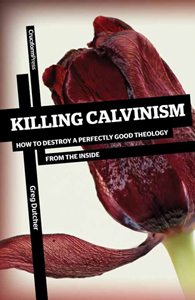
Tolle Lege: Killing Calvinism

Readability: 1

Length: 105 pp

Author: Greg Dutcher

Douglas Wilson has written about the YRR (Young, Restless, and Reformed) becoming the OSR (Old, Settled, and Reformed), and how this could be a good thing. Restlessness is not always a virtue. Growing old is not an evil. Old, settled wisdom will trump young, restless zeal any day. Give me Gandalf over Pippin. Restlessness is a virtue when folly rules, otherwise is it is the folly.

I rejoice in the recovery of reformed theology by my peers, but many of us, self included, do need to grow up, and settle down. Many wise men have called for young Calvinists to be locked up for the first years after they believe the doctrines of grace. Greg Dutcher calls them cage stage Calvinists. They are ready to fight, and with purpose, but so were Simeon and Levi. Zeal without wisdom is dangerous. It can be as dangerous as the untruth that opposes the doctrines we love. If Satan can’t get you to preach a lie, he will be content if you preach the truth in a hellish way.

Greg Dutcher has done all the YRR a favor in Kiling Calvinism. I believe it will be an ent-draught to many a zealous Pippin who took the palantír, growing them up into the Peregrin Took who cleansed the shire of orc-men.

(If you don’t understand any of this YRR talk, good for you. If I lost you with all of the LOTR (Lord of the Rings) references, shame on you!)

Windshields are one of those technological wonders we have all gotten used to. In fact, they work best when you don’t notice them, when they are invisible so that all you can see is what they reveal.

I am concerned that many Calvinists today do little more than celebrate how wonderfully clear their theological windshield is. But like a windshield, Reformed theology is not an end in itself. It is simply a window to the awe-inspiring universe of God’s truth, filled with glory, beauty, and grace. Do we need something like a metaphorical windshield of clear, biblical truth to look through as we hope to marvel at God’s glory? Absolutely. But we must make sure that we know the difference between staring at a windshield and staring through one.

While all true disciples are theologians, not all theologians are true disciples. If knowing the Bible and understanding theology were reliable measures of discipleship, Satan would be the greatest disciple ever. After all, his knowledge of Scripture is exceptional and he’s been observing the spiritual realm for quite a long time.

WTS Books: $8.99               Amazon:$9.99

Tolle Lege: Practicing Affirmation

Readability: 1

Length: 160 pp

Author: Sam Crabtree

Why read a book on affirmation? Does man really need to be praised? You might think that you have some strong theological reasons for not praising others more. You may reason that it is more loving to show someone Christ’s glory than their own. That showing a person their depravity and Christ’s glory and salvation are the kinder act. But are praising people and praising God at odds?

Why should you want to affirm people? Because you want to praise God! Total depravity does not mean we never affirm a person, rather it means we always know to whom all glory is due whenever any human does anything good, true, or beautiful.

Affirmation should be worship, or we shouldn’t do it. God alone is due all the glory, and this does not mean the neglect of affirmation, but laboring at it. Here is a book that directs affirmation towards its proper end. It does not entreat you to labor at affirmation with man or manipulation as a goal, but with the glory of God as a goal. For this reason I affirm this book. It is Christ-glorifying. I thank God for Sam Crabtree and Practicing Affirmation, because God is due the glory.

When our mouths are empty of praise for others, it is probably because our hearts are full of love for self.

Good affirmations are God-centered, pointing to the image of God in a person. The only commendable attributes in people were given to them. Everything is from God, through God, and to God so that in all things—including the commendable qualities in people—he might get the glory: “‘Who has given a gift to him that he might be repaid?’ For from him and through him and to him are all things. To him be glory forever. Amen” (Rom. 11:35–36).

[Paul] didn’t thank people for things; he thanks God for people.

We help people be shallow when we focus our compliments on their braiding of hair, wearing of gold, putting on of clothes, sequins, piercings, and tattoos (see 1 Peter 3:3-4).

Be careful what you affirm. You may get more of it. Just as there are superior ways of correcting, there are superior ways of affirming.

If we affirm trendy clothing, we may get more shallow trendiness.

If we affirm accessories, we may get an emphasis on accessorizing.

If we affirm only winning, we may get an increase in unscrupulous win-at-any-cost attitudes and behaviors.

If we affirm things like Scripture memory and serving others less than we affirm dance lessons or soccer performance, we may discover a corresponding set of values and priorities developed in the life of the affirmed.

WTS Books: $10.04               Amazon:$10.19

Tolle Lege: The Hole in Our Holiness

Readability: 1

Length: 146 pp

Author: Kevin DeYoung

The free grace of Jesus frees us. Fruitless salvation makes as much sense as cold lava. It is a legit fear that in the midst of recovering the gospel against legalism we may fall into antinomianism. We must not forget that the law is good and that holiness is necessary. Our consciences are numb and desensitized. Kevin DeYoung gives sensitizing Biblical truth in The Hole in Our Holiness. Why read this book? Because it will encourage you with God’s Word to pursue holiness. If that does not persuade you, I leave you with the words of John Owen, “Be killing sin or it will be killing you.”

The hole in our holiness is that we don’t really care much about it. The hole in our holiness is that we don’t really care much about it. Passionate exhortation to pursue gospel-driven holiness is barely heard in most of our churches. It’s not that we don’t talk about sin or encourage decent behavior. Too many sermons are basically self-help seminars on becoming a better you. That’s moralism, and it’s not helpful. Any gospel which says only what you must do and never announces what Christ has done is no gospel at all. So I’m not talking about getting beat up every Sunday for watching SportsCenter and driving an SUV. I’m talking about the failure of Christians, especially younger generations and especially those most disdainful of “religion” and “legalism,” to take seriously one of the great aims of our redemption and one of the required evidences for eternal life—our holiness.

J. C. Ryle, a nineteenth-century Bishop of Liverpool, was right: “We must be holy, because this is one grand end and purpose for which Christ came into the world. …Jesus is a complete Saviour. He does not merely take away the guilt of a believer’s sin, he does more—he breaks its power (1 Pet. 1:2; Rom. 8:29; Eph. 1:4; 2 Tim. 1:9; Heb. 12:10).” My fear is that as we rightly celebrate, and in some quarters rediscover, all that Christ has saved us from, we are giving little thought and making little effort concerning all that Christ has saved us to. Shouldn’t those most passionate about the gospel and God’s glory also be those most dedicated to the pursuit of godliness? I worry that there is an enthusiasm gap and no one seems to mind.

WTS Books: $10.79               Amazon:$10.04