Headship Is (1 Timothy 2:8)

When there are problems in the church, start with the men. When there are problems in the church, men are always responsible for them; either because they caused the problem, or failed to address it. If men haven’t caused the problem, they must deal with it. If problems are not dealt with in this way, you intensify your problems. When men have failed in the church and women have stepped in to fill the void, this hasn’t solved any problems, but caused larger ones. When women lead it doesn’t help men be men, and thus, it doesn’t help women either. Women can’t help men to be men when they try to be men.

Men are women’s biggest problem (outside their own sin), but right behind men is feminism. Have feminist and egalitarians championed some righteous causes. Certainly. But this wasn’t because they were feminists. Did Nazi scientists make breakthroughs beneficial for mankind? Certainly. But this wasn’t because they were Nazis. Feminism is problem for women because it amplifies men being a problem for women.

We have so feminized the church that it is as attractive to men as a feather boa. Men failed, women stepped in, and now there aren’t any men, only mothers and boys, mothers who perpetuate the boyhood of boys. The women do while overgrown boys sit on their duff playing video games. Oh, but their video games without x-rated material, supervised by upright mothers! Right.

The reason why a disregard for gender fundamentally fails is because headship is. When Scripture speaks of husbands being heads of their wives, it doesn’t come as a command, but as a statement of fact.

“For the husband is the head of the wife even as Christ is the head of the church, his body, and is himself its Savior (Ephesians 5:23 ESV).”

“But I want you to understand that the head of every man is Christ, the head of a wife is her husband, and the head of Christ is God (1 Corinthians 11:3).”

Headship is stated as an indicative fact, not an imperative command. Irrevocably, men dominate. That is to say they have a headship that affect all that is under them. Douglas Wilson gets at this well,

“Because the husband is the head of the wife, he finds himself in a position of inescapable leadership. He cannot successfully refuse to lead. If he attempts to abdicate in some way, he may, through his rebellion, lead poorly. But no matter what he does, or where he goes, he does so as the head of his wife. This is how God designed marriage. He has created us as male and female in such a way as to ensure that men will always be dominant in marriage. If the husband is godly, then that dominance will not be harsh; it will be characterized by the same self-sacrificial love demonstrated by our Lord—Dominus—at the cross. If a husband tries to run away from his headship, that abdication will dominate the home. If he catches a plane to the other side of the country, and stays there, he will dominate in and by his absence. How many children have grown up in a home dominated by the empty chair at the table? If the marriage is one in which the wife ‘wears the pants,’ the wimpiness of the husband is the most obvious thing about the marriage, creating a miserable marriage and home. His abdication dominates.”

In conclusion, let me say a few words to ward off any naysayers and gender benders. First, if you erase male/female distinctions you open the door wide to homosexuality and transgender endorsement. Second, if you have a problem with submission, you have a problem with the godhead as seen in 1 Corinthians 11:3. Third, just as in the godhead, having different roles in which one submits to the other does not mean that men and women are not equal in value, dignity, and worth any more that the Son is less God or less worthy of worship than the Father. Finally, I leave you with Chesterton’s short poem, “Comparisons.”

If I set the sun beside the moon,
And if I set the land beside the sea,
And if I set the town beside the country,
And if I set the man beside the woman,
I suppose some fool would talk about one being better.

The Dogmatician: The Essential, Foundational Trinity

The confession of the Trinity is the heartbeat of the Christian Religion. …

The doctrine of the Trinity makes God known to us as the truly living God, over against the cold abstractions of Deism and the confusions of pantheism. A doctrine of creation—God related to but not identified with the cosmos—can only be maintained on a trinitarian basis. In fact, the entire Christian belief system stands or falls with the confession of God’s Trinity. It is the core of the Christian faith, the root of all its dogmas, the basic content of the new covenant. The development of trinitarian dogma was never primarily a metaphysical question but a religious one. It is in the doctrine of the Trinity that we feel the heartbeat of God’s entire revelation for the redemption of humanity. We are baptized in the name of the triune God, and in that name we find rest for our soul and peace for our conscience. Our God is above us, before us, and within us. —Herman Bavinck, Reformed Dogmatics

The Dogmatician: The Blessed God

Now, when ascribed to God blessedness has three components. In the first place it expresses that God is absolute perfection, for blessedness is the mark of every being that is, and to that extent it is complete; in other words, blessedness is the mark of every being that lives and in living is not hampered or disturbed by anything from within or without. Now, because God is absolute perfection, the sum total of all virtues, the supreme being, the supreme good, the supreme truth (etc.); in other words, because God is absolute life, the fountainhead of all life, he is also the absolutely blessed God. In Scripture ‘life’ and ‘blessedness’ are very closely related: life without blessedness is not worthy of the name, and in the case of God’s children eternal life coincides with blessedness. Second, implied in the words “the blessed God” is that God knows and delights in his absolute perfection. …God absolutely delights in himself, absolutely rests in himself, and is absolutely self-sufficient. …God’s delight in his creatures is part and parcel os his delight in himself. —Herman Bavinck, Reformed Dogmatics

Theology Is as Practical as the Prayers on Your Lips (1 Timothy 2:4–6)

In 1 Timothy 2 Paul urges Timothy to urge prayer. In doing so Paul not only tells Timothy what to do, he shows him how. Paul wants the Ephesian church to say all kinds of prayers for all kinds of people (2:1). Paul says that such prayer pleases God (2:3), and then goes on to describe God and what he has done (2:4ff). Paul’s solution to the prayer problem was theology. This is natural, for the prayer problem was caused by bad theology. Paul tells Timothy, “First of all, then.” The “then,” relates this admonition to the “certain persons,” like “Hymenaeus and Alexander,” who were teaching “different doctrine.” Theology is as practical as the prayers in your mouth.

If you are prayerless, or if your prayers are small and selfish the wrong place to start is with disciplines regarding the time, posture, and method of prayer. The proper place to begin is disciplines regarding Bible study, Bible reading, Bible memorization, and Bible meditation. The professional interviewer who spends all of his time practicing in the mirror concerning his posture, using the right intonations and emphasis in his speech, and making sure that the time and setting of the interview are perfect, rather than studying the interviewee, will be a poor interviewer. Likewise, the Christian who spends all their time thinking about posture, time, and method will pray small, selfish prayers because all their focus is on themselves. Get to know God, and you’ll pray. You’ll know the right kind of questions to ask. You’ll grow in prayer. Your prayer life can only be as big and deep as your theology.

The Dogmatician: “Further Up and Further In” or “Beyond Aseity to Independence” or “There’s Always a Bigger Fish: When One Attribute Swallows Another”

While aseity expresses God’s self-sufficiency in his existence, independence has a broader sense and implies that God is independent in everything: in his existence, in his perfections, in his decrees, and in his works. —Herman Bavinck, Reformed Dogmatics

House Rule Number One: Pray (1 Timothy 2:1–3)

First of all—pray. Paul begins a list of house rules with prayer (1 Timothy 3:14–15). But this isn’t merely serial list so that number one could have easily been number two. Prayer is a priority. House rule number one is emphatically this: the family must pray to the Father. Paul says, first of all “then.” The calling for Prayer is related to the good warfare mentioned previously. In the very heat of this battle against false teachers, Paul says, first of all, pray.

When you move from the church to the temple there is continuity and discontinuity. Some things go, some things remain, but everything is changed because of Jesus. I’m afraid the American church has kept the bad and failed to carry over the good. We’ve carried over what was never meant to have a place among the people of God. When Jesus cleansed the temple He said, “It is written, ‘My house shall be called a house of prayer,’ but you make it a den of robbers.” We have carried over the commercialization of the temple and not its supplications. The church today majors on entertainment, not intercessions; on production, not prayer. D.A. Carson captures the sin adequately,

We have become so performance-oriented that it is hard to see how compromised we are. Consider one small example. In many of our churches, prayers in morning services now function, in large measure, as the time to change the set in the sanctuary. The people of the congregation bow their heads and close their eyes, and when they look up a minute later, why, the singers are in place, or the drama group is ready to perform. It is all so smooth. It is also profane.

I don’t think God is impressed with the show. Our acting betrays a boredom with God’s drama of redemption. Our productions indicate a faith in our works instead of God’s. We must pray when there is false teaching, but what evangelicals now also know is that we must pray lest false teaching.

Tolle Lege: What’s Best Next

What's Best NextReadability: 1

Length: 325 pp

Author: Matt Perman

What’s Best Next is by far the best book on productivity I’ve read, and this isn’t because it has some clumsy obligatory gospel focus. The gospel, rightly understood and well applied, makes all things better. Matt Perman demonstrates this in the area of productivity. When a man dies and is resurrected he is resurrected a better man. Perman baptizes productivity, and he isn’t “Presbyterian”. This isn’t productivity sprinkled with some Christianity. It is dunked, drowned and resurrected.

The only way to be productive is to realize you don’t have to be.

Productive things, then, are things that do good. Productivity always has to be understood in relation to a goal, and God’s goal is that we do good works. Hence, we can redefine productivity this way: to be productive is to be fruitful in good works.

But the Bible has a very different view of good works. According to the Scriptures, good works are not simply the rare, special, extraordinary, or super spiritual things we do. Rather, they are anything we do in faith.

Good character is not an excuse for not knowing what you are doing. Trustworthiness is based not on character alone, but on character and competence.

[The core principle of productivity] Here it is: know what’s most important and put it first.

WTS Books: $13.99               Amazon: $15.92

The Dogmatician: God the Archetype

In reality God, not the creature, is primary. He is the archetype [the original]; the creature is the ectype [the likeness]. In him everything is original, absolute, and perfect; in creatures everything is derived, relative, and limited. God, therefore, is not really named after things present in creatures, but creatures are named after that which exist in an absolute sense in God. —Herman Bavinck, Reformed Dogmatics

The Backroads to Heresy (1 Timothy 1:18–20)

“…wage the good warfare, holding faith and a good conscience. By rejecting this, some have made shipwreck of their faith…” 1 Timothy 1:18b-19

Paul gives two combats tips concerning waging the good warfare; a weapon for each hand. You fight the good fight of the faith by holding faith, and holding a good conscience. The first tip makes perfect sense, as much as the drill sergeant yelling, “You kill the enemy by shooting him!” But the second tip sounds like, “You kill the enemy with good hygiene.” Huh? Yet, it’s as simple as this, when trench foot impairs, disables, or kills you, it hurts the campaign. Shoot the wolves, and stay healthy—that’s how we win.

“This,” in v. 19 is singular. It is by rejecting a good conscience particularly that some have made shipwreck of the faith. Holding a good conscience is waging the good warfare. We must contend for the faith lest we be a heretic.

There are two routes to heresy, the interstate and the backroads. The interstate is clearly marked with big green signs that read, “PELAGIANISM—NEXT RIGHT,” or “MODALISM—THREE MILES.” You know where you’re going and you mean to go there. Then there are the backroads of immorality. You were on the well-lit heavenly highway but you messed up. You pulled off the road because you wanted some darkness. Now your lost and scared, but you like this darkness, so you delude yourself. You redraw the map. You convince yourself that if you just keep this direction, you’ll still get to the heavenly city.

John Calvin wrote, “All the errors that have existed in the Christian Church from the beginning, proceeded from this source, that in some persons, ambition, and in others, covetousness, extinguished the true fear of God. A bad conscience is, therefore, the mother of all heresies.” Really? But listen to how well Calvin’s assessment jibes with Scripture.

“If anyone teaches a different doctrine and does not agree with the sound words of our Lord Jesus Christ and the teaching that accords with godliness, he is puffed up with conceit [Do you hear ambition?] and understands nothing. He has an unhealthy craving for controversy and for quarrels about words, which produce envy, dissension, slander, evil suspicions, and constant friction among people who are depraved in mind and deprived of the truth, imagining that godliness is a means of gain [See covetousness?].” —1 Timothy 6:3–6

Still not convinced?

“But false prophets also arose among the people, just as there will be false teachers among you, who will secretly bring in destructive heresies, even denying the Master who bought them, bringing upon themselves swift destruction. And many will follow their sensuality, and because of them the way of truth will be blasphemed. And in their greed they will exploit you with false words. Their condemnation from long ago is not idle, and their destruction is not asleep.”

Just as sound belief and sound behavior go together, so do heresy and immorality (1 Timothy 1:5–6, 10; 6:3). And the relation is mutual. Heresy not only leads to immorality. Immorality leads to heresy.

“Doctrinal purity must be accompanied by purity of life. There is an inseparable link between truth and morality, between right belief and right behavior. Consequently, theological error has its roots in moral rather than intellectual soil (cf. Matt. 7:15-20). People often teach wrong doctrine to accommodate their sin. That truth is borne out by the immorality that so often characterizes false teachers.” —John MacArthur

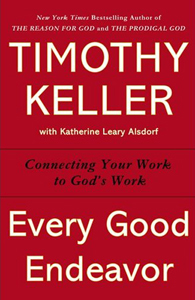
Tolle Lege: Every Good Endeavor

Readability: 2

Every Good EndeavorLength: 253 pp

Author: Tim Keller

Because of sin, work is hard. Because of God, work is good. Because of God’s work, sin is being undone. God worked. We’re supposed to. It’s a way we image Him. Because God in flesh worked like none of us ever have, because he sweat drops of blood and bore the heaviest of burdens, we can again worship God in our work. Tim Keller’s Every Good Endeavor looks at work as it was meant to be, as it is because of sin, and how the gospel changes things. If you work, you should read this book. If you don’t work, you should work, and this book will help you to do so in a God glorifying way.

Work is our design and our dignity; it also a way to serve God through creativity, particularly in the creation of culture.

Work has dignity because it is something that God does and because we do it in God’s place, as his representatives. We learn not only that work has dignity in itself, but also that all kinds of work have dignity. God’s own work in Genesis 1 and 2 is “manual” labor, as he shapes us out of the dust of the earth, deliberately putting a spirit in a physical body, and as he plants a garden (Genesis 2:8). It is hard for us today to realize how revolutionary this idea has been in the history of human thinking. Minister and author Phillip Jensen puts it this way: ‘If God came into the world, what would he be like? For the ancient Greeks, he might have been a philosopher-king. The ancient Romans might have looked for a just and noble statesman. But how does the God of the Hebrews come into the world? As a carpenter.’

The applications of this dictum—that competent work is a form of love—are many. Those who grasp this understanding of work will still desire to succeed but will not be nearly as driven to overwork or made as despondent by poor results. If it is true, then if you have to choose between work that benefits more people and work that pays you more, you should seriously consider the job that pays less and helps more particularly if you can be great at it. It means that all jobs—not merely so-called helping professions—are fundamentally ways of loving your neighbor. Christians do not have to do direct ministry or nonprofit charitable work in order to love others through their jobs.

WTS Books: $16.84               Amazon: $15.52