[T]he doctrine of the Trinity is of incalculable importance for the Christian religion. The entire Christian belief system, all of special revelation, stands or falls with the confession of God’s Trinity. It is the core of the Christian faith, the root of all its dogmas, the basic content of the new covenant. …The profoundest question implicit in every Christian creed and system of theology is how God can be both one and yet three. Christian truth in all its parts comes into its own to a lesser or greater extent depending on how that question is answered. In the doctrine of the Trinity we feel the heartbeat of God’s entire revelation for the redemption of humanity. Though foreshadowed in the Old Testament, it only comes to light fully in Christ. Religion can be satisfied with nothing less than God himself. Now in Christ God himself comes out to us, and in the Holy Spirit he communicates himself to us. The work of re-creation is trinitarian through and through. From God, through God, and in God are all things. Re-creation is one divine work from beginning to end, yet it can be described in terms of three agents: it is fully accomplished by the love of the Father, the grace of the Son, and the communion of the Holy Spirit. A Christian’s faith life, accordingly, points back to three generative principles. “We know all these things,” says article 9 of the Belgic Confession, from the testimonies of holy Scripture, as well as from the operations of the persons, especially from those we feel within ourselves.” We know ourselves to be children of the Father, redeemed by the Son, and in communion with both through the Holy Spirit. Every blessing, both spiritual and material, comes to us from the triune God. In that name we are baptized; that name sums up our confession; that name is the source of all the blessings that come down to us; to that name we will forever bring thanksgiving and honor; in that name we find rest for our souls and peace for our conscience. Christians have a God above them, before them, and within them. Our salvation, both in this life and in the life to come, is bound up with the doctrine of the Trinity; yet we grant that we cannot determine the measure of knowledge—also of this mystery—needed for a true and sincere faith. —Herman Bavinck, Reformed Dogmatics
Author: Josh King
The Dogmatician: The Wonders of the Trinity
Only by the Trinity do we begin to understand that God as he is in himself—hence also, apart from the world—is the independent, eternal, omniscient, and all-benevolent One, love, holiness, and glory. —Herman Bavinck, Reformed Dogmatics
The Dogmatician: The Deity of the Holy Spirit
The choice is clear: either the Holy Spirit is a creature—whether a power, gift, or person—or he is truly God. If he is a creature he cannot in fact and in truth communicate to us the Father and the Son with all their benefits; he cannot be the principle of the new life either in the individual Christian or in the church as a whole. In that case, there is no genuine communion between God and humans; God remains above and outside of us and does not dwell in humanity as in his temple. But the Holy Spirit is not, nor can he be, a creature. For he is related to the Son as the latter is to the Father and imparts to us both the Son and the Father. He is as closely bound up with the Son as the Son is with the Father. He is coinherent in the Son as the Son is coinherent in him. In substance he is the same as the Son. He is the Spirit of wisdom and truth, of power and of glory; the Spirit by whom Christ sanctifies the church and in whom he communicates himself and all his benefits: the divine nature, the adoption as children, the mystical union. He who gives us God himself must himself be truly God. —Herman Bavinck, Reformed Dogmatics
Awful Deacons (1 Timothy 3:8–13)
Ever try to define a word, a word you thought you knew really well, a word you use all the time, only to find yourself dumbstruck? This can be because you know the meaning so well. For instance, try to define “it.” You may stutter, but your usage likely indicates that you undertand “it” perfectly well. I’m afraid that this isn’t the case with the word “deacon.” The word is part of our churchy parlance, but, as Inigo told Vizzini, “You keep using that word. I do not think it means what yo think it means.” When a definition is readily offered most often the description better fits an elder. “Whereas the office of overseer is often ignored in the modern church,” writes Benjamin Merkle, “the office of deacon is often misunderstood.”
Why are we so confused? “How Sweet and Aweful is the Place,” may be my favorite hymn. It would be a mistake to understand the meaning of that title according to today’s usage of “aweful.” The word meant awesome, which is yet another word lying on its death bed. “Deacon” suffers a similar malady. We read our modern traditional idea of deacon back into the Bible, instead of reading the Biblical idea into our churches.
“Deacon,” in reference to the office, only occurs three times in the New Testament (there is a fourth instance that I believe should also be translated deacon, but that would require another, and much longer post). It occurs twice in 1 Timothy 3, and if you’re hoping for the their instance to be more illuminating, I’m afraid you’ll be disappointed. “Paul and Timothy, servants of Christ Jesus, To all the saints in Christ Jesus who are at Philippi, with the overseers and deacons (Philippians 1:1 ESV).” After you survey every explicit mention of deacons in the New Testament you are left with the predicament of knowing that deacons should be, but not what they should do.
But, though the word in reference to the office is only used three times, the noun is used another twenty-nine times in a general sense, most often translated “servant.” For instance, Jesus is said to be a deacon in Romans 15:8. Further, the verb form is used thirty-seven times. Jesus is said to deacon, that is, to serve us in Matthew 20:28. The word originally refers to one who waits tables, and with that our ears perk up when we read Acts 6 in regards to the problem of hellenistic jewish women being neglected in the early church. “And the twelve summoned the full number of the disciples and said, “It is not right that we should give up preaching the word of God to serve [deacon] tables (Acts 6:2 ESV).” The seven chosen to serve the church are never called deacons, but it is what they do, and I believe that the division between the twelve who minister in word and prayer, and the seven who minister to the physical needs of the body, is the same division we see in regards to overseers and deacons.
So what is the distinction between the two offices? What are their respective tasks? Overseers oversee, and deacons deacon. Or, in an attempt to be more clear, yet, at risk of being misunderstood, we could say overseers oversee souls, whereas deacons deacon bodies. The only thing I mean by that language is that overseers look after the souls of their flock, whereas deacons serve the physical needs of the flock. The church needs both offices, and not some conflagration or hybrid of the two. She needs multiple elders, and multiple deacons, and when she has them, the church is a wholesome family, well ordered, well behaved (1 Timothy 3:16, Titus 1:5).
The Dogmatician: Father
This name of ‘Father,’ accordingly, is not a metaphor derived from the earth and attributed to God. Exactly the opposite is true: fatherhood on earth is but a distant and vague reflection of the fatherhood of God (Eph. 3:14-15). God is Father in the true and complete sense of the term. Among humans a father is also someone else’s son, and a son in turn becomes a father. Here, too, a father cannot bring forth a son by himself; fatherhood is temporary and accidental, not essentially bound up with being human. It starts relatively late in life; it also ends rather soon, in any case at death. But in God all this is different. He is solely, purely, and totally Father. He is Father alone; he is Father by nature and Father eternally, without beginning or end. For that reason also generation has to be eternal, for if the Son were not eternal, the Father could not be eternal either. The eternity of the Father carries with it the eternity of the Son. Addressing God as Father, one by implication also addresses the Son. —Herman Bavinck, Reformed Dogmatics
Knowing What You Should Know (1 Timothy 3:1-7)
Questions beget questions. 1 Timothy 3:1–7 gives us the qualifications for what the KJV terms “bishops.” What is a bishop? Modern translations help in well communicating the original meaning with the word “overseer.” What is an overseer? When was the last time you heard it clearly communicated who the overseers were in your church? When Paul lists the qualifications for elders in Titus he goes on to call them overseers. Overseers are elders. Does that help? What is an elder? An elder is a pastor. Overseer, elder, pastor—all are the same office.
Diabolically perhaps, many churches uses the least common terms in the Bible, and have abandoned the most common. As a result, the Scriptures sound foreign to us. There should be a ready, one-to-one correspondence when we read about overseers and elders such that we exclaim, “I know (experientially) that,” or “I should know that!” What should be domestic, is alien, and we are like sheep without a shepherd for it. Pastor (shepherd) is only used one time as a noun in Scripture to indicate this office (Ephesians 4:11), and even then, it isn’t a proper title but a metaphor. Elder and overseer, those are the titles (by the way, “minister” and “preacher” don’t officially count either). Shepherding is the chief metaphor, teaching, the essential job skill. That this is so is seen in the following passages (all emphasis are mine):
“Now from Miletus he [Paul] sent to Ephesus and called the elders of the church to come to him. …he said to them…‘Pay careful attention to yourselves and to all the flock [this be shepherding language], in which the Holy Spirit has made you overseers, to care for the church of God, which he obtained with his own blood (Acts 20:17–18, 28 ESV).’”
“So I exhort the elders among you, as a fellow elder and a witness of the sufferings of Christ, as well as a partaker in the glory that is going to be revealed: shepherd the flock of God that is among you, exercising oversight, not under compulsion, but willingly, as God would have you; not for shameful gain, but eagerly (1 Peter 1:5–7 ESV).”
Two things seem especially pertinent: 1. There are multiple elders in a singular church, 2. Overseers oversee souls.
The task of shepherding the flock isn’t to be done alone. Without exception, the pattern in the New Testament is that churches are to be shepherded by a plurality of elders. This was true of the church at Jerusalem (Acts 15:22), Ephesus (Acts 20:17), Philippi (Philippians 1:1) the churches in the towns of Crete (Titus 1:5), the churches that Peter wrote to (1 Peter 5:1), the churches that Paul planted (Acts 14:23), the churches that James wrote to (James 5:14). Shepherds are to look after their own souls as well as the flock’s. Shepherds need other shepherds to help look after the flock, but also to look after them. They need other overseers to oversee their souls for the sake of the flock’s souls.
Overseers oversee. They do not oversee the church as though she were an organization, a company, a business, a non-profit, a trust, or a charity. They oversee souls. Why did the early church esteem the office of overseer so that a “trustworthy saying” spread through the churches calling it a “noble task” (1 Timothy 3:1)? Why are they not esteemed so today? Because too many look at their leaders as professional managers, visionary CEOs, program developers, entertainers, charismatic personalities and dynamic communicators, whereas the early church knew their elders the way a sheep knows its shepherd. They knew their overseers’ feeding, leading, guarding, and knowing of their souls.
When you know this truth, you then read through the Scriptures and either know that you know (again experientially) this, or know that you should know this shepherding of your souls. And that leads to this final wowzer of a thought: as a regenerate church member, there is no bigger decision you make in the church, than who the elders of that church are, or, as a Christian, the biggest factor to consider when joining a church is who the elders are that you will entrust your soul to.
The Dogmatician: Trinity means Unity and Diversity
“The glory of the confession of the Trinity consists above all in the fact that that unity, however absolute, does not exclude but includes diversity. God’s being is not an abstract unity or concept, but a fullness of being, an infinite abundance of life, whose diversity, so far from diminishing the unity, unfolds it to its fullest extent.” —Herman Bavinck, Reformed Dogmatics
Fertile Femininity and the Impotent Feminist (1 Timothy 2:9–15)
Femininity is under attack and there is too little masculinity to protect it. Feminists are the ones who are actually anti-women, desiring to erase that which is particularly and gloriously feminine in women by trying to make them men. Part of the genius of their ploy is neutering men so as to eliminate any resistance. “Make the men women and we can make the women men.” It is serpentine—both crafty and destructive. “Now the serpent was more crafty than any other beast of the field that the LORD God had made. He said to the woman… .”
Gender, sexuality, manhood, and womanhood are where the battle lines are drawn for our times. Bruce Ware captures this well,
Today… the primary areas in which Christianity is pressured to conform are on issues of gender and sexuality. Postmoderns and ethical relativists care little about doctrinal truth claims; these seem to them innocuous, archaic, and irrelevant to life. What they do care about, and care with a vengeance, is whether their feminist agenda and sexual perversions are tolerated, endorsed and expanded in an increasingly neo-pagan landscape. Because this is what they care most about, it is precisely here that Christianity is most vulnerable. To lose the battle here is to subject the Church to increasing layers of departure from biblical faith. And surely, it will not be long until ethical departures (the Church yielding to feminist pressures for women’s ordination, for example) will yield even more central doctrinal departures (questioning whether Scripture’s inherent patriarchy renders it fundamentally untrustworthy, for example). I find it instructive that when Paul warns about departures from the faith in the latter days, he lists ethical compromises and the searing of the conscience as the prelude to a full-scale doctrinal apostasy (1 Tim 4:1-5).
This means that when we come to a text like 1 Timothy 2:9–15 we mustn’t cringe in embarrassment; we must glory and rejoice. We must remember that the joy of the Lord is our strength, and, that a glorying in Biblical manhood and womanhood is a rejoicing in the Lord. This joy isn’t one that we must fain or force. Femininity is a glorious, beautiful, graceful, and strong thing, and when a woman embraces it, she outshines the world’s perversions the way the sun outshines a lightning bug.
Imagine coming up to a group of builders using hammers to drive screws and screwdrivers to drive nails. “No. You’ve got it backwards. That isn’t using them according to design.” The foolish builders say that design, function, purpose, and roles are relative and to be determined by self. Using a hammer for a screwdriver opens the door to using a wrecking ball for a hammer, and then it won’t be long before the house comes crashing down. When men are men, and women are women, it is then that they are most glorious because it is then that they are most godlike, functioning according to design, imaging forth the Designer.
Femininity is a powerful and glorious thing; something in which women are far superior to men. In a unique way that men are not able to, Christian women get to model for all humanity the grace, beauty, and glory of the submissive quietness of Christ’s bride. Submission and obedience don’t kill, they give life. When Adam and Eve rebelled and did what they wanted this house came down, and it came down because Adam didn’t step up and protect Eve’s femininity; he sat in his recliner, did nothing, and ate the food that he let her eat, and that he let her bring to him (Genesis 3:6). Freedom is a fish in water; a man under God. Under authority, man flourishes. When a godly woman is under a godly man under our gracious God, she is a glorious living parable of this truth.
This kind of beauty is attractive and powerful. It makes men want to be men. It will produce men who will bleed for such beauty, and, like our Savior, bleed to beautify it.
Tolle Lege: Evangelism
Readability: 1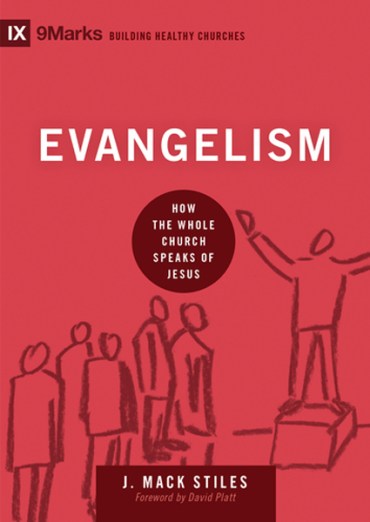
Length: 114 pp
Author: Mack Stiles
Here is an excellent book on evangelism for the whole church, which is the only kind of evangelism that should be. The church is God’s program for evangelism and the gospel is the power of God to salvation. In Evangelism you’ll find simplicity and sanity concerning what has too often, unnecessarily, been complicated and done insanely.
Evangelism is teaching the gospel (the message from God that leads us to salvation) with the aim to persuade. If a church does not understand biblical evangelism, over time that church will be subverted. If we don’t practice healthy evangelism, the dominoes start to fall:
- The focus of preaching and teaching turns to living a moral life, not a gospel-centered life.
- Non-Christians are lulled into thinking that they are okay in their lost state.
- Christians think that non-Christians are believers because they made a superficial outward commitment.
- The church baptizes those who are not believers.
- The church allows non-Christians into membership.
- Eventually, non-Christians become leaders in the church.
- A church becomes a subculture of nominalism.
Unbiblical evangelism is a method of assisted suicide for a church, so there is much at stake in getting evangelism right.
WTS Books: $11.16 Amazon: $11.73
The Dogmatician: How Unbiblical Terms Help You Be Scriptural
Furthermore, reflection on the truth of Scripture and the theological activity related to it is in no way possible without the use of extrabiblical terminology. Not only are such extrabiblical terms and expressions used in the doctrine of the Trinity but also in connection with every other dogma and throughout the entire discipline of theology. Involved in the use of these terms, therefore, is the Christian’s right of independent reflection and theology’s right to exist. Finally, the use of these terms is not designed to make possible the introduction of new—extrabiblical or anti biblical dogmas, but, on the contrary, to defend the truth of Scripture against all heresy. Their function is much more negative than positive. They mark the boundary lines within which Christian thought must proceed in order to preserve the truth of revelation. Under the guise of being scriptural, biblical theology has always strayed farther away from Scripture, while ecclesiastical orthodoxy, with its extrabiblical terminology, has been consistently vindicated as scriptural. —Herman Bavinck, Reformed Dogmatics
 No Other Boast