Blessings Fall Like Rain, not Missiles

May God be gracious to us and bless us
and make his face to shine upon us, Selah 
that your way may be known on earth,
your saving power among all nations.
—Psalm 67:1-2 (ESV)

Blessings fall like rain, not missiles. The immediate power of a missile may be more impressive, but the rains’ power is the more impactful. The missile hits, and its power is soon exhausted. The rain falls, and its life-giving impact continues on for ages. Because of the rain, a fruit seed germinates, a man is later nourished by that seed, that man then works to provide for his family, his nurtured son finds a cure for some disease, many are then healed. Blessings fall like rain. Blessings are not a zero sum game. When someone else is blessed that does not mean you’re not. When God blesses the farmer, others eat, and even more benefit from those others eating. When God blesses one man on this earth He blesses them all. When God blesses Abraham, He blesses the world. Not all know God’s saving grace, but all men know varying degrees of common grace on this earth because of God’s saving grace. When God blesses His people, they are the light and salt of this earth; the earth benefits from their being blessed.

We’re saved to the praise of God’s glorious grace. Grace need not fall directly on us for us to rejoice in it or benefit from it. Grace is often like fireworks. It’s when it goes off over there, that you can most behold its glory. Our joy should be in the magnifying of God’s grace, so that wherever it falls we rejoice, “Look, more amazing grace! There, there, and there too.” When God’s grace falls on others, do not be jealous for self, but zealous for God.

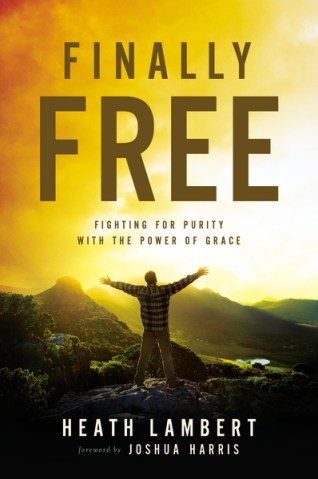
Tolle Lege: Finally Free

Finally FreeReadability: 1

Length: 159 pp

Author: Heath Lambert

A porndemic is upon us, Christians not excluded. Inoculation is possible, even for the infected. In such deadly times I am deeply thankful for Heath Lamber’s Finally Free. I say with many others that this is best book I know of to help those battling pornography.

This book is not about pornography. You can find countless books about pornography.

…The goals of these other books are noble. There is a time and place to talk about all of these issues. But this book has a different purpose. For the past decade, I have spent thou- sands of hours talking with hundreds of people who struggle with pornography. I have never met anyone who experienced profound change because someone told them how many billions of dollars are spent on pornography every year. I have never met anyone whose life was radically changed by hearing (again) how damaging the pornography industry is and how they desperately need to think differently about it. Rather, every person I have ever talked to who sincerely wanted help already knew most of this information. People who are trapped in the deceitful web of pornography do not need more information about pornography.

This book is about something much better than pornography. This book is about the amazing power of Jesus Christ to free you from pornography.

In this book, I want to share with you the amazing depth and effect of Christ’s power to eradicate pornography from your life. Whether you struggle with pornography yourself or are trying to help someone who struggles, I have good news for you: no matter how intense or long-standing the struggle, it is the work of Jesus Christ to set people free from such sin.

WTS Books: $11.39               Amazon:$12.33

The Dogmatician: The Source of Truth

The assertion that the religious and moral human being is autonomous is always linked with either deism or pantheism. Deism makes human beings independent of God and the world, teaches the all-sufficiency of reason, and leads to rationalism. Pantheism, on the other hand, teaches that God discloses himself and comes to self-consciousness in human beings and fosters mysticism. Both destroy objective truth, leave reason and feeling, the intellect and the heart, to themselves, and end up in unbelief or superstition. Reason criticizes all revelation to death, and feeling gives the Roman Catholic as much right to picture Mary as the sinless Queen of Heaven as the Protestant to oppose this belief. It is therefore noteworthy that Holy Scripture never refers human beings to themselves as the epistemic source and standard of religious truth. How indeed, could it, since it describes the ‘natural’ man as totally darkened and corrupted by sin in his intellect (Ps. 14:3; Rom. 1:21-23; Rom. 8:7; 1 Cor. 1:23; 2:14; Eph. 4:23; Gal. 1:6,7; 1 Tim. 6:5; 2 Tim. 3:8); in his heart (Gen. 6:5; 8:21; Jer. 17:9; Ezek. 36:26; Mark 7:21); in his will (John 8:34; Rom. 7:14; 8:7; Eph. 2:3), as well as in his conscience (Jer. 17:9; 1 Cor. 8:7, 10, 12; 10:28; 1 Tim. 4:2; Titus 1:15)? For the knowledge of truth Scripture always refers us to objective revelation, to the word and instruction that proceeded from God (Deut. 4:1; Isa. 8:20; John 5:39; 2 Tim. 3:15; ). And where the objective truth is personally appropriated by us by faith, that faith still is never like a fountain that from itself brings the living water but like a channel that conducts the water to us from another source. —Herman Bavinck, Reformed Dogmatics

Test the Book but It’s Your Heart that’s Proven

You know how it was with Moses, when he saw two men fighting, one an Egyptian, and another an Israelite, he killed the Egyptian; but when he saw two Hebrews fighting, now, saith he, I will go and reconcile them, for they are brethren; why so, but because he was a good man, and gracious? So also it is with a gracious heart; when he sees the Scripture fighting with an Egyptian, and heathen author, or apocryphal, he comes and kills the heathen… the Egyptian, or the apocrypha; but when he sees two Scriptures at variance (in view, though in truth not), Oh, saith he, these are brethren, and they may be reconciled, I will labour all I can to reconcile them; but when a man shall take every advantage of seeming difference in Scripture, to say, Do ye see what contradictions there are in this book, and not labour to reconcile them; what doth this argue, but that the corruption of a man’s nature, is boiled up to an unknown malice against the word of the Lord; take heed therefore of that. —William Bridge from A Quest for Godliness by J.I. Packer

Tolle Lege: Reforming Marriage

Reforming MarriageReadability: 1

Length: 144 pp

Author: Douglas Wilson

There are few authors I enjoy more than Douglas Wilson. There is no subject I enjoy reading Douglas on more than family. Here is a smattering of why that I hope will intrigue.

God is the one who called our first parents by the collective name Adam. Now Adam is also a generic term for man or mankind. This shows clearly the biblical practice of including women under such a description. Our English use of the generic man and mankind follows this biblical example exactly. Far from being insulting to women, as feminists want to maintain, it reflects a biblical pattern of thought. The feminist reaction to this, and their rejection of taking a new last name (in order to keep their father’s name!), is not just a small bit of modern silliness. It is a fundamental rebellion against God. So when our Susan Miller becomes Mrs. Robert Carter it is not just “something we do.” It is covenant security.

[Commenting on Ephesians 5:23 where Paul says, “the husband is the head of the wife.”] Because the husband is the head of the wife, he finds himself in a position of inescapable leadership. He cannot successfully refuse to lead. If he attempts to abdicate in some way, he may, through his rebellion, lead poorly. But no matter what he does, or where he goes, he does so as the head of his wife. This is how God designed marriage. He has created us as male and female in such a way as to ensure that men will always be dominant in marriage. If the husband is godly, then that dominance will not be harsh; it will be characterized by the same self-sacrificial love demonstrated by our Lord—Dominus—at the cross. If a husband tries to run away from his headship, that abdication will dominate the home. If he catches a plane to the other side of the country, and stays there, he will dominate in and by his absence. How many children have grown up in a home dominated by the empty chair at the table? If the marriage is one in which the wife ‘wears the pants,’ the wimpiness of the husband is the most obvious thing about the marriage, creating a miserable marriage and home. His abdication dominates.

[A] husband can never stop talking about Christ and church. If he is obedient to God, he is preaching the truth; if he does not love his wife, he is speaking apostasy and lies—but he is always talking.

WTS Books: $12.23               Amazon:$13.50

The Dogmatician: Dogmatics vs. Ethics

Dogmatics describes the deeds of God done for, to, and in human beings; ethics describes what renewed human beings now do on the basis of and in the strength of those divine deeds. In dogmatics human beings are passive; they receive and believe; in ethics they are themselves active agents. In dogmatics, the articles of the faith are treated; in ethics, the precepts of the decalogue. In the former, that which concerns faith is dealt with; in the latter, that which concerns love, obedience, and good works. Dogmatics sets forth what God is and does for human beings and causes them to know God as their Creator, Redeemer, and Sanctifier; ethics sets forth what human beings are and do for God now; how, with everything they are and have, with intellect and will and all their strength, they devote themselves to God out of gratitude and love. Dogmatics is the system of the knowledge of God; ethics is that of the service of God. The two disciplines, far from facing each other as two independent entities, together form a single system; they are related members of a single organism. —Herman Bavinck, Reformed Dogmatics

According to Script (Matthew 26:1-16)

“When Jesus had finished…”

When Jesus finishes speaking of returning in glory, He then says it is time for Him to be humiliated. After speaking of a judgment He will bring, He reminds the disciples that He is off to be judged. Jesus is saying that everything is going according to plan.

Jesus was no sailor adjusting for wind. He is the God of the wind and the sea. The cross isn’t some improvised plan B during an intense field operation. Jesus didn’t just recently have an epiphany with a sudden courageous resolve. The cross wasn’t just en route to the throne, it was the road. And it was the only road. Jesus here is saying, “I’ve got them where I want them.” Imagine a quarterback readying for the Super Bowl turning to his teammates saying, “Well, it’s victory time, so I’m off to their locker room to let them break my arm.” The King turns to His knights saying, “Victory is certain. Here is the plan: I’m going to let the dragon eat me.”

Christ never so effectually bruised Satan’s head, as when Satan bruised his heel. The weapon with which Christ warred against the devil, and obtained a most complete victory and glorious triumph over him, was the cross, the instrument and weapon with which he thought he had overthrown Christ, and brought on him shameful destruction. Col. 2:14,15. ‘Blotting out the handwriting of ordinances,—nailing it to his cross: and having spoiled principalities and powers, he made a show of them openly, triumphing over them in it.’ In his last sufferings, Christ sapped the very foundations of Satan’s kingdom, he conquered his enemies in their own territories, and beat them with their own weapons as David cut off Goliath’s head with his own sword. The devil had, as it were, swallowed up Christ, as the whale did Jonah—but it was deadly poison to him, he gave him a mortal wound in his own bowels. He was soon sick of his morsel, and was forced to do by him as the whale did by Jonah. To this day he is heart-sick of what he then swallowed as his prey. —Jonathan Edwards

Jesus is no improv actor. Everything is going according to Script.

In a good story, the villain’s plotting cannot outdo the author’s plot. All of man’s rebellion can do nothing but accomplish God’s plan. Efforts to rebel against God are more futile than a character in a book trying to rebel against the author. The villain wants to kill the hero, so does the Author, but whereas one means to take life, the other means to unleash it. A good story is being told, the very best one, and no evil can ruin it.

Tolle Lege: The Philosophy of Tolkein

Philosophy of TolkienReadability: 2

Length: 225 pp

Author: Peter Kreeft

There are a lot of The Gospel According to (fill in the blank with latest hip movie) titles out there. Corny seems too cheesy a word to describe my reaction to such titles. Gag reflex. Not interested. Sure, Star Wars has spiritual themes, and there is a worldview behind The Matrix, but I sense that such books labor hard to put something there that isn’t.  Like trying to turn a Slim Jim into a steak. Sure, technically it’s meat, but I’m not paying $14.95 for it. Maybe I’m wrong. Maybe I need to expand my palate, but I’m almost certain most such titles are junk food of the worst kind, something like Crystal Pepsi.

Peter Kreeft’s The Philosophy of Tolkien is nothing like my guesstimation of the aforementioned titles. Here are some reasons why. First, Kreeft is a legit philosopher. I’d venture he reads a lot more books than he watches popular movies. It’s the difference between a hobbit trying to make magic, and a wizard. Second, he is dealing with good material. He has a real fillet in front of him, not a meat snack. Kreeft isn’t dealing with a film, but a book—a big book. Arguably the greatest work of fiction. Kreeft, as the subtitle says, is looking for “The Worldview behind The Lord of the Rings.” We bring our worldview to everything we do. What we do likewise reveals our worldview. With books, fiction especially, worldview can be powerfully and persuasively communicated. The Lord of the Rings was a massive undertaking and therefore communicates Tolkein’s worldview, a good one in my opinion, in a very potent, concentrated way. Further, Kreeft legitimately brings out, rather than puts in. Concerning Tolkein’s trilogy he does exegesis, not eisegesis. An added bonus is that The Philosophy of Tolkein also serves as a good introduction to philosophy. Finally, this steak is seasoned with Kreeft’s clear and enjoyable style. Tolkein is fun to read. This is too.

[I]t is no surprise that in a culture in which philosophers scorn wisdom, moralists scorn morality, preachers are the world’s greatest hypocrites, sociologists are the only people in the world who do not know what a good society is, psychologists have the most mixed-up psyches, professional artists are the only ones in the world who actually hate beauty, and liturgists are to religion what Dr. Von Helsing is to Dracula—it is no surprise that in this culture the literary critics are the last people to know a good book when they see one.

Beauty is the bloom on the rose of goodness and truth, the child conceived by their union; and thus it is not only good, but heavenly.

The weakness of evil is that it cannot conquer weakness. No matter how much power evil has, it is always defeated by the free, loving renunciation of power. It can be defeated in Middle-earth as it was on Calvary: by martyrdom. Scripture’s image of the last battle between good and evil is a battle between two mythical beasts: Arnion, the meek little Lamb, and Therion, the terrible dragon beast. And the Lamb overcomes the Beast by a secret weapon: His own blood.

Evil is limited to power; it cannot use weakness. It is limited to pride; it cannot use humility. It is limited to inflicting suffering and death; it cannot use suffering and death. It is limited to selfishness; it cannot use selflessness. But good can.

It takes selflessness to give birth, whether biologically or artistically. You let yourself be used as a birth canal, or as an instrument of divine inspiration. Evil cannot create, or give birth. For ‘nothing is evil in the beginning’ (LOTR, p. 261). ‘Trolls are only counterfeits, made by the Enemy in the Great Darkness, in mockery of Ents, as Orcs were of Elves’ (LOTR, p. 474) ‘The Shadow that bred them can only mock, it cannot make’ (LOTR, p. 893).

http://rcm-na.amazon-adsystem.com/e/cm?lt1=_blank&bc1=000000&IS2=1&bg1=FFFFFF&fc1=000000&lc1=0000FF&t=glo-20&o=1&p=8&l=as4&m=amazon&f=ifr&ref=ss_til&asins=1586170252
The Dogmatician: Dogma—A Good but Fallible Servant

Accordingly, dogmatics is not itself the Word of God. Dogmatics is never more than a faint image and a weak likeness of the Word of God; it is a fallible human attempt, in one’s own independent way, to think and say after God what he in many and various ways spoke of old by the prophets and in these last days has spoken to us by the Son. —Herman Bavinck, Reformed Dogmatics

“I’m Against Doctrine” is a Doctrine

When you read “dogmatics” with Bavinck think systematic theology. When you see “dogma,” think doctrine, or truth.

[O]ne who clings to the truth of religion cannot do without dogma and will always recognize in it an unchanging and permanent element. A religion without dogma, however vague and general it may be, without say, faith in a divine power, does not exist, and a nondogmatic Christianity, in the strict sense of the word, is an illusion and devoid of meaning. Opposition to dogma is not resistance to dogma as such, for ‘unbelief has at all times been most dogmatic” (Kant), but to certain specific dogmas with which people no longer agree. —Herman Bavinck, Reformed Dogmatics