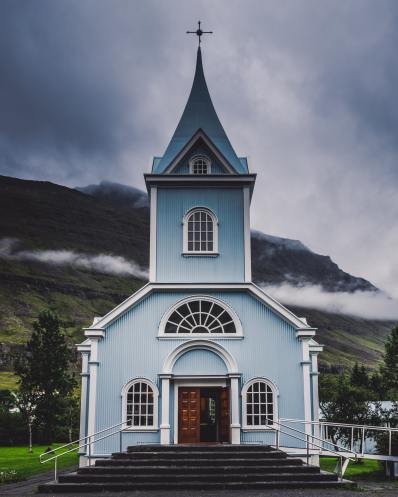
The State of the Church and the State of the State (Jeremiah 23:9–40)


deniz-fuchidzhiev-HNfZAnl3RM4-unsplash

In the prophets of Samaria
I saw an unsavory thing:
they prophesied by Baal
and led my people Israel astray.
But in the prophets of Jerusalem
I have seen a horrible thing:
they commit adultery and walk in lies;
they strengthen the hands of evildoers,
so that no one turns from his evil;
all of them have become like Sodom to me,
and its inhabitants like Gomorrah.

—Jeremiah 23:13–14

In conversations concerning politics and religion, Americans frequently mention a wall of separation between church and state. That idea was intended by Jefferson as a one way street, yet most people today, ignoring the “Wrong Way” signage, are driving the opposite direction. The phrase was meant, not to keep the church from driving to Washington, but to keep Washington from driving a church—a state church on the republic.

Nevertheless, using my liberty to leverage the phrase in yet another manner, let us pray that the church is truly separate from the state in this—in holiness. Let us pray that there is a wall of separation between the sins of the state and the state of the church. Unfortunately, I believe the reason the state is full of lies is because the church is. The world is dark because the world is dark while the light has been hidden. When the world is rotting without pause, it means that which is posing as salt isn’t salty and therefore good for nothing but to be cast out.

In Israel there was to be no separation of church and state; rather, both were to be separate, set apart unto Yahweh. But both the state, that is the kings, and the church, that is the prophets and priests, had become defiled. In chapters 21–23 Jeremiah first denounces the kings and then the prophets. More time is spent on the kings in these chapters, but it’s highly likely more time is spent on the prophets in the book as a whole. Indeed, Jeremiah speaks concerning false prophets more than any other true prophet.

Whereas the main invective against the kings was their oppressing the poor, that of the prophets was their deceiving the people. The former fleeces the sheep, the latter leads them to destruction. John MacKay comments, 

“From the preceding section the impression might readily be gained that the problems facing Jeremiah had to do with the political institutions of Judah and its civil leadership. That unfortunately was true but they were by no means the exclusive source of opposition to him. Both church and state were corrupt in Judah, and in this section he focus is on the religious degeneracy of the land. …it was what they [the prophets] proclaimed in the name of the LORD that set the tone for church and state in Judah, as well as reflecting prevailing sentiment.” 

This section is “concerning the prophets,” but yet is speaks of the wickedness of the land. The implication is that the prophets are to blame. Where prophets are false, the church is false. When the church is false, the state of the state is sure to be one full of lies.

Meridian Church · Jeremiah 23:9–40 || Concerning the Prophets || Josh King


Playing Christianity without the Church (1 Timothy 3:14–16)

This post was originally published on August 11, 2014. It was revised and republished on April 27, 2020.

“I hope to come to you soon, but I am writing these things to you so that, if I delay, you may know how one ought to behave in the household of God, which is the church of the living God, a pillar and buttress of the truth. Great indeed, we confess, is the mystery of godliness:

He was manifested in the flesh,
vindicated by the Spirit,
seen by angels,
proclaimed among the nations,
believed on in the world,
taken up in glory.”

—1 Timothy 3:14–16

cosmic-timetraveler-_R1cc2IHk70-unsplash.jpgThe church needs to behave herself; this is why Paul wrote to Timothy. Sadly, many professing Christians aren’t even in a church in which to misbehave. They are intentionally churchless. Occupying the number nine spot in Amazon’s “ecclesiology” category [when this post originally appeared] is Kelly Bean’s How to be a Christian without Going to Church. That’s as comprehensible as a baseball coach offering a clinic, “How to Hit a Home Run without Using a Bat.” Don’t want to use a ball either? Hakuna Matata, baseball leagues are certain to crop up everywhere, all playing the game according to their own desires.

Consider the case of Stott v. Miller and ask yourself which holds up in God’s court. The defendant, Donald Miller, questions himself, “So, do I attend church?” He answers, “Not often, to be honest. Like I said, it’s not how I learn. But I also believe the church is all around us, not to be confined by a specific tribe.”  Before moving on to the prosecution let me interject that one thing that church can teach Miller, and every other soul, is to get over ourselves. The late John Stott then addresses the audience (there is no jury, only the Judge), “I trust that none of my readers is that grotesque anomaly, an un-churched Christian. The New Testament knows nothing of such a person. For the church lies at the very center of the eternal purpose of God.”* Unfortunately, the “un-churched Christian” isn’t so much of an anomaly now, and it certainly isn’t thought to be the grotesque thing that it is.

Paul has written “these things” so that the Ephesians Christians will know how to behave themselves in church. “These things” include praying together (2:1–8), which assumes gathering as the church. These things include elders (3:1–7), which necessitates teaching. These things include discipline (1:20), which means membership is necessary. If there is an out, there must be an in. Being part of a local church is necessary and normal—apostolically so.

We live in an age when it is popular, for “Christians,” to belittle or disassociate from the church. Admittedly, there is much to criticize, but tone is crucial. Any criticism we have for the church should sound like a loving and godly father imploring a wayward daughter. We would do well not to speak lightly of that which Jesus has purchased with His blood. Yet, many who are speaking so negatively about “the church,” aren’t speaking about the church at all, and they need to realize it. You can sharply and righteously expose “a church” that is posing, precisely because you love the church. Biting wit and satire can say, “I know the church, and that ain’t her.”

Many churches and church substitutes aren’t churches, or, at the least, they’re not behaving like one. They’ve lost their dignity. They behave like a silly tween girl at a faddish boy band concert instead of a queen ready to feast at the banquet hall of the King. The deep joys of reverence for the great I AM have been exchanged for the shallow pleasures of dancing before Baal, and, like Manasseh, they do it in “the house of the Lord.” For instance, recently I saw a video of a local church where, on the stage, Darth Vader and Luke Skywalker had a lightsaber duel. Then, out of nowhere, Princess Leia jumped in and they danced to Michael Jackson’s thriller, inappropriate gestures and all.

Much of our problem—and let us not for a minute think we are immune as many have the disease but only mask the symptoms better—much of our problem is that we have forgotten who the church is. The church is the church of the living God. She is the household of God; a pillar and buttress of the truth. We don’t behave because we don’t believe. Theological erosion leads to moral corrosion.


*John Stott, The Living Church (InterVarsity, 2007), p. 19

Meridian Church · 1 Timothy 3:14–16 || The Church and the Mystery || Josh King

Singing While the Bombs are Falling (Habakkuk 3:17–19)

This post was originally published on January 12th, 2015. It was lightly revised and republished on April 19th, 2020.

climate-change-1325882_1280.jpg

I think anyone can get the general sense of Habakkuk 3:17 from an initial reading, but reading that verse in light of the entire Old Testament and then seeing what Habakkuk goes on to say is like hearing the “Hallelujah Chorus,” within the entirety of Handel’s Messiah—it makes it soar.

Figs, grapes, and olives were the choicest produce of the land. They’re iconic; frequently used in the prophetic corpus. There seems to be an increasing severity to the images Habakkuk uses. The absence of figs by itself hardly suggests privation. From grapes they received their daily drink, but these wouldn’t be essential for life. From the olive they resourced oil not only to anoint their faces, but to fuel their lamps and cook their food. The fields yielding no food transitions from frills to necessities. The flocks being cut off not only means the absence of another food source, but also of clothing. Finally, the cattle being absent from the stalls suggests not so much that beef isn’t now an alternative to mutton, but that their tractors have been stolen. Now there is not only no food, there is no possibility of food. David Prior paints the canvas well:

Everything has been destroyed. There is no grain, oil or wine. There is no meat or wool. There is no food of any kind—fruit, vegetables, cereals, milk, meat. It is not simply a devastated economy. It is the end of everything that can keep body and soul together. There is nothing, absolutely nothing—and an invading army takes possession of the land, pillaging and raping with indiscriminate violence. It is Bosnia, Vietnam and Rwanda rolled into one. ‘How could life be sustained at all in such conditions?’ Nothing to eat, nothing to drink, nothing to wear. Not just poverty, but the enemy stalking the land. Nowhere to hide.

But this is only the general sense that a good reading of the text itself can give us. There is a much deeper significance. Our story begins in a garden of plenty and peace. It is the story of a kingdom: God’s people in God’s place under God’s rule. Man rebels against God’s rule and is driven from the garden, separated from God—not His people. The earth is cursed. Thorns grow. But God calls Abraham out for Himself. He promises to make from Abraham a people for Himself, to give them a land, and to bless them—to reverse the curse.

Habakkuk gives us a picture of the curse gone full bloom, consuming all so that nothing blooms. Habakkuk is saying that though there is not one tangible evidence to His senses of the covenant God made with His people, yet he will rejoice in Yahweh. When the only part of God’s promises that you have is God Himself, that is all you need. Just like Abraham, Habakkuk can’t see the promises, but greets them from afar (Hebrews 11:8–16).

Picture a devastated village within German occupied territory during the second great war receiving news that the tide has turned. The war isn’t over, but they believe it will be soon. In the midst of the bombed out buildings and stripped gardens, with tattered clothes they sing and dance with joy. When there is not one tangible sign of the kingdom come, when all you have is the Scripture’s declaration of Christ’s victory, this is all faith needs to rejoice because it is all that faith ever has. When faith sings in the midst of darkness it demonstrates that the joy of the kingdom isn’t in the people, the place, or the rule (peace and righteousness) themselves in isolation from God as though that were possible. The joy of the kingdom is that it is God’s people in God’s place under God’s rule.

How to Grow a Symphony (Habakkuk 3:1–16)

This post was originally published on January 5th, 2015. It was lightly revised on April 13th, 2020.

opera-594592_1280

Habakkuk begins with lament and ends with a prayer praise. Habakkuk is unique among the prophets, because instead of speaking for God to the people, he speaks to God for the people. In the last chapter the uniqueness is ratcheted up.

“A prayer of Habakkuk the prophet, according to Shigionoth.”

This isn’t just a prayer of Habakkuk; this is to be a prayer and song of praise for the people of God. “Prayer” here is a liturgical term to introduce this”psalm”, just as it is used in Psalms 17, 86, 90, 102, 142. As for “Shigionoth,” well, we haven’t the slightest, other than that this puts Habakkuk’s song in the same league as Psalm 7. “Selah,” occurs here three times; the only instances of the word in the Scriptures outside of the Old Testament psalter. Finally, Habakkuk ends the song with the subscript “To the choirmaster: with stringed instruments.”

Because Habakkuk has cried, the people can sing. Because Habakkuk has lamented, and God has spoken, the people of God, His remnant, may prepare for exile with a song of faith on their lips. Habakkuk has lamented for the people; now he leads them to sing.

This is a song of joy born out of a lament of confusion. The fruit of joy grew out of the soil of confusion, watered by the tears of sorrow. This is always God’s way. On a hill called Golgotha, meaning “place of a skull,” and watered with blood, God grew the tree of life. This is a song for the darkness; a pure and holy light for the darkest of caves. This isn’t a song for the naive, the gullible, or the delusional. This is a song you can sing when a child dies, when cancer is diagnosed, and when riots plague your city. This is a song of rooted unshakable joy. This isn’t “If You’re Happy and You Know It.” This isn’t Pharrell’s “Happy.” It is William Cowper’s “God Moves in a Mysterious Way.”

I’m afraid that just as many “church members” don’t know the joy of salvation because they’ve never known the sorrows of repentance, likewise, many saints don’t know rooted joy because they rarely lament sin and its devastation. They’ve ignored the sorrows meant to drive them into the depths of God. To often we are like Nebuchadnezzar, confident in the city of glory we’ve built for ourselves. If that is you, and you are God’s, prepare for suffering. And, I would admonish you, embrace it as a great mercy. God breaks our mute idols that we might worship the living God. He removes His rays of blessings that we might not be infatuated with them and turn our heads to the Sun of all glory. If you are God’s child know this: His taking is always a giving. You may leave the shallow joy of an imaginative children’s song behind, but you will find an eternal symphony of solid joy that you’ll never tire of. That symphony is the redemption of our Triune God.

The Threat of Security (Habakkuk 2:6–20)

This post was originally published on December 29, 2014 and was revised  on April 3, 2020.

Woe to him who gets evil gain for his house,
to set his nest on high,
to be safe from the reach of harm!
You have devised shame for your house
by cutting off many peoples;
you have forfeited your life.
For the stone will cry out from the wall,
and the beam from the woodwork respond.

—Habakkuk 2:9–11

pawel-czerwinski-zBTYRFCeaS0-unsplash

When threatened, picking up a sword could be the most dangerous response. Reaching for a gun when an officer has commanded “Freeze!” is a fool’s act. Sometimes, the supposed wisdom of security is really the folly of unbelief. All our attempts at security might be nothing more than thinly veiled self-reliance and idolatry.

Nebuchadnezzar built an eagle’s nest where he thought his dynasty and kingdom would be safe. Walls were erected wide enough for a chariot to travel on. Much was invested in security, but all this was counterproductive because the most crucial factor in any building program wasn’t heeded—the One who holds the atoms of every stone, brick, and piece of lumber together—God Almighty.

Unless the LORD builds the house,
those who build it labor in vain.
Unless the LORD watches over the city,
the watchman stays awake in vain.
—Psalm 127:1

All that was for safety only testified against Babylon. The materials gained by evil means antiphonally cry out against her (2:11), just as Abel’s blood cried out against Cain (Genesis 4:10; Habakkuk 2:12). Where men see glory, God sees sin; and He isn’t intimidated. Babylon was a city built with blood and sin; and thus, it was not a city to flee to, but to flee from. Worse than building their own prison, they’d constructed nothing more than a giant lightning rod to attract the unbearable storm of God’s wrath.

Your efforts at security may not be mortared with blood, but if they’re an expression of self-reliance and idolatry, then it’s still bonded with explosive-laced sin and a fire is coming. Tis far better to be Habakkuk in certain-to-fall Jerusalem, confusingly trusting in the Rock (1:12). The righteous shall live by faith (Habakkuk 2:4).

Shaking our Confidence to Strengthen our Faith (Habakkuk 1:12–2:5)

This post was originally published on December 22, 2014 and was lightly revised on March 30, 2020.

Habakkuk: “We shall not die.”

Yahweh: “The righteous shall live by his faith.”

—Habakkuk 1:12; 2:4

Habakkuk laments. God responds. Yet, God’s response seems to rattle more than settle Habakkuk. God’s answer to evil appears only to be greater evil. Habakkuk is flabbergasted as to how God can use the more evil Babylonians for reproof such that the wicked swallows up the man more righteous than he.

But before Habakkuk launches into further lament, expressing his greater confusion, he takes comfort in recalling who God is. He reasons, “Are you not from everlasting? We shall not die.” How does God’s being from everlasting result in the conclusion that they shall not die? God is from everlasting, and what he does is from everlasting (2 Kings 19:25; Isaiah 46:9–10). Also, God is from everlasting, therefore, what He does is everlasting. He makes a covenant with Abraham that is an everlasting covenant (Genesis 17:7). God’s covenant love for his people is from everlasting, and is everlasting. When Habakkuk cries out “my God, my Holy One” he is speaking the language of covenant, just as when a husband says “my wife.”  Habakkuk’s addressing God as “the LORD,” or Yahweh is not insignificant or unrelated. Yahweh is the covenant name of God, given by Him to His people for them to remember Him by throughout all their generations (Exodus 3:15). Habakkuk knows God as holy, righteous, good, and faithful because of who God has revealed Himself to be for His people. He calls Yahweh his Rock (cf. Psalm 62:6–7). Habakkuk comes before God, on the basis of God. In the midst of confusion, Habakkuk finds comfort in who God is, and yet, it is who God is that is the reason for his confusion. His theology and his reality don’t seem to jibe.

sven-scheuermeier-VNseEaTt9w4-unsplash.jpg

When God answers Habakkuk a second time, he explains how he will judge the Babylonians but that is all. He makes no explicit promises of salvation, discloses nothing of His plan to make it right in the end, offers no explanation of how everything will work out, and states not how He can remain righteous in all of this. God simply contrasts the proud man with the man who lives by faith. The man of faith lives, and he lives by his faith. By implication, and as it is spelled out in the rest of chapter 2 concerning the Babylonians, the proud man dies. With this, God is calling for Habakkuk to go deeper into what Habakkuk has already expressed he believes about God—that He is the everlasting, holy God of covenant, and that He is a sure and steady Rock of salvation.

In the midst of injustice, tragedy, and suffering, you don’t need to understand the situation; you need to believe in who God has revealed Himself to be. We don’t need situation specific answers; we need to lean into the revelation of who God is, what He has done, and what He promises to do.

When Your Chapter Is Dark (Habakkuk 1:1–11)

This post was originally published on December 15, 2014 and was lightly revised on March 23rd, 2020.

Habakkuk: “Why do you make me see iniquity, and why do you idly look at wrong?”

Yahweh: “Look among the nations, and see; wonder and be astounded. For I am doing a work in your days that you would not believe if told.”

—Habakkuk 1:3, 5

klim-sergeev-UYNH5VCsYPU-unsplash.jpgHabakkuk begins in lament and ends in praise, yet, nothing has changed. As far as the circumstances on the ground are concerned, violence abounds. Habakkuk begins in lament and ends in praise because nothing has changed. God is still God.

Habakkuk laments because of the violence and injustice committed by the leaders of Judah. God answers by telling Habakkuk to zoom out and see the bigger picture. God sees on vastly larger scale than we do and in His revelation, He gives us a glimpse of His perspective. Imagine someone who has only seen an ugly part of Yosemite and when asked about the park replies he finds it repulsive; or the person who has only read or seen the darkest part of an epic tale saying it’s horrid. Zoom out. God is calling for Habakkuk to read on to the next chapter and beyond.

Frodo and Sam queried what kind of tale they had fallen into. They knew, that as in all good tales, they they couldn’t truly know the ending, yet, when they began to think of their tale in light of the bigger one it was wrapped up in, they took hope.

Yes, that’s so,’ said Sam. ‘And we shouldn’t be here at all, if we’d known more about it before we started. But I suppose it’s often that way. The brave things in the old tales and songs, Mr. Frodo: adventures, as I used to call them. I used to think that they were things the wonderful folk of the stories went out and looked for, because they wanted them, because they were exciting and life was a bit dull, a kind of a sport, as you might say. But that’s not the way of it with the tales that really mattered, or the ones that stay in the mind. Folk seem to have been just landed in them, usually—their paths were laid that way, as you put it. But I expect they had lots of chances, like us, of turning back, only they didn’t. And if they had, we shouldn’t know, because they’d have been forgotten. We hear about those as just went on—and not all to a good end, mind you; at least not to what folk inside a story and not outside it call a good end. You know, coming home, and finding things all right, though not quite the same—like old Mr Bilbo. But those aren’t always the best tales to hear, though they may be the best tales to get landed in! I wonder what sort of a tale we’ve fallen into?’

‘I wonder,’ said Frodo. ‘But I don’t know. And that’s the way of a real tale. Take any one that you’re fond of. You may know, or guess, what kind of a tale it is, happy-ending or sad-ending, but the people in it don’t know. And you don’t want them to.’

‘No, sir, of course not. Beren now, he never thought he was going to get that Silmaril from the Iron Crown in Thangorodrim, and yet he did, and that was a worse place and a blacker danger than ours. But that’s a long tale, of course, and goes on past the happiness and into grief and beyond it—and the Silmaril went on and came to Eärendil. And why, sir, I never thought of that before! We’ve got—you’ve got some of the light of it in that star-glass that the Lady gave you! Why, to think of it, we’re in the same tale still! It’s going on. Don’t the great tales never end?’

‘No, they never end as tales,’ said Frodo. ‘But the people in them come, and go when their part’s ended. Our part will end later—or sooner.

‘And then we can have some rest and some sleep,’ said Sam. He laughed grimly. ‘And I mean just that, Mr. Frodo. I mean plain ordinary rest, and sleep, and waking up to a morning’s work in the garden. I’m afraid that’s all I’m hoping for all the time. All the big important plans are not for my sort. Still, I wonder if we shall ever be put into songs or tales. We’re in one, of course; but I mean: put into words, you know, told by the fireside, or read out of a great big book with red and black letters, years and years afterwards. And people will say: ‘‘Let’s hear about Frodo and the Ring!’’ And they’ll say: ‘‘Yes, that’s one of my favourite stories. Frodo was very brave, wasn’t he, dad?’’ ‘‘Yes, my boy, the famousest of the hobbits, and that’s saying a lot.’’’

‘It’s saying a lot too much,’ said Frodo, and he laughed, a long clear laugh from his heart. Such a sound had not been heard in those places since Sauron came to Middle-earth. To Sam suddenly it seemed as if all the stones were listening and the tall rocks leaning over them. But Frodo did not heed them; he laughed again. ‘Why, Sam,’ he said, ‘to hear you somehow makes me as merry as if the story was already written. But you’ve left out one of the “chief characters: Samwise the stouthearted. ‘‘I want to hear more about Sam, dad. Why didn’t they put in more of his talk, dad? That’s what I like, it makes me laugh. And Frodo wouldn’t have got far without Sam, would he, dad?’’ ’

‘Now, Mr. Frodo,’ said Sam, ‘you shouldn’t make fun. I was serious.’

‘So was I,’ said Frodo, ‘and so I am. We’re going on a bit too fast. You and I, Sam, are still stuck in the worst places of the story, and it is all too likely that some will say at this point: ‘‘Shut the book now, dad; we don’t want to read any more.’’’

‘Maybe,’ said Sam, ‘but I wouldn’t be one to say that. Things done and over and made into part of the great tales are different.’ *

Habakkuk finds himself in a dark part of the tale and God’s answer is that the next chapter is even darker. God’s answer to violence is greater violence, but, it is used violence. This is not the last chapter, nor is it even the darkest. We’re not at the end of the story yet, but we’ve seen the climax and if you look at the tale that has been told thus far, you may be confident that the Author isn’t going to botch the ending. He wrote Himself into the very darkest chapter and burst through the other side with life and light and eternal bliss for His people. The greatest injustice ever was that of the cross and it was an injustice ordained by God for His glory and His people’s good (Acts 2:22–24). God has answered in bold red the question, “Why do the wicked prosper?” For His glory and His people’s good, and nothing more.


*Tolkien, J. R. R. (2004). The Return of the King. London: The Folio Society LTD.

King or Tyrant (Jeremiah 22:10–23:8)

“Woe to him who builds his house by unrighteousness,
and his upper rooms by injustice,
who makes his neighbor serve him for nothing
and does not give him his wages,
who says, ‘I will build myself a great house
with spacious upper rooms,’
who cuts out windows for it,
paneling it with cedar
and painting it with vermilion.

Do you think you are a king
because you compete in cedar?
Did not your father eat and drink
and do justice and righteousness?
Then it was well with him.
He judged the cause of the poor and needy;
then it was well.
Is not this to know me?
declares the Lord.

But you have eyes and heart
only for your dishonest gain,
for shedding innocent blood,
and for practicing oppression and violence.” —Jeremiah 22:13–17

chess-2727443_1280.jpgIt has been said that democracy is the worst form of government, except for all others. The real genius of our democratic republic is more negative than positive in nature. The brilliance isn’t foremost in contriving a constitutional government that is so good, but recognizing that the constitution of man is bad. The system of checks and balances, the limitation of terms, the division of power, the constitutional rights—all of these limit how much bad, bad men can do. 

Given this, isn’t it peculiar, that even in our republic, even we are enchanted by kings. You could chalk this up to fairy tales, Arthurian legend, historical intrigue, and royal pomp, but I believe there is something far deeper. The historical story of kings is filled with injustice and unrighteous, and even so, there is a longing for the royal, the regal, the kingly, the majestic. Our republic betrays this when she says “In God we trust.”

From Jeremiah 21:1–22:30 we have a string of wicked kings, and the answer of chapter 23:1–8 to this, the hope held out, isn’t the abolition of the Davidic Dynasty, but the fulfillment of it. It is not less monarchy, but monarchy in the fullest that is the hope of man. Spreading the power of government out to more fallen men doesn’t bring enduring peace and justice. The answer is an absolute sovereign who is absolutely good. Mysteriously, He is also man. He is certainly more than a mere man, but He must be a man. He shows us man as man ought to have been. Kingly, imaging forth his Sovereign in the domain given to him, acting as a steward-king.

What is it that makes a king a king? Cedar does not a king make. Rightfully residing in a royal palace doesn’t make one royalty. Jehoiakim was indeed king, but he was not kingly. What is it that makes a king a king?

This is similar to the question “what makes a man a man?” There are men, who though they are men, they are not manly. They remain boyish. It is just this type who so often strives for manliness, but always in a way that makes it more boyish. Such men try to compensate by artificial markers of manliness, a self-defeating act manifesting just how boyish they are. Such violent strength and ill gained wealth are empty of all that is truly regal and royal. As Jehoiakim builds up, he tears down. As he tries to climb, he digs.

In Lewis’s The Horse and His Boy, the earthy (not earthly mind you) King Lune of Archenland was kingly, whereas the outrageously opulent Tisroc was trying to compensate. What makes the difference? The Tisroc’s glory is one built by taking, whereas King Lune’s is built by giving. King Lune’s glory is one of magnanimous joy; the Tisroc’s, of demanding servitude of others. King Lune explains to his son, “…this is what it means to be a king: to be first in every desperate attack and last in every desperate retreat, and when there’s hunger in the land (as must be now and then in bad years) to wear finer clothes and laugh louder over a scantier meal than any man in your land.”

The truly majestic is not a glory that grabs, but that gives. This is the difference between a tyrant and a king. The King of kings bled to make His bride beautiful. The kingly is that which flows with sacrifice knowing it is more blessed to give than to receive.

Perhaps? Perhaps! (Jeremiah 21:1–22:9)

“This is the word that came to Jeremiah from the LORD, when King Zedekiah sent to him Pashhur the son of Malchiah and Zephaniah the priest, the son of Maaseiah, saying, ‘Inquire of the Lord for us, for Nebuchadnezzar king of Babylon is making war against us. Perhaps the LORD will deal with us according to all his wonderful deeds and will make him withdraw from us’ ” (Jeremiah 21:1–3).

Zedekiah was the last reigning king of Judah. This siege began in the ninth year of his eleven year reign. This means Jeremiah had been prophesying near forty years at this point, warning Judah of judgment and calling for her to repent. Neither Zedekiah nor Jerusalem have repented, but ol’ Zed thinks “Perhaps?” Perhaps!

Perhaps Zedekiah recalls the instance when Assyria done messed up by mocking Israel’s God during the reign of Hezekiah (2 Kings 18–19). In that instance, it wasn’t so much that Judah was so good, but that Assyria was so bad. Though God has promised to destroy Jerusalem with the Babylonians, Zedekiah presumptuously thinks “Perhaps?” Perhaps!

Thomas Brooks warned “Despair hath slain her thousand but presumption her ten-thousand.” Ol’ Zed is not alone in thinking “Perhaps?” As Zedekiah went to the prophet, so we go to the word or the preaching of the word, not desiring to hear the word of the Lord, but a word from the Lord, because “Perhaps?” We don’t want to know what Scripture says concerning His will for our lives; we want Him to speak encouragement and blessing on our lives. We have no inkling of honestly obeying Him without reservation, yet we come to the word thinking “Perhaps?” Perhaps!

If you’re not following me, every time we sin, we presumptuously think to ourselves “Perhaps?” The presumption of “Perhaps?” is as foolish as heading west on Route 66 and expecting to get arrive in the Caribbean. We hear the serpent’s whisper, “You will not surely die… you will be like God.” We know what God said, but hey, perhaps? God clearly said that the wages of sin is death, but we think “Perhaps?” Perhaps!

To our wretched “Perhaps?” the immutable I AM of heaven always and without fail replies, “Absolutely not!”

“Do not be deceived: God is not mocked, for whatever one sows, that will he also reap. For the one who sows to his own flesh will from the flesh reap corruption, but the one who sows to the Spirit will from the Spirit reap eternal life” (Galatians 6:7–8)

Discomfort with Whose Complaining? (Jeremiah 20:1–18)

“O LORD, you have deceived me,
and I was deceived;
you are stronger than I,
and you have prevailed.
I have become a laughingstock all the day;
everyone mocks me” (Jeremiah 20:7).

If one was hoping the more uncomfortable passages in Jeremiah might be left behind after chapters 18 and 19, chapter 20 proves sorely disappointing. But whereas the discomfort of chapter 19 consists in Yahweh’s ear-tingling judgment, that of chapter 20 is found in Jeremiah’s complaints. We feel as though we are in the presence of a rebellious child publicly lashing out at their venerable father.

Here we see Jeremiah at both his best and his worst. Before he complains to the Lord, he is bold for the Lord. We too easily dismiss the boldness for the complaint. Jeremiah’s complaint is the last of six that are called the “Confessions of Jeremiah.” The others are found in 11:18–20; 12:1–6; 15:10–21; 17:14–18; 18:18–23. In some of these, Jeremiah righteously laments; in others, he sinfully complains. This complaint bears the most similarity to the one found in 15:10–21, which along with 12:1–6 are the only places where we find a word of rebuke following Jeremiah’s “confession.” This lament, though no rebuke follows it, stands above, or should we say, far below the rest. Here we see Jeremiah at his lowest; in his darkest pit.

I’ve argued before that though Jeremiah is known as the weeping prophet, we shouldn’t unnecessarily slander him as a weepy prophet. He’s a sinner true enough, and he doesn’t need our imaginations to make him more so. Over a ministry spanning forty years we have five recorded lament/complaints, and we, on the basis of those, might like to think Jeremiah a cry baby, and thus below us. If you look down on his lament, ask yourself if you have risen to the heights of his courage? If you have never been so high, can you really understand such lows?

My point in this is not to excuse Jeremiah in the least. His complaint makes me cringe. It is repulsive. May we never complain as he does. Lord forgive me when my prayers and the sentiments of my heart are just as blasphemous. Forgive me that I think myself superior to Jeremiah simply because I mask the same ugliness. My desire is that instead of looking down on Jeremiah, we would see our own cowardice and complaining, and then, having seen it, strive, in hope of the same grace, to be as courageous in the future without the complaint on the other side.