The Doing that Must Be Done (James 1:22–25)

“But be doers of the word, and not hearers only, deceiving yourselves.”

—James 1:22

Note that this command begins with “but.” There is a contrast. James has told us to “receive with meekness the implanted word which is able to save your souls. But…” Recognize then the gravity of what James is saying. If you go to the doctor, and he hands you a prescription and says, “This is able to save you life, but…” how earnestly are you going to listen to the words after that follow that conjunction? The implanted word is able to save your souls but

James here speaks of the necessity of doing concerning the salvation of our souls. There is a doing that must be done in the doing of your salvation. This can make us uneasy. We may even feel as though there is a tension within the Word of God. The same tension is felt when James later says, “What good is it, my brothers, if someone says he has faith but does not have works? Can that faith save him?” (James 2:14). Some have so profoundly felt this tension that they pit Paul against James. But before we resort to pitting James against Paul, let’s see James in harmony with Jesus. Fewer dare to pit Paul against Jesus. Paul is in harmony with Jesus. James, we will see, is in harmony with Jesus. This is because Jesus is in harmony with Jesus, and Paul and James both are apostles of Jesus Christ. There is not a Jesus of Paul and a Jesus of James. Any tension we feel is owing to us, not the Scriptures. Jesus said, “Everyone then who hears these words of mine and does them will be like a wise man who built his house on the rock. And the rain fell, and the floods came, and the winds blew and beat on that house, but it did not fall, because it had been founded on the rock. And everyone who hears these words of mine and does not do them will be like a foolish man who built his house on the sand. And the rain fell, and the floods came, and the winds blew and beat against that house, and it fell, and great was the fall of it” (Matthew 7:24–27).

Many try to escape this tension because they are trying to escape this truth: there is a doing that must be done. Many are not trying to resolve a felt tension by seeking Biblical harmony. They are trying to escape conviction by emphasizing one truth to the exclusion of another. They think their huge ears will compensate for their tiny hands. “[R]eceive with meekness the implanted word which is able to save your souls. But, be doers of the word and not hearers only.” There is a doing that must be done in the doing of your salvation.

Still there is a felt tension, but much can be alleviated when we examine more carefully the doing that is to be done. The hearer-doer does the perfect law, the law of liberty. What is the perfect law? While this could refer to the law being whole and complete in itself (cf. Psalm 19:7), I believe it refers to the law as being complete in Christ (Matthew 5:17–20). The perfect law then is the law received from the hand of Christ who fulfilled the law for us.

What is the law of liberty? It is the law as received by those who have been set free in Christ. It is “the law of the Spirit of life.”

“There is therefore now no condemnation for those who are in Christ Jesus. For the law of the Spirit of life has set you free in Christ Jesus from the law of sin and death. For God has done what the law, weakened by the flesh, could not do. By sending his own Son in the likeness of sinful flesh and for sin, he condemned sin in the flesh, in order that the righteous requirement of the law might be fulfilled in us, who walk not according to the flesh but according to the Spirit” (Romans 8:1–4).

The doing that must be done is a doing within the context of the gospel. It is not a doing for life, but a doing from life. It is not a doing that procures salvation, but that is part of our salvation. This is not a “do this or you will not be saved,” but a “do this or you have not been saved.” It is not a doing that results in salvation, but a doing that is a result of salvation. No doing, no salvation. Or, as James will later put it, no works, not faith. Faith lays hold of Christ and Christ has been made unto us righteousness and sanctification (1 Corinthians 1:30). Do not deceive yourself that you have Christ if you only have a claim to justification but no demonstration of sanctification.

The Statue and the Stone (Daniel 2:31–49)

“You saw, O king, and behold, a great image. This image, mighty and of exceeding brightness, stood before you, and its appearance was frightening. The head of this image was of fine gold, its chest and arms of silver, its middle and thighs of bronze, its legs of iron, its feet partly of iron and partly of clay. As you looked, a stone was cut out by no human hand, and it struck the image on its feet of iron and clay, and broke them in pieces. Then the iron, the clay, the bronze, the silver, and the gold, all together were broken in pieces, and became like the chaff of the summer threshing floors; and the wind carried them away, so that not a trace of them could be found. But the stone that struck the image became a great mountain and filled the whole earth.”

—Daniel 2:31–35

Sometimes Nebuchadnezzar’s dream is referred to as his “dream of the great image.” Some Bibles might even have something like that as the heading for this chapter. But that is only half the dream, and it is the lesser half. There is not only a statue; there is a Stone. This is “Nebuchadnezzar’s dream of the statue and the Stone.” And if the statue is great, mighty, of exceeding brightness, and frightening in appearance, how much more awesome is this Stone?

The Stone is cut out, but not by human hand. It is a Divine Stone. There is something about the image, not only in its shape, but in its origin, that is of man. Not so with this Stone.

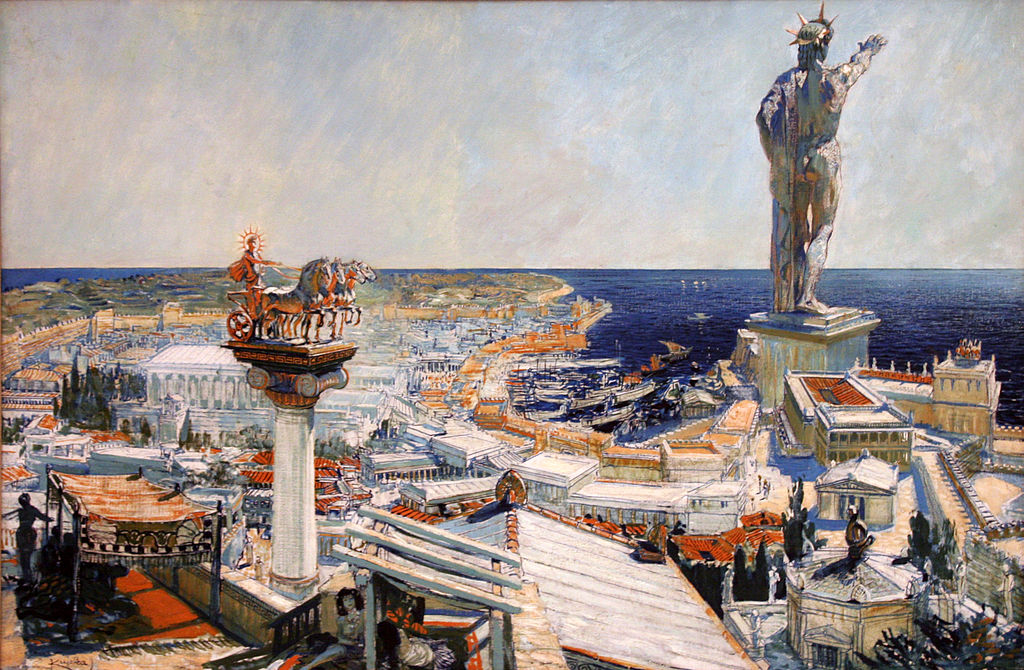
The Stone strikes the image on the feet of iron and clay. The divine clashes with the human. This doesn’t simply topple the image; it disintegrates it. When the Colossus of Rhodes fell, it was still so impressive that many continued to journey to see it until the seventh century when Arabian forces raided and broke it up for scrap. But when this great image is struck by the stone, all is broken into pieces so that is becomes like chaff and is carried off by the wind with not a trace left to be found. The Jew, reading of this vision, no doubt could not but think of the wicked being described in just this way in the first psalm. “The wicked… are like chaff that the wind drives away. Therefore the wicked will not stand in the judgment, nor sinners in the congregation of the righteous” (Psalm 1:4–5).

Not only does the Stone destroy; it dominates (v. 35b). The stone destroys the image and becomes a mountain that fills the earth. Though this dream is one of a statue and the Stone, if we are going to pick one of them to designate this dream, it should be the Stone. What is this great image in comparison to the great mountain? The image may explain part of Nebuchadnezzar’s fright, but the Stone is the superior cause.

Transmission by Tradition (Proverbs 4:1–9)

"When I was a son with my father, 
     tender, the only one in the sight of my mother,
he taught me and said to me,
'Let your heart hold fast my words;
     keep my commandments, and live.
Get wisdom; get insight; 
     do not forget, and do not turn away from the words of my mouth.'"

—Proverbs 4:3–5

We see here the relationship of tradition to wisdom. Tradition may have a negative connotation, as when Jesus rebuked the Pharisees in Matthew 15 for breaking the commands of God for the sake of their tradition. But the problem is not with tradition itself. Tradition by itself is simply a method.

Wisdom we see gives reasons. Wisdom has roots. Tradition for the sake of tradition is rootless. It is not wisdom. Tradition for the sake of tradition can be nothing more than fools foolishly listening to fools. Even so, tradition is the vehicle for the transmission of wisdom. The enduring creeds, confessions, and catechisms of the church have value for this reason. They are accrued wisdom, rooted in the Scriptures, handed down through tradition.

Jarosav Pelikan said “Tradition is the living faith of the dead, traditionalism is the dead faith of the living. And, I suppose I should add, it is traditionalism that gives tradition such a bad name.” Paul admonished the Thessalonians saying, “So then, brothers, stand firm and hold to the traditions that you were taught by us, either by our spoken word or by our letter” (2 Thessalonians 2:15). What we have in Proverbs 4:3–9, is the same kind of generational transmission that Paul speaks of in 2 Timothy 2:2. “[W]hat you have heard from me in the presence of many witnesses entrust to faithful men, who will be able to teach others also.”

Wisdom is to be wed to tradition because wisdom is better inherited than earned. It is wise to readily receive an inheritance of wisdom. It is foolish to spurn it. Many adolescents are eager to receive the wealth of their parents, while rejecting the wisdom that led to that wealth. This is the folly of the prodigal son. By spurning the wisdom he did not want, he also lost the wealth that he did want. He eventually gained wisdom through experience, but it was a costly lesson. Buy wisdom cheap. Purchase it through another’s experience. One theologian writes,

“Tradition can be described as vicarious experience. An old proverb states that ‘experience is the wisdom of fools.’ This may appear to be counter-intuitive, but the point is simple. Fools learn from experience that fire burns your fingers; wise people learn this by heeding what they are taught—and by observing fools! The biggest fools do not learn even from their experience. As the saying goes, there is not much to learn from the second kick of the mule. There is no need to reinvent the wheel in every generation”

Wisdom is to be sought, not found.

“There is a way that seems right to a man, but its end is the way to death” (Proverbs 14:12).

“Thus says the LORD: ‘Stand by the roads, and look, and ask for the ancient paths, where the good way is; and walk in it, and find rest for your souls. But they said, ‘We will not walk in it’” (Jeremiah 6:16).

Before you walk in the way that seems right to you, ask the gray head for the ancient paths. Wisdom is to be sought. And such wisdom transmitted through tradition. 

Parents, know the value of giving and receiving inherited wisdom. Learn the value of good tradition. Implore your children as former fools who have graciously been shown wisdom. Implore them to seek Christ, the wisdom of God (1 Corinthians 1:25) and to walk in the fear of Yahweh.

The Illogicality of Fear (Psalm 46)

God is our refuge and strength, 
      a very present help in trouble. 
Therefore we will not fear though the earth gives way, 
      though the mountains be moved into the heart of the sea, 
though its waters roar and foam, 
      though the mountains tremble at its swelling. Selah

—Psalm 46:1–3

The metaphor of God as a refuge assumes a threat. There was an occasion for this psalm’s composition and that occasion was trouble. God is a refuge, strength, and help in… trouble. Knowing the covenant God of Israel doesn’t eliminate trouble. Trouble will be, but in trouble, the people of God have a refuge.

And it is for this reason, we do not fear. Not because there is no trouble, but because in trouble there is a refuge. “Therefore, we will not fear.” Perhaps it is better to say, that in trouble, the saints understand that they should not fear and therefore they resolve not to fear. “God is our refuge” this is our confession. “Therefore we will not fear,” this is our resolution.

Theology is practical. Theology therefores. The darkness of fear dissipates as the flame of faith in our refuge grows. This flame of faith is fed by God’s truth, doctrine, teaching as to who He is. The more you know God, the less you will know of carnal fear. Spurgeon comments, “How fond the Psalmist is of therefores! his poetry is no poetic rapture without reason, it is as logical as a mathematical demonstration. The next words are a necessary inference from these. ‘Will not we fear.’ With God on our side, how irrational would fear be! Where he is all power is, and all love, why therefore should we quail?”

We will not fear though… though what? Though trouble! Though anything. “Who shall separate us from the love of Christ? Shall tribulation, or distress, or persecution, or famine, or nakedness, or danger, or sword? As it is written, ‘For your sake we are being killed all the day long; we are regarded as sheep to be slaughtered.’ No, in all these things we are more than conquerors through him who loved us. For I am sure that neither death nor life, nor angels nor rulers, nor things present nor things to come, nor powers, nor height nor depth, nor anything else in all creation, will be able to separate us from the love of God in Christ Jesus our Lord” (Romans 8:35–39).

We will not fear “though the earth gives way, though the mountains be moved into the heart of the sea, though its waters roar and foam, though the mountains tremble at its swelling.”

We will not fear though towers burn and fall, though terrorists attack, though viruses threaten, though wars rage.

We will not fear though the wicked dominate the media, though drag queens seek to target children, though we are silenced and arrested for righteousness sake, though we are ridiculed, mocked, and laughed at.

God is our refuge therefore, we will not fear.

Revealing the Revealed (John 21:1–14)

After this Jesus revealed himself again to the disciples by the Sea of Tiberias, and he revealed himself in this way.

This was now the third time that Jesus was revealed to the disciples after he was raised from the dead.

—John 21:1, 14 (emphasis added)

Critical scholars are nearly unanimous in rejecting the 21st chapter of John as unoriginal. They believe it smells fishy. I believe they are smelling their own breath. They think John 20:30–31 is the climactic conclusion of this gospel, period, such that chapter 21 was added later and by someone other than John. They think this, though there is absolutely zero manuscript evidence to suggest this. This is the arrogance of modern minds telling ancient minds how they must think, because it is how they think. This grandly exposes how “higher criticism” really works. It isn’t about humble investigation, but arrogant presuppositions.

When you look at John itself, chapter 21 brings perfect balance to this gospel. John opens with a majestic prologue, in which the Eternal Word becomes flesh in John 1:1–18. Following this, John falls into two parts. Part one, “The Book of Signs,” runs from 1:19–12:50. Central to this section are seven signs revealing that Jesus is the Christ, the Son of God, and calling for our faith. Part two, beginning with chapter 13 and running to 20:31, is referred to as “The Book of Glory.” It focuses exclusively on the sign of signs, the death and resurrection of our Lord. And now, John closes with this epilogue, chapter 21. The epilogue is as humble as the prologue was majestic, and yet it remains glorious. Two parts with a prologue and epilogue on each side. Balanced.

The climactic conclusion of 20:30–31 is echoed at the end of this epilogue, forming a frame around it. On the front of the epilogue we read, “Now Jesus did many other signs in the presence of the disciples, which are not written in this book; but these are written so that you may believe that Jesus is the Christ, the Son of God, and that by believing you may have life in his name.” And on the back, “This is the disciple who is bearing witness about these things, and who has written these things, and we know that his testimony is true. Now there are also many other things that Jesus did. Were every one of them to be written, I suppose that the world itself could not contain the books that would be written” (John 20:25).

Also, the epilogue itself breaks down into two parts. Part one (vv. 1–14) opens with the disciples and prepares us to focus on Peter in particular as we move into part two (vv. 15–25). It is as you ponder this increasing focus Peter that I believe you begin to see the divine purpose in this epilogue. We move from the disciples to Peter. Once more Peter stands in for the disciples, all of whom have failed their Lord. Jesus will restore and commission Peter afresh. On the heels of this, we are reminded that we are reading a gospel given to one of these apostles. What was reveled to them lies before us. This gospel reveals the Revealed. Jesus’ resurrection doesn’t bring a sharp conclusion to this gospel. The effects of Jesus’ resurrection are made to linger. This revealing of Christ is still reverberating with redemption to this day.

Part one of this epilogue is bracketed with references to Jesus revealing Himself. At the beginning we read “After this Jesus revealed himself again to the disciples by the Sea of Tiberias, and he revealed himself in this way” (v. 1). At the end we read, “This was now the third time that Jesus was revealed to the disciples after he was raised from the dead.” In between these two references, we are first told that “the disciples did not know that it was Jesus” (v. 4), and then “none of the disciples dared ask him, ‘Who are you?’ They knew it was the Lord” (v. 12). Why the change? It is because Jesus revealed Himself. Christianity is a religion of revelation, not discovery. Discovery is human work rising up. Revelation is divine grace coming down.

Revelation is not just for blind sinners who cannot see God. Revelation is for disciples. Revelation is for apostles. Indeed, speaking in systematic terms, “revelation” is only for apostles and prophets. What we need is illumination. We need the Spirit to reveal Christ in the prophetic and apostolic revelation. We need the Spirit to illumine the Scriptures and give us the light of the knowledge of God in the face of Jesus Christ.

That is why this gospel sits before you. Just before we are told that Jesus revealed Himself, one to whom Christ was revealed tells us “but these [signs] are written so that you may believe that Jesus is the Christ, the Son of God, and that by believing you may have life in his name.” This gospel is written so that you might see what they saw. This gospel is written so that the Revealed might be revealed to you.

The Bishop: ABC and SIN

“To know ‘our sins’ is the first letter in the alphabet of saving religion. To understand our position in the sight of God is one step towards heaven. The true secret of peace of conscience is to feel ‘our sins’ put away. If we love life we ought never to rest till we can give a satisfactory answer to the question,—WHERE ARE MY SINS?'” —J.C. Ryle, Old Paths

Grieving for the Loss of Hope

“But we do not want you to be uninformed, brothers, about those who are asleep, that you may not grieve as others do who have no hope. For since we believe that Jesus died and rose again, even so, through Jesus, God will bring with him those who have fallen asleep.”

1 Thessalonians 4:13–14

I grieve that we (the saints) have forgotten how to grieve. Death is a loss. Yes, it is gain for the departed, but for we who remain, experientially, it is loss (Philippians 1:21). We have tried to transform funerals into festivals. There is a time to mourn. We are not the healthier for ignoring that time.

I grieve that we have forgotten to grieve, but I grieve all the more that this often means we have forgotten how to hope. We rejoice in the life lived (on earth) instead of the life being lived and the life to be lived (in heaven). We look back when we should look forward. We exercise our memory of the past more than we do our longing for the future. We look to past photos more than future promises. We watch a video instead of reading the Bible. We listen to a favorite song of the departed instead of lifting up a song to the eternal Son who rose from the grave.

The remembrances are not for rejoicing. They are for grieving the loss and expressing gratitude for gifts enjoyed. Remember. Laugh. Smile. Give thanks. Yes! But do not anchor your joy or comfort there. The memories are for mourning. The promises are for praise. It is not as we look back that we find solace for our sorrow. It is as we look forward that we find hope to illumine our grief. Death is an enemy. He has dealt his blow. But there is victory in Christ. It is because we don’t grieve that we fail to lament “Come Lord Jesus!” Paradoxically, is because we are short on grief and lament that we are short on hope and joy.

I do grieve for the loss of hope, but more so, I have hope for the loss of all grief. Every tear will be wiped away. One reason I shed tears now is because I want others to know such hope in the midst of the grief they try to ignore. The storm is real. The rock is just as real. Don’t ignore the storm. Cherish the rock.

I love you, O LORD, my strength. 
The LORD is my rock and my fortress and my deliverer, 
     my God, my rock, in whom I take refuge, 
     my shield, and the horn of my salvation, my stronghold. 
I call upon the LORD, who is worthy to be praised, 
     and I am saved from my enemies. 

The cords of death encompassed me; 
     the torrents of destruction assailed me; 
the cords of Sheol entangled me; 
     the snares of death confronted me. 

In my distress I called upon the LORD; 
     to my God I cried for help. 
From his temple he heard my voice, 
     and my cry to him reached his ears.

—Psalm 18:1–6 (ESV)

The Fading Lamp Shines Brightest (John 3:22–36)

“He must increase, but I must decrease.”

“He was a burning and shining lamp, and you were willing to rejoice for a while in his light. But the testimony that I have is greater than that of John.”

—John 3:30; 5:35–36

O what paradoxical glory! As this lamp fades, he shines brightest. John was not the Light, but he was a lamp. It is when the lamp exclaims “I am not the Light” that it shines brightest. When John says “I am not the Christ” it is then that he radiates with Christ-like glory. Edward Klink comments, “It was only at the point of his ‘not’ that the Baptist could truly be who he was supposed to be, a messenger for the message and a witness to the true ‘I AM.’”

When a loyal herald announces the coming of the King, he isn’t downcast when people then move to the side and look down the street. That’s the point! If John were a fish, this is water. John, as one sent before the Lord, heralds, “Behold the Lamb of God who takes away the sin of the world.” And when the crowd then turns their eyes from him to the bridegroom, he “rejoices with joy.”

When all eyes look down the street for the king, that is when the herald is greatest and gladdest. Saints, this is oxygen, to use our lungs to say, “We are not! He is! Do not look to us. Look to Christ! We are just a voice. Jesus is the Word.” Saints, do you truly want to live? Then fill your longs with John’s exclamation, “He must increase, but I must decrease.”

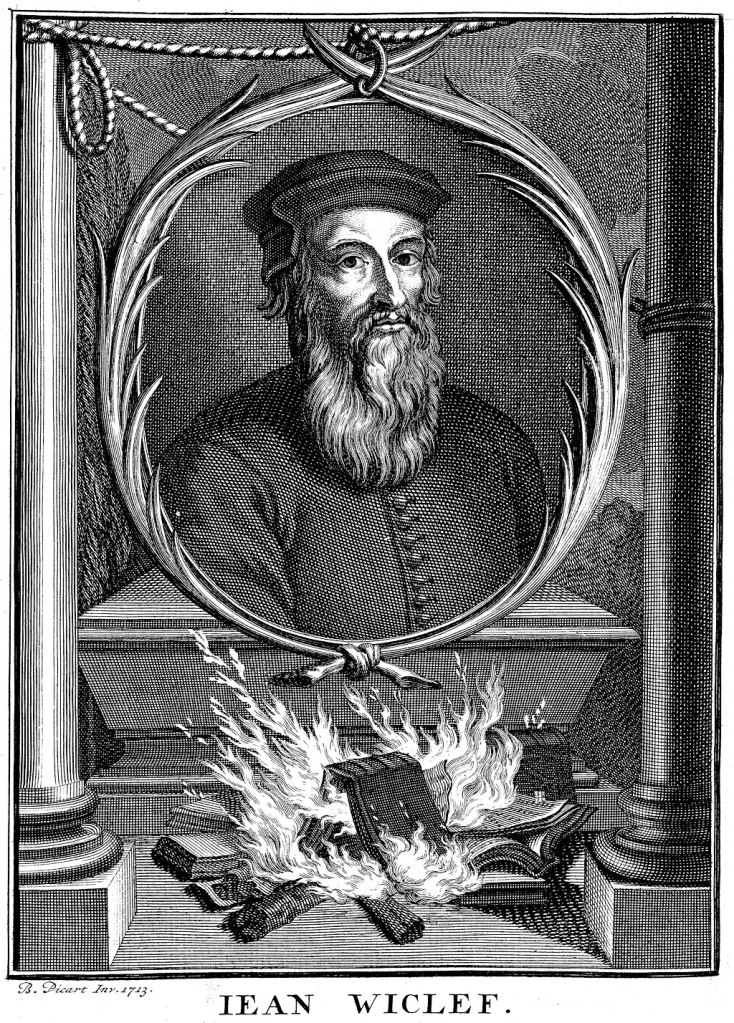
The Bishop: Wycliffe’s Banner

“The importance of this great principle can never be overrated. It lies at the very foundation of Protestant Christianity. It is the backbone of the Articles of the Church of England and of every sound Church in Christendom. The true Christian was intended by Christ to prove all things by the word of God, all churches, all ministers, all teaching, all preaching, all doctrines, all sermons, all writings, all opinions, all practices. These are his marching orders. Prove all by the word of God; measure all by the measure of the Bible; compare all with the standard of the Bible; weigh all in the balances of the Bible; examine all by the light of the Bible: test all in the crucible of the Bible. That which can abide the fire of the Bible, receive, hold, believe, and obey. That which cannot abide the fire of the Bible, reject, refuse, repudiate, and cast away. This is the standard which Wycliffe raised in England. This is the flag which he nailed to the mast. May it never be lowered!” —J.C. Ryle, “John Wycliffe” in Light from Old Times

The Bishop: No Half Imitations

If we say with Paul, ‘O wretched man that I am’, let us also be able to say with him, ‘I press toward the mark.’ Let us not quote his example in one thing, while we do not follow him in another (Rom. 7:24; Phil. 3:14). —J.C. Ryle, Holiness