An Unwelcoming Welcome (John 4:43–54)

“After the two days he departed for Galilee. (For Jesus himself had testified that a prophet has no honor in his own hometown.) So when he came to Galilee, the Galileans welcomed him, having seen all that he had done in Jerusalem at the feast. For they too had gone to the feast.”

—John 4:43–45

Here, a puzzling statement makes the following statement puzzling. Unfortunately, we’re tempted to grab the hammer and make the pieces fit instead of doing the hard work of finding out how they fit. Rather than knocking off the rough edges of the first piece, it is after connecting its oddity to the second piece (a piece that initially didn’t seem to go with it) that it comes to make sense.

Jesus departs for Galilee because, as He has testified, a prophet has no honor in his hometown. That’s puzzling. To hammer the piece in place, a number of clunky explanations are suggested. The most reasonable of these is that, as in the synoptic gospels, “hometown” refers specifically to Nazareth. Jesus goes to Galilee, but once there, He doesn’t go to that place He is shown no honor—Nazareth. My problem with this explanation is that Nazareth is nowhere in view, the context doesn’t give the slightest hint of Nazareth.

Instead, I believe that what was true of Nazareth is being expanded to apply to the region of Galilee. Galilee, alongside Judea, is being set in contrast to Samaria. What we see in both Judea and Galilee is the truth John introduced in John 1:11, “He came to his own, and his own people did not receive him.”

But the Galileans have a peculiar way of not honoring Jesus. They welcome Him. This isn’t puzzling in itself. It is puzzling in how it fits with the last piece. There is a way of welcoming Jesus that does not honor Him. The key word to unlocking what a dishonoring welcome consists of is the word “seen.” The Samaritans, we were told repeatedly, believed because of the testimony of the woman and the word of Christ (4:39–42). But these Galileans, like the Judeans, “believe” because of what they see.

“Now when he was in Jerusalem at the Passover Feast, many believed in his name when they saw the signs that he was doing. But Jesus on his part did not entrust himself to them, because he knew all people and needed no one to bear witness about man, for he himself knew what was in man” (John 2:23–25).

Not all welcoming is welcoming. Not all believing is believing. Not all receiving is receiving. And what distinguishes the true from the false is that in the false the eye is elevated above the ear. Marvel takes precedence over meaning. 

And so it is that Jesus is welcomed in many churches today where the eye is awed while ears remain deaf as the word of the gospel which is the power of God unto salvation is not proclaimed. Charismatic churches provide wonders. Evangelical churches have fog and lights. Even much of the young, restless, and reformed crowd has frequently proven to be more about hype than hearing. Such welcoming isn’t excited to receive the King, but the parade of gifts that come in His train. That this is so, that this is the correct interpretation I take to be clear in Jesus rebuff, “unless you see signs and wonders you will not believe.”

Sinner, you do not need to see a sign for faith to be. You need to see the significance of the signs that are and believe. Jesus is the Christ, the Son of God. John records these signs so that you may believe this truth and that by believing you may have life in His name.


The Bishop: The Measure of a Church

“Which are the Churches on earth which are producing the greatest effect on mankind? The Churches in which the Bible is exalted. Which are the parishes in England and Scotland where religion and morality have the strongest hold? The parishes in which the Bible is most circulated and read. Who are the ministers in England who have the most real influence over the minds of the people? Not those who are ever crying ‘Church! Church!’ but those who are faithfully preaching the word. A Church which does not honour the Bible is as useless as a body without life, or a steam engine without fire. A minister who does not honour the Bible is as useless as a soldier without arms, a builder without tools, a pilot without compass, or a messenger without tidings.” —J.C. Ryle, Light From Old Times

The Fading Lamp Shines Brightest (John 3:22–36)

“He must increase, but I must decrease.”

“He was a burning and shining lamp, and you were willing to rejoice for a while in his light. But the testimony that I have is greater than that of John.”

—John 3:30; 5:35–36

O what paradoxical glory! As this lamp fades, he shines brightest. John was not the Light, but he was a lamp. It is when the lamp exclaims “I am not the Light” that it shines brightest. When John says “I am not the Christ” it is then that he radiates with Christ-like glory. Edward Klink comments, “It was only at the point of his ‘not’ that the Baptist could truly be who he was supposed to be, a messenger for the message and a witness to the true ‘I AM.’”

When a loyal herald announces the coming of the King, he isn’t downcast when people then move to the side and look down the street. That’s the point! If John were a fish, this is water. John, as one sent before the Lord, heralds, “Behold the Lamb of God who takes away the sin of the world.” And when the crowd then turns their eyes from him to the bridegroom, he “rejoices with joy.”

When all eyes look down the street for the king, that is when the herald is greatest and gladdest. Saints, this is oxygen, to use our lungs to say, “We are not! He is! Do not look to us. Look to Christ! We are just a voice. Jesus is the Word.” Saints, do you truly want to live? Then fill your longs with John’s exclamation, “He must increase, but I must decrease.”

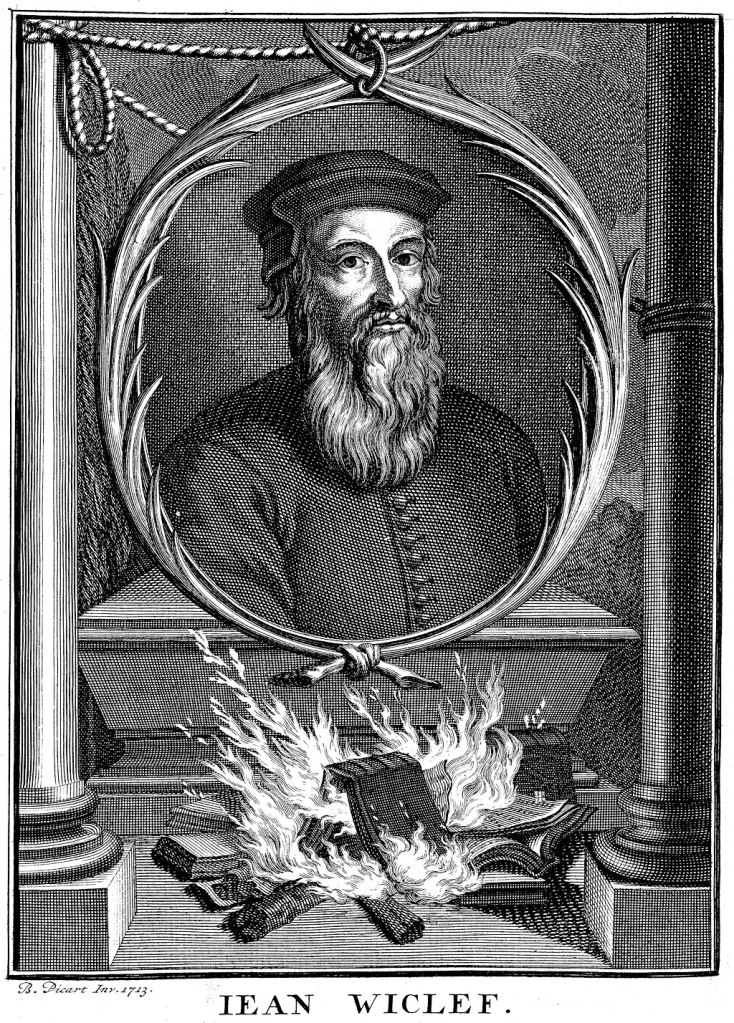
The Bishop: Wycliffe’s Banner

“The importance of this great principle can never be overrated. It lies at the very foundation of Protestant Christianity. It is the backbone of the Articles of the Church of England and of every sound Church in Christendom. The true Christian was intended by Christ to prove all things by the word of God, all churches, all ministers, all teaching, all preaching, all doctrines, all sermons, all writings, all opinions, all practices. These are his marching orders. Prove all by the word of God; measure all by the measure of the Bible; compare all with the standard of the Bible; weigh all in the balances of the Bible; examine all by the light of the Bible: test all in the crucible of the Bible. That which can abide the fire of the Bible, receive, hold, believe, and obey. That which cannot abide the fire of the Bible, reject, refuse, repudiate, and cast away. This is the standard which Wycliffe raised in England. This is the flag which he nailed to the mast. May it never be lowered!” —J.C. Ryle, “John Wycliffe” in Light from Old Times

Man Must Be Born from Above; The Son of Man Must Be Lifted Up (John 3:12–21)

Nicodemus said to him, “How can these things be?” 10 Jesus answered him, “Are you the teacher of Israel and yet you do not understand these things? 11 Truly, truly, I say to you, we speak of what we know, and bear witness to what we have seen, but you do not receive our testimony. 12 If I have told you earthly things and you do not believe, how can you believe if I tell you heavenly things? 13 No one has ascended into heaven except he who descended from heaven, the Son of Man. 14 And as Moses lifted up the serpent in the wilderness, so must the Son of Man be lifted up, 15 that whoever believes in him may have eternal life.

John 3:9–15

In the first part of the conversation with Nicodemus, Jesus speaks of what must be done to Nicodemus. In the second part of the conversation, Jesus speaks of what must be done for Nicodemus. Man must be born from above. The Son of Man must be lifted up. The Spirit must cause regeneration. The Son must accomplish redemption.

The transition from the work of the Spirit in Nicodemus to the work of the Son for Nicodemus happens with Nicodemus’ clumsy question, “How can these things be?” Jesus both rebukes and then answers Nicodemus’ question. 

“You must be born again.”

“How can these things be?”

“The Son of Man must be lifted up.”

The lifting up of the Son of Man is the how behind man’s being born from above. Regeneration is the Spirit’s application of the redemption accomplished by the Son. Because of the dying of the Son of Man, the Spirit makes men alive.

For man’s salvation, man needs the work of Christ for Him, and the work of the Spirit in Him. The Spirit must renew. For the Spirit to renew, the Son must be lifted up. The Son of Man was lifted up. Thus, the Spirit causes men to be born from above. And behind both the sending of the Son to redeem and the sending of the Spirit to renew is the love of the Father.

Here is how Paul spoke of these things in Titus 3:4–7. 

“But when the goodness and loving kindness of God our Savior [referring to the Father] appeared, he saved us, not because of works done by us in righteousness, but according to his own mercy, by the washing of regeneration and renewal of the Holy Spirit, whom he poured out on us richly through Jesus Christ our Savior, so that being justified by his grace we might become heirs according to the hope of eternal life.”