Strawy or Sweet? (James 1:1)

“In fine, Saint John’s Gospel and his first epistle, Saint Paul’s epistles, especially those to the Romans, Galatians, Ephesians, and Saint Peter’s first epistle,—these are the books which show thee Christ, and teach thee everything that is needful and blessed for thee to know even though thou never see or hear any other book or doctrine. Therefore is Saint James’s epistle a right strawy epistle in comparison with them, for it has no gospel character to it.”

—Martin Luther

Contrary to how some have misconstrued this, Luther did not deny the inspiration and value of James, but he did disparage it as secondary in relation to other books. So zealous was Luther for the truth of the gospel and justification by faith, that he had little use for a book of the Bible that he could not utilize for the great cause of the Reformation. Herein was his strength and herein was his weakness.

But when the good Shepherd puts straw in the manger without the Babe, you can trust him that you need the fiber. And you can trust He who sent the Spirit to give us this book, knowing that the straw is surely not far from the bread and the wine.

In the same way that Proverbs assumes redemption, so too does James. And when you realize this, you can perceive that in a way, Jesus is more present in this letter than he is in any other. Douglas Moo states, “James depends more than any other NT author on the teaching Jesus.” And again, “while Jesus’ person and work might be generally absent, his teaching is not. No NT document is more influenced by the teaching of Jesus than James.” James draws heavily on what would become the synoptic tradition, especially as we see it presented in Matthew. 

More narrowly, referring to the Sermon on the Mount, John MacArthur writes, James “may be viewed as a practical commentary on our Lord’s sermon.” If you doubt that Jesus pervades the book of James, read it alongside the Sermon on the Mount a few times and see if the doubt persists.

When you understand this, I believe it radically impacts how you understand James when He refers to the “royal law” (2:8). Yes, James is full of law, but it is as considered the royal law, the law of the Lord Jesus Christ. The royal law then is on par with what Paul speaks of in Galatians 6:2 as “the law of Christ.” The significance of this expression can be seen in that though James can be said to make much of the law, he makes nothing of the ceremonial or civil aspects of the law. James considers the law in light of the one who declared, “Do not think that I have come to abolish the Law or the Prophets; I have not come to abolish them but to fulfill them” (Matthew 5:17).

So whenever the commands of James pierce with conviction and lie heavy on your conscience, do not forget the gospel that he assumes of his reader. Paul makes plain what James assumes in Romans 8:1–4.

“There is therefore now no condemnation for those who are in Christ Jesus. For the law of the Spirit of life has set you free in Christ Jesus from the law of sin and death. For God has done what the law, weakened by the flesh, could not do. By sending his own Son in the likeness of sinful flesh and for sin, he condemned sin in the flesh, in order that the righteous requirement of the law might be fulfilled in us, who walk not according to the flesh but according to the Spirit.”

Luther is reputed to have said, “Oh, how sweet are the commandments of God to us when we receive them not as they are in the book, but as they are in the wounds of Christ.” Oh that Luther had eyes to clearly see all the commands of James as coming to us in the wounds of Christ! This is not an epistle of straw. It is a sweet epistle.

“Our pleasure and our duty, Though opposite before,
Since we have seen his beauty, Are join’d to part no more :
It is our highest pleasure, No less than duty’s call,
To love him beyond measure, And serve him with our all.”
—John Newton

Simplifying Seventy Sevens as Scriptural Symbolism

The interpretations of Daniel 9 are a bit like the horns of this book. You find that there are not only multiple horns, but that the horns have horns. There are not just a myriad of interpretive options, the options have options. When we look to the seventy sevens, that is where the interpretations seem to multiply seventy times seven.

As we look at these seventy sevens (and that is the better translation), we must note that we are looking at them. This is a “vision” (v. 23) and it is a vision of the seventy sevens. They are the focal point of this vision. Though this vision is less dreamy than the others, a vision it is. The key feature of apocalyptic literature is its rich imagery and pervasive symbolism. The previous visions have centered on beasts, beasts that are kingdoms with horns that are kings. This vision centers on seventy sevens. At the least then, one then should be cautious about insisting that we must read them literally. Because from a literary standpoint, this is not the genre you are meant to interpret literally.

When Peter spoke of forgiving his brother seven times, and Jesus rebuked him saying seventy times seven, to do any math would be to miss the meaning (Matthew 18:21–22). Yes, these seventy sevens do refer to time, but it is symbolic time. When you start to examine all the ways people have tried to crunch the numbers and all the ways the numbers may be crunched, it is dizzying. These seventy sevens do break down into seven sevens, sixty-two sevens, and one seven, but I find Dale Ralph Davis’ assessment thereof to be the most satisfying. The seven sevens are a “relatively restricted time.” The sixty-two sevens are a “relatively extended time.” And the final seven is a “clearly climactic time.”

To understand these seventy sevens, let’s try then to do some meaning rather than some math. First, lets ask why there was a seventy before the seventy sevens? In the covenant curses of Leviticus 26, after God speaks of scattering them, he says, “Then the land shall enjoy its Sabbaths as long as it lies desolate, while you are in your enemies’ land; then the land shall rest, and enjoy its Sabbaths. As long as it lies desolate it shall have rest, the rest that it did not have on your Sabbaths when you were dwelling in it” (Leviticus 26:34–35). Every six years the law instructed the people that they were to celebrate a Sabbath Year in which the land was to lie fallow. Neither Israel nor Judah were faithful to obey this command. 2 Chronicles reflects on this telling us that Judah was taken captive by Babylon until the establishment of Persia “to fulfill the word of the LORD by the mouth of Jeremiah, until the land had enjoyed its Sabbaths. All the days that it lay desolate it kept Sabbath, to fulfill seventy years” (2 Chronicles 36:21). The sabbath year which would occur every seven years is multiplied by ten. After ten sabbath years, then they would return.

Now, how would the Jew hear seventy sevens or 490 years? Listen to these instructions from Leviticus 25.

“You shall count seven weeks of years, seven times seven years, so that the time of the seven weeks of years shall give you forty-nine years. Then you shall sound the loud trumpet on the tenth day of the seventh month. On the Day of Atonement you shall sound the trumpet throughout all your land. And you shall consecrate the fiftieth year, and proclaim liberty throughout the land to all its inhabitants. It shall be a jubilee for you, when each of you shall return to his property and each of you shall return to his clan. That fiftieth year shall be a jubilee for you; in it you shall neither sow nor reap what grows of itself nor gather the grapes from the undressed vines” (Leviticus 25:8–11).

Every seven sevens, that is every 49 years, commencing with the Day of Atonement, the Jews were to celebrate the Year of Jubilee. Not only was the land to have rest, property was to return to its rightful inheritors and slaves were to be set free. So we first have the Sabbath Year multiplied by ten and now we have the Jubilee Year multiple by ten.

Daniel has this longing, and it is to be found not simply in the Sabbath, but with the Jubilee, following not the seventy, but the seventy sevens. Then meaning, as one pastor puts it, is not calendrical, but theological. With the Year of Jubilee then in mind, listen to the sixfold purpose of the seventy sevens.

“Seventy weeks are decreed about your people and your holy city, 

to finish the transgression, 
to put an end to sin, 
and to atone for iniquity, 
to bring in everlasting righteousness, 
to seal both vision and prophet, 
and to anoint a most holy place” (v. 24).

All these purposes are good, but three are negative and three are positive. Negatively, sin is dealt with. Positively, righteousness is established, prophecy is completed, done, fulfilled, sealed, and finally, a most holy place is anointed. Jesus does all this by His cross and resurrection, bringing the age to come breaking into the present. He became sin for us that in Him we might become the righteousness of God in Him. He fulfilled the Scriptures. And His temple, being destroyed, was raised again on the third day, and then, having ascended, He sends His Spirit to anoint the living temple of His mystical body, the church.

Daniel is looking to the end of the seventy, but it is not until the end of the seventy sevens, the ultimate Jubilee, that all that he longs for will come. Through Isaiah, Yahweh spoke of the hoped for Son of David who will bring this to fulfillment.

“The Spirit of the Lord GOD is upon me, because the LORD has anointed me to bring good news to the poor; he has sent me to bind up the brokenhearted, to proclaim liberty to the captives, and the opening of the prison to those who are bound; to proclaim the year of the LORD’s favor, and the day of vengeance of our God; to comfort all who mourn; to grant to those who mourn in Zion—to give them a beautiful headdress instead of ashes, the oil of gladness instead of mourning, the garment of praise instead of a faint spirit; that they may be called oaks of righteousness, the planting of the LORD, that he may be glorified. They shall build up the ancient ruins; they shall raise up the former devastations; they shall repair the ruined cities, the devastations of many generations” (Isaiah 61:1–4)

When does this happen? Jesus read this very text in the Synagogue at Nazareth, ending with the words, “to proclaim the year of the Lord’s favor,” and then He preached this short sermon, “Today this Scripture has been fulfilled in your hearing” (Luke 4:21).

Courage Must Be Pursued Indirectly (Daniel 6)

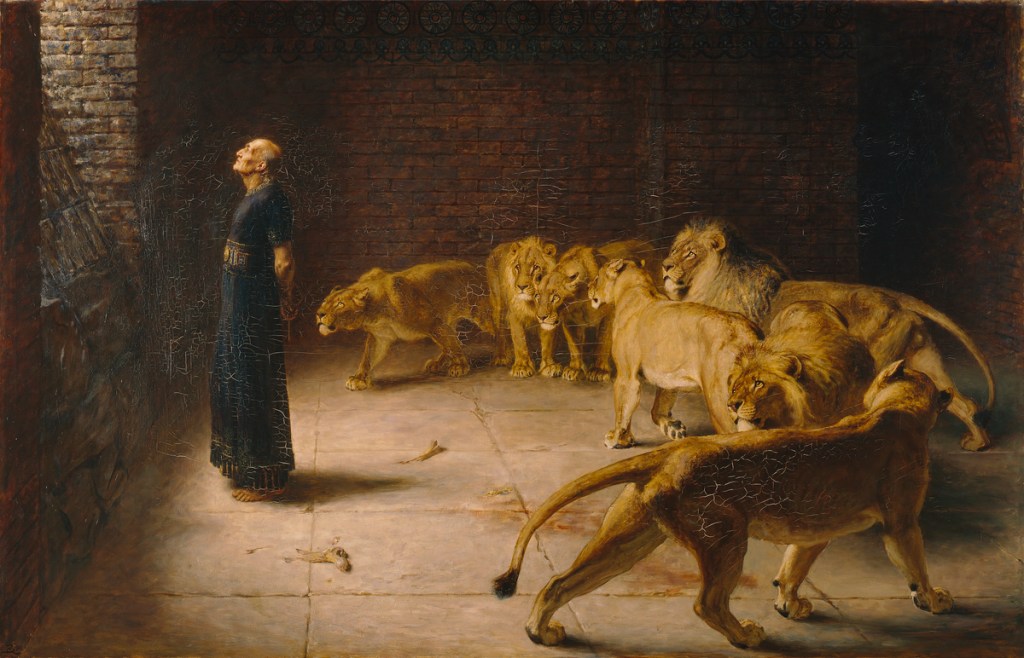
When Daniel knew that the document had been signed, he went to his house where he had windows in his upper chamber open toward Jerusalem. He got down on his knees three times a day and prayed and gave thanks before his God, as he had done previously.

—Daniel 6:10

In typical Chestertonian style, G.K. Chesterton writes, “Courage is almost a contradiction in terms. It means a strong desire to live taking the form of a readiness to die. ‘He that will lose his life, the same shall save it,’ is not a piece of mysticism for saints and heroes. It is a piece of everyday advice for sailors or mountaineers. This paradox is the whole principle of courage… A man cut off by the sea may save his life if he will risk it on the precipice.”

Courage is a strong desire to live taking the form of a readiness to die. To understand this more clearly, think of two ancient Christians called on to make the profession “Caesar is Lord.” One buckles and is freed. The other, professing “Christ is Lord,” dies a martyr. One may still exist, but which one truly lived?

Courage is a strong desire to live taking the form of a readiness to die. It was for desire to live that Hugh Latimer, the English Reformer, cried out to his friend Nicholas Ridley as they were to be burned at the stake, “Be of good comfort, Master Ridley, and play the man; we shall this day light such a candle, by God’s grace, in England, as I trust never shall be put out.” J.C. Ryle writes of Latimer, “He feared God, and nothing else did he fear. ‘Latimer, Latimer,’ he exclaimed at the beginning of one of his sermons, ‘thou art going to speak before the high and mighty King Henry VIII, who is able, if he think fit, to take thy life away. Be careful what thou sayest. But Latimer, Latimer, remember also thou art about to speak before the King of kings, and Lord of lords. Take heed that thou dost not displease him.’”

What produces such Christian courage? What underlies it? You won’t get the answer by looking at the courage itself. Courage is a secondary thing. C.S. Lewis reminds us, “You can’t get second things by putting them first; you can get second things only by putting first things first.” Many men want to be courageous, but when the fire comes they find their hearts cold. This is because they merely wanted to be courageous, but find they have nothing to be courageous about.

Saints, be inspired by Daniel, but not obsessed with him. An obsession with a Daniel is likely a prideful desire to be like Daniel, meaning, to be seen to be like a Daniel. Such aspirations for courage melt like wax in the flame. No, be obsessed with Daniel’s God, the one who took on flesh, acted with perfect righteousness, was crucified for sinners, was buried and placed behind a sealed stone, and rose with victory. If you want to grow in courage, grow in faith. If you want to grow in faith, look to Christ. If you want to see Christ, look to the Word. “[F]aith comes from hearing, and hearing through the word of Christ” (Romans 10:17). Look to the one who rules kings and kingdoms so that the Stone might be seen superior to the statue knowing that nothing can separate you from the love of God in Christ Jesus your Lord.

"for he is the living God, 
enduring forever;
his kingdom shall never be destroyed,
and his dominion shall be to the end.
He delivers and rescues;
he works signs and wonders
in heaven and on earth,
he who has saved Daniel
from the power of the lions.”

—Daniel 6:26–27

Daniel’s Rhythm and History’s Beat (Daniel 6)

“He was driven from among the children of mankind, and his mind was made like that of a beast, and his dwelling was with the wild donkeys. He was fed grass like an ox, and his body was wet with the dew of heaven, until he knew that the Most High God rules the kingdom of mankind and sets over it whom he will. And you his son, Belshazzar, have not humbled your heart, though you knew all this, but you have lifted up yourself against the Lord of heaven. And the vessels of his house have been brought in before you, and you and your lords, your wives, and your concubines have drunk wine from them. And you have praised the gods of silver and gold, of bronze, iron, wood, and stone, which do not see or hear or know, but the God in whose hand is your breath, and whose are all your ways, you have not honored.”

—Daniel 5:21–23

Early in his commentary on Daniel, Sinclair Ferguson offers this insight, “From one point of view (and one of which the teacher or preacher needs to be aware in the study of Daniel) there is a certain monotony about the underlying structure and theme of the succeeding chapters of this book. The scenario changes, but the plot remains the same.” Kings live and die. Kingdoms rise and fall. There is change; this is constant. But God Most High, He lives forever, His Kingdom is an everlasting kingdom and His dominion endures from generation to generation (4:3).

This is the major theme, the bass drum of the rhythm of Daniel. And the same minor themes, the toms, snares, and cymbals, keep steadily recurring as well. But this “monotony” is now amplified as the movement of Daniel 2–7 begins to turn back in on itself, making its way back through the themes it has developed. The chiasm of Daniel 2–7 has reached its center and now works its way back out again.

These chapters, all written in Aramaic, have a definite chiastic structure. A chiasm is a structuring device that has an ABCBA pattern. On the outside of this chiasm, we have Nebuchadnezzar’s dream about four kingdoms (ch. 2) and Daniel’s vision of four kingdoms (ch. 7). Further in, we have two stories of faithful Jews, first that of Shadrach, Meshach, and Abednego in chapter 3, then that of Daniel and the lion’s den in chapter 6. Then at the center, we have two stories about kings being humbled, first Nebuchadnezzar in chapter 4 then Belshazzar in chapter 5.

A Nebuchadnezzar’s Vision of Four Kingdoms (Chapter 2)

B The Fiery Furnace (Chapter 3)

C Nebuchadnezzar Humbled (Chapter 4)

C' Belshazzar Humbled (Chapter 5)

B' The Lion’s Den (Chapter 6)

A' Daniel’s Vision of Four Kingdoms (Chapter 7)

Remember also that the book of Daniel clearly falls into two halves. The first half, chapters 1–6, is comprised of six narratives. The latter half is made up four apocalyptic visions. The Aramaic section, as it draws in chapter 7, demonstrates that the message of Daniel is singular. The narratives help you interpret the visions. And here is the singular and united message of Daniel. Daniel is given to us “to the end that the living may know that the Most High rules the kingdom of men and gives it to whom he will and sets over it the lowliest of men” (Daniel 4:17).

This is the rhythm of Daniel. It is the rhythm of history. It is steady, but it is not painfully “monotonous.” It is the beat that holds history together and keeps all things marching along to His eternal purpose. The Most High rules the kingdom of men for His purposes. And this is His purpose: that the Stone might be seen to be superior to the Statue.

“The Most High rules the kingdom of men and gives it to whom he will and sets over it the lowliest of men.”

“And being found in human form, [the Christ] humbled himself by becoming obedient to the point of death, even death on a cross. Therefore God has highly exalted him and bestowed on him the name that is above every name, so that at the name of Jesus every knee should bow, in heaven and on earth and under the earth, and every tongue confess that Jesus Christ is Lord, to the glory of God the Father” (Philippians 2:8–11).

The Statue and the Stone (Daniel 2:31–49)

“You saw, O king, and behold, a great image. This image, mighty and of exceeding brightness, stood before you, and its appearance was frightening. The head of this image was of fine gold, its chest and arms of silver, its middle and thighs of bronze, its legs of iron, its feet partly of iron and partly of clay. As you looked, a stone was cut out by no human hand, and it struck the image on its feet of iron and clay, and broke them in pieces. Then the iron, the clay, the bronze, the silver, and the gold, all together were broken in pieces, and became like the chaff of the summer threshing floors; and the wind carried them away, so that not a trace of them could be found. But the stone that struck the image became a great mountain and filled the whole earth.”

—Daniel 2:31–35

Sometimes Nebuchadnezzar’s dream is referred to as his “dream of the great image.” Some Bibles might even have something like that as the heading for this chapter. But that is only half the dream, and it is the lesser half. There is not only a statue; there is a Stone. This is “Nebuchadnezzar’s dream of the statue and the Stone.” And if the statue is great, mighty, of exceeding brightness, and frightening in appearance, how much more awesome is this Stone?

The Stone is cut out, but not by human hand. It is a Divine Stone. There is something about the image, not only in its shape, but in its origin, that is of man. Not so with this Stone.

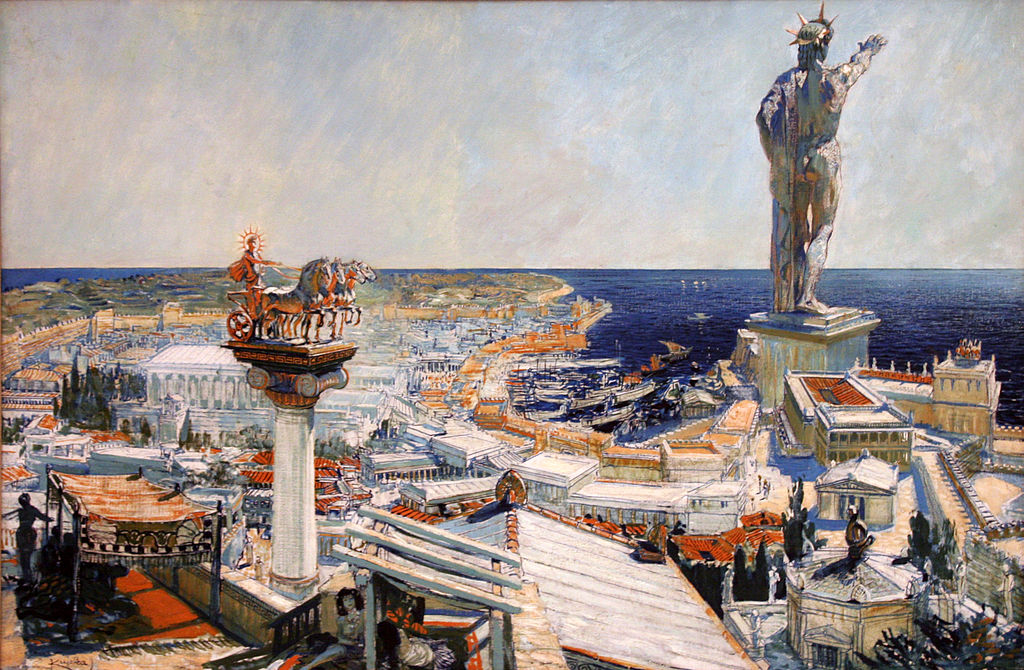
The Stone strikes the image on the feet of iron and clay. The divine clashes with the human. This doesn’t simply topple the image; it disintegrates it. When the Colossus of Rhodes fell, it was still so impressive that many continued to journey to see it until the seventh century when Arabian forces raided and broke it up for scrap. But when this great image is struck by the stone, all is broken into pieces so that is becomes like chaff and is carried off by the wind with not a trace left to be found. The Jew, reading of this vision, no doubt could not but think of the wicked being described in just this way in the first psalm. “The wicked… are like chaff that the wind drives away. Therefore the wicked will not stand in the judgment, nor sinners in the congregation of the righteous” (Psalm 1:4–5).

Not only does the Stone destroy; it dominates (v. 35b). The stone destroys the image and becomes a mountain that fills the earth. Though this dream is one of a statue and the Stone, if we are going to pick one of them to designate this dream, it should be the Stone. What is this great image in comparison to the great mountain? The image may explain part of Nebuchadnezzar’s fright, but the Stone is the superior cause.

What a Language You Can’t See Says (Daniel 2:1–30)

In the second year of the reign of Nebuchadnezzar, Nebuchadnezzar had dreams; his spirit was troubled, and his sleep left him. Then the king commanded that the magicians, the enchanters, the sorcerers, and the Chaldeans be summoned to tell the king his dreams. So they came in and stood before the king. And the king said to them, “I had a dream, and my spirit is troubled to know the dream.” Then the Chaldeans said to the king in Aramaic, “O king, live forever! Tell your servants the dream, and we will show the interpretation.”

—Daniel 2:1–4

The most obvious thing about our text is 99.99% invisible to us in our English translations. The only hint of it subtly comes in the midst of verse 4 when we are told that the wise men spoke to the King in Aramaic. The next words in the text are Aramaic. Not only are their words in Aramaic, but all the following words in Daniel are in Aramaic until 7:28.

Aramaic is a cousin to Hebrew. It too is a “Semitic language.” These days we are once more hearing of antisemitism, referring to hatred of the Jews. “Semetic” in the context of languages has a broader reach, but shares the same root and reference point. Semetic languages are those spoken by the descendants of Shem, the son of Noah (Genesis 10:21). Among the offspring of Shem are Aram and Eber. From Aram we eventually get Aramaic. And from Eber we eventually get Hebrew. That these languages share much in common should be no surprise, for Abraham was called by God out of Ur of the Chaldeans (Genesis 15:7). Deuteronomy 26:5 refers to Joseph as being “a wandering Aramean.” Still, these languages are distinct. These are not brothers with different accents or dialects. They are cousins; something like Spanish and Portuguese.

Why is this portion of Daniel in Aramaic? As you carefully read on, an answer emerges alongside a pattern. There is a chiastic pattern to chapters 2–7. A chiasm is a greater than (>) or an ABCBA pattern. The text curves back in on itself. On the outside of this chiasm, with chapters 2 and 7, we have first Nebuchadnezzar’s dream concerning four kingdoms and then Daniel’s vision concerning four kingdoms. In chapters 3 and 6 there is a story of faithfulness despite the threat of death, first that of the three Hebrew children and the fiery furnace and then that of Daniel and the lion’s den. Finally, in the middle, chapters 4 and 5, we have stories of two kings who are humbled, first Nebuchadnezzar then Belshazzar.

Remember that Daniel falls into two halves: the first half is made up of six narratives, the latter half relates four apocalyptic visions given to Daniel. Chapter 7 is a bridge, linking the narratives to the visions and showing the unity of the message of Daniel. Yahweh, the God of Israel, is sovereign over all nations. Also, it should now be noted, Aramaic was the lingua franca of this era, the common language, the trade language, the international language.

From the Ishtar Gate built by Nebuchadnezzar around 575 BC.

So as you see these pagan kings recognizing something of Yahweh’s supremacy and as you see them make public decrees like, “…he is the living God, enduring forever; his kingdom shall never be destroyed, and his dominion shall be to the end” (6:26), it is fitting that this be recorded in the very language that would reach the empire. Yahweh is telling the nations that He is Lord of the nations.

But this message is framed by Hebrew. Further insight and understanding of this proclamation of the international Lordship of Yahweh is held out to His covenant people. Daniel is a message to the people of God that contains within it a message to all the nations. The message to the nations, is understood most deeply by the people of God to whom Yahweh reveals Himself in covenant. What is that message? It is essentially the same message that gives the people of God hope and the nations cause to tremble in Psalm 2.

Why do the nations rage 
     and the peoples plot in vain? 
The kings of the earth set themselves, 
     and the rulers take counsel together, 
     against the LORD and against his Anointed, saying, 
“Let us burst their bonds apart 
     and cast away their cords from us.” 

He who sits in the heavens laughs; 
     the Lord holds them in derision. 
Then he will speak to them in his wrath, 
     and terrify them in his fury, saying, 
“As for me, I have set my King 
     on Zion, my holy hill.” 

I will tell of the decree: 
The LORD said to me, “You are my Son; 
     today I have begotten you. 
Ask of me, and I will make the nations your heritage, 
     and the ends of the earth your possession. 
You shall break them with a rod of iron 
     and dash them in pieces like a potter’s vessel.” 

Now therefore, O kings, be wise; 
     be warned, O rulers of the earth. 
Serve the LORD with fear, 
     and rejoice with trembling. 
Kiss the Son, 
     lest he be angry, and you perish in the way, 
     for his wrath is quickly kindled. 
Blessed are all who take refuge in him.

Transmission by Tradition (Proverbs 4:1–9)

"When I was a son with my father, 
     tender, the only one in the sight of my mother,
he taught me and said to me,
'Let your heart hold fast my words;
     keep my commandments, and live.
Get wisdom; get insight; 
     do not forget, and do not turn away from the words of my mouth.'"

—Proverbs 4:3–5

We see here the relationship of tradition to wisdom. Tradition may have a negative connotation, as when Jesus rebuked the Pharisees in Matthew 15 for breaking the commands of God for the sake of their tradition. But the problem is not with tradition itself. Tradition by itself is simply a method.

Wisdom we see gives reasons. Wisdom has roots. Tradition for the sake of tradition is rootless. It is not wisdom. Tradition for the sake of tradition can be nothing more than fools foolishly listening to fools. Even so, tradition is the vehicle for the transmission of wisdom. The enduring creeds, confessions, and catechisms of the church have value for this reason. They are accrued wisdom, rooted in the Scriptures, handed down through tradition.

Jarosav Pelikan said “Tradition is the living faith of the dead, traditionalism is the dead faith of the living. And, I suppose I should add, it is traditionalism that gives tradition such a bad name.” Paul admonished the Thessalonians saying, “So then, brothers, stand firm and hold to the traditions that you were taught by us, either by our spoken word or by our letter” (2 Thessalonians 2:15). What we have in Proverbs 4:3–9, is the same kind of generational transmission that Paul speaks of in 2 Timothy 2:2. “[W]hat you have heard from me in the presence of many witnesses entrust to faithful men, who will be able to teach others also.”

Wisdom is to be wed to tradition because wisdom is better inherited than earned. It is wise to readily receive an inheritance of wisdom. It is foolish to spurn it. Many adolescents are eager to receive the wealth of their parents, while rejecting the wisdom that led to that wealth. This is the folly of the prodigal son. By spurning the wisdom he did not want, he also lost the wealth that he did want. He eventually gained wisdom through experience, but it was a costly lesson. Buy wisdom cheap. Purchase it through another’s experience. One theologian writes,

“Tradition can be described as vicarious experience. An old proverb states that ‘experience is the wisdom of fools.’ This may appear to be counter-intuitive, but the point is simple. Fools learn from experience that fire burns your fingers; wise people learn this by heeding what they are taught—and by observing fools! The biggest fools do not learn even from their experience. As the saying goes, there is not much to learn from the second kick of the mule. There is no need to reinvent the wheel in every generation”

Wisdom is to be sought, not found.

“There is a way that seems right to a man, but its end is the way to death” (Proverbs 14:12).

“Thus says the LORD: ‘Stand by the roads, and look, and ask for the ancient paths, where the good way is; and walk in it, and find rest for your souls. But they said, ‘We will not walk in it’” (Jeremiah 6:16).

Before you walk in the way that seems right to you, ask the gray head for the ancient paths. Wisdom is to be sought. And such wisdom transmitted through tradition. 

Parents, know the value of giving and receiving inherited wisdom. Learn the value of good tradition. Implore your children as former fools who have graciously been shown wisdom. Implore them to seek Christ, the wisdom of God (1 Corinthians 1:25) and to walk in the fear of Yahweh.

Ten Seeds to Sow in the Garden of Your Children (Ephesians 6:1–4)

Fathers, do not provoke your children to anger, but bring them up in the discipline and instruction of the Lord.

—Ephesians 6:4

What our children need is discipline, not distraction. Distraction is easy. Discipline is hard work. Discipline requires discipline. But discipline pays dividends for decades. Distraction just delays destruction, disrespect, and disobedience. It caps the pipe only to build pressure.

Discipline means discipleship. You are always discipling, either with life in Adam or life in Christ. Here is a call to disciple with intentionality. Here is a call to disciple your children in the Lord. Your children are a garden entrusted to you by the Lord. You cannot make the soil good, but you can pull weeds and sow seeds. Here then are ten lessons, ten seeds you ought to be especially zealous to plant in the garden of your children.

1. Plant the seed of God’s Law

Have your children memorize the ten commandments. Refer to them often. Help them to look at their behavior and the behavior of the world through them. It was especially these “ten words from the fire” that Moses had in mind when he said, “And these words that I command you today shall be on your heart. You shall teach them diligently to your children, and shall talk of them when you sit in your house, and when you walk by the way, and when you lie down, and when you rise” (Deuteronomy 6:6–7). Lead them to Sinai so that they might see God’s holiness, righteousness, and justice in His law. The fear of the Lord is the beginning of wisdom. Teach them God’s law.

2. Plant the seed of God’s gospel.

Learning that they are wicked sinners, tell them that God is a gracious Savior. Show them how all the Bible is about Jesus the Redeemer. Teach them of His incarnation, life, death, burial, resurrection, ascension, session, and return—all for the salvation of sinners. Pray for them and with them that God would open their eyes to see the light of the glory of God in the face of Jesus Christ. Pray with them and for them that God would grant them the new birth and repentance and faith. Teach them the gospel.

3. Plant the seed of Bible disciplines.

Teach them to read the Bible, meditate on the Bible, memorize the Bible and pray the Bible. Do this not just as part of family worship, but instill it as a personal discipline. Before they can read, have them listen to Bible storybooks on their own. Move on to listening to chapters of the Bible from the gospels, Genesis, Acts, Philippians, Psalms or Proverbs (the ESV Bible app is excellent tool for this). Once they can read, use a reading plan for children like David Murray’s Exploring the Bible. As they mature, move them on to yearly reading plans. While their minds are sponges, have them memorize tons of Scripture. Pick good gospel texts. Pick texts that deal with sins that they struggle with. Have them memorize chapters, even books. Teach them Bible disciplines.

4. Plant the seed of prayer.

Pray at meals. Pray when they are afraid. Pray when you travel. Pray when you make decisions. Pray when there is tragedy. Pray during family worship. When they come to you and you don’t know the answer, you do know this answer—”Let’s pray about this.” All these lessons are to be taught by actions as well as words, but with prayer, we teach them with actions that are words. Teach them to pray.

5. Plant the seed of song.

Sing as a family. Sing the rich hymns of the faith. Listen to worshipful music often. Don’t let the culture dictate their taste. Cultivate it yourself. Teach them what good music is and what bad music is. Teach them the power of music. Teach them to sing.

6. Plant the seed of theology.

Don’t just teach them the gospel story line of the Bible, teach them the theology of the Bible. Teach them about revelation and Scripture. Teach them about the Trinity and the person of Christ. Teach them about angels and demons. Teach them about the family and the church. Teach them about manhood and womanhood. Teach them theology.

7. Plant the seed of a Biblical worldview.

Teach them to apply the law, the gospel, and theology to this world. Teach them to look at culture, politics, economics, art, and media through the lens of a Biblical worldview. Teach them a Biblical worldview.

8. Plant the seed of work.

As soon as they are able to pick up their toys, teach them to pick up their toys. As they grow, so should their work. It takes work to teach work, but work brings a harvest. When you examine at the household codes of the New Testament (Ephesians 5:22–6:9; Colossians 3:18–4:1), you notice that they include slaves. This is because households were economies. The Greek roots of for the word “economy” mean “law of the house.” “Home economics” is a redundant phrase. Homes should be productive. They should be fruitful. God put man in the garden to work and keep it. Teach them to do what God made them to do. Teach them to work.

9. Plant the seed of stewardship.

Teach them stewardship of their time, possessions, and money. Teach them these things are not their own. They are given to them. They are God’s. He gives talents and He expects returns. 

When your children complain of being bored, they’re not being good stewards of their time. Give them a job. When they destroy their toys and won’t share them, they are not being good stewards of their possessions. Require them to take care of their stuff and to share their stuff. As soon as they start earning money, teach them to wisely spend it, wisely save it, and generously give it with a cheerful heart.

Remember, we are to disciple our children to love God with their all, all the time, everywhere, and in everything. If they learn the lesson of stewardship young it will be far easier to practice it when they have a car, a job, and can contribute to the church. You can’t allow them to practice selfishness for 10, 14, or 18 plus years then think they are automatically going to be generous upon conversion. The old man has habits and those habits will be hard to break. Teach them to be wise and generous stewards.

10. Plant the seed of respect.

“Yes sir.” “No mam.”

“Sit up straight. Wipe you mouth. Chew with your mouth closed. Look them in the eye. Tell them your name. Walk, don’t run. Sit like a lady. Carry yourself like a man. Dress modestly. Take your hat off.” Teach them not to think of these things as fashions. Teach them how to show respect and how to carry themselves with honor. Children are to honor their parents. Teach them respect.

“But they’re not converted,” you might object. Yes, but they are created and they are obligated. Inability doesn’t negate responsibility. Teach them how to love God as you teach them the love of God in Christ. Even if they are not converted, you will have given them something of a common grace and a lesson of how to live in God’s world. They may not be salt and light, but you will have salted and lighted the earth to some degree with them.

I tell my boys often that to outshine ninety percent of their peers doesn’t take a great deal these days. They need only do two things: 1. Work hard. 2. Be respectful. If your children learn just a few of these lessons, they can reap a lot of blessings. Pray for their conversion. Disciple them to love God. And know that this world is better for your disciplining your children in the Lord.

And when you fail to discipline, delightfully remember that your heavenly Father does not. He will never leave you or forsake you. He is perfectly conforming you to the image of His perfect Son with all wisdom. Because Christ bore the curse on the cross, you only bear the rod of reproof. Christ was judged as a sinner so that you might be disciplined as a son. Discipline your children by receiving His discipline.  Let your Heavenly Father use your failures as His child to accomplish this goal—bringing up your children in the discipline and instruction of the Lord.

Love Them More by Loving Them Less (Deuteronomy 6:4–9)

“Hear, O Israel: The LORD our God, the LORD is one. You shall love the LORD your God with all your heart and with all your soul and with all your might. And these words that I command you today shall be on your heart. You shall teach them diligently to your children, and shall talk of them when you sit in your house, and when you walk by the way, and when you lie down, and when you rise.”

—Deuteronomy 6:4–7

The Shema (Deuteronomy 6:4–9) tells us that we are to be zealous to teach our children to love God. Of course this means teaching them of the love of the redeeming God. We love because He first loved us (1 John 4:19). Yes, we teach them the law to lead them to the gospel, but we also teach them that the gospel leads to the law. Our parenting is to reach beyond the hope of conversion and demonstrate to them the wisdom and beauty of sanctification. Teach them not only of God’s love for sinners; teach them how the saints are to love their Savior.

Too much parenting fails at this point. Many Christian parents are zealous to teach two lessons. They are good lessons, but they are out of balance.

Lesson #1: God loves you. 

Lesson #2: I love you.

Here’s the problem with lesson 1: Your children are sinners. They abide under the wrath of God. Don’t simply tell them that God loves them. Tell them God is holy. God is just. God is righteous. But He is also loving, merciful, and gracious. They currently stand under His judgment, but He offers grace in Christ. Repent and believe in the Lord Jesus Christ and you will know God’s never-ending, unfailing, steadfast covenant love.

Here’s the problem with lesson 2: Neither you nor your children are God. Yes, love your children. Yes, tell them you love them. But here is the lesson you are to be most zealous to teach them: love God.

Do not be more earnest to teach them that you love them than you are to teach them to love God. Too many parents are living under the laws of man, trying to appease the gods of their children and demonstrate that they really do love them. Are the little gods happy? Your children don’t need all the games, all the activities, and all the toys. All the time and everywhere parents are exhausting themselves trying to teach this lesson to their children, “I love you.” Your children would be better off with a lot less of that kind of love. The greatest thing you can do for your children and for society, is not to love them, but to love God. You cannot teach your children to love God by loving them as a god.

It must be clear to our children that there are two things we love more them them: our God and our spouse. Our love to them flows from these two strong fountains; the former infinite, the later finite. If you want to love your children best, don’t exhaust yourself to give them your all. Give God all and teach them to do the same. 

Make your children god and you will crush them and crush yourself. Take on Jesus’ yoke, and learn from him. He is gently and lowly. You will find rest for your souls (Matthew 11:29). You will find liberation and peace. And the hope is that as you do so, your Father would use your weak love of Him to kindle a love for Him in your sons and daughters. Don’t distract them from God by making them god. Love God with all that you are and teach them to do the same. Less them and more God is the way to love them most.

Why Fear the Wicked-Wealthy? (Psalm 49)

"Why should I fear in times of trouble, 
     when the iniquity of those who cheat me surrounds me, 
those who trust in their wealth 
     and boast of the abundance of their riches? 
Truly no man can ransom another, 
     or give to God the price of his life, 
for the ransom of their life is costly 
     and can never suffice, 
that he should live on forever 
     and never see the pit."

—Psalm 49:5–9

Why should the saints not fear the wicked-rich-powerful? Because no matter how rich they are, they cannot buy their own ransom. Adam was warned that he would surely die when he ate of the fruit of the tree of the knowledge of good and evil (Genesis 1:27). The wages of sin is death (Romans 6:23). In his sin and rebellion, man incurs a debt and that debt is his everlasting soul. It is a debt he cannot pay. The price for life is life. Man cannot pay because he owes himself. Another sinful man cannot pay for him, for that man also owes himself. The wealthy who trust in their wealth trust in that which cannot ransom them. Spurgeon wrote, “They boast of what they will do with us, let them see to themselves. Let them weigh their gold in the scales of death, and see how much they can buy therewith from the worm and the grave. The poor are their equals in this respect… A king’s ransom would be of no avail, a Monte Rosa of rubies, an America of silver, a world of gold, a sun of diamonds, would all be utterly contemned. O ye boasters, think not to terrify us with your worthless wealth, go ye and intimidate death before ye threaten men in whom is immortality and life.” Jesus asked, “For what will it profit a man if he gains the whole world and forfeits his soul? Or what shall a man give in return for his soul?” (Matthew 16:26). Why fear those who stand empty-handed before the holy God of heaven?

Still, death is the great leveler. Before God, all our pockets are empty. If you can’t give riches for your life, you can’t give poverty either. So if both the wise and the fool alike die, shouldn’t we fear? We have wicked men to deal with now and a righteous God thereafter—should we not fear?

“For he sees that even the wise die; 
     the fool and the stupid alike must perish 
     and leave their wealth to others” (v. 10)

No, for although the wicked-rich can purchase no ransom, for the poor in spirit, one has been provided.

“But God will ransom my soul from the power of Sheol, 
     for he will receive me” (v. 15)

What the psalmist could not pay, God has paid for him. God would become poor, so that man might become rich. For Egypt there is darkness and death, but for Israel, there is light and life. But for this to happen, God must provide a Lamb. God has paid Himself. He has paid a life for a life. Jesus Christ, owing no debt, came as the Second Adam and laid down His life. He came to death with His pockets full, having achieved all righteousness in our stead. Jesus endured the darkness. Jesus conquered death. He rose in light with life. He took on our debt so that we might share in His wealth. And though our debt was infinite, His wealth is greater still. We are not simply out of the red, we are wealthy in Christ.

Dear souls, God will accept no ransom from sinful man, but He has provided one in the God-man Jesus Christ. Do not be a fool, receive this wisdom, Jesus Christ the riches of God.