Fathers, do not provoke your children to anger, but bring them up in the discipline and instruction of the Lord.
—Ephesians 6:4
What our children need is discipline, not distraction. Distraction is easy. Discipline is hard work. Discipline requires discipline. But discipline pays dividends for decades. Distraction just delays destruction, disrespect, and disobedience. It caps the pipe only to build pressure.
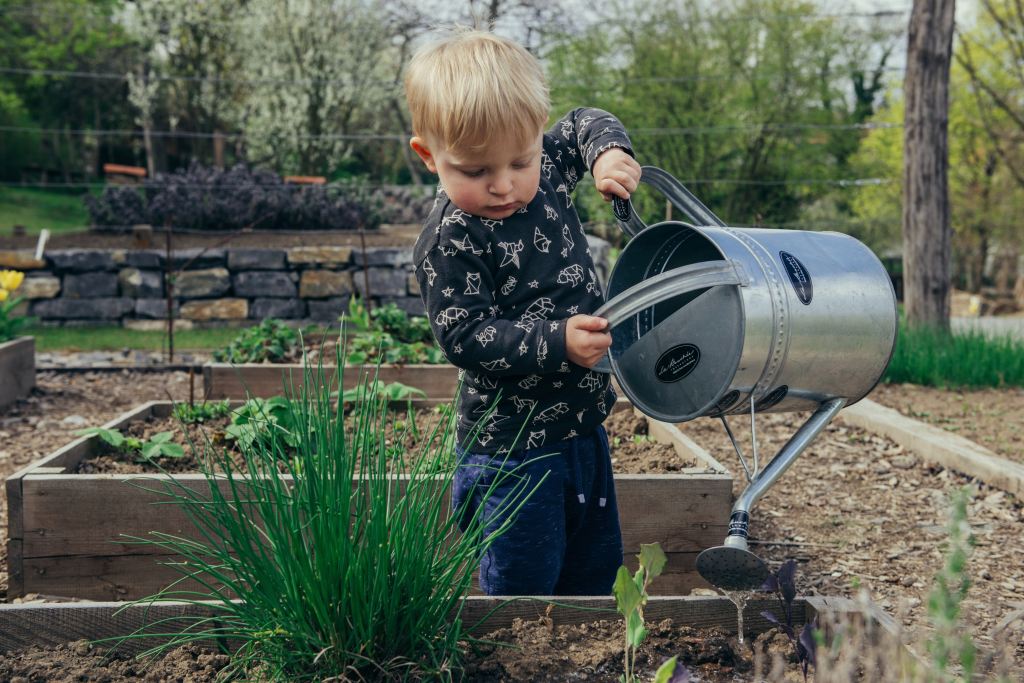
Discipline means discipleship. You are always discipling, either with life in Adam or life in Christ. Here is a call to disciple with intentionality. Here is a call to disciple your children in the Lord. Your children are a garden entrusted to you by the Lord. You cannot make the soil good, but you can pull weeds and sow seeds. Here then are ten lessons, ten seeds you ought to be especially zealous to plant in the garden of your children.
1. Plant the seed of God’s Law
Have your children memorize the ten commandments. Refer to them often. Help them to look at their behavior and the behavior of the world through them. It was especially these “ten words from the fire” that Moses had in mind when he said, “And these words that I command you today shall be on your heart. You shall teach them diligently to your children, and shall talk of them when you sit in your house, and when you walk by the way, and when you lie down, and when you rise” (Deuteronomy 6:6–7). Lead them to Sinai so that they might see God’s holiness, righteousness, and justice in His law. The fear of the Lord is the beginning of wisdom. Teach them God’s law.
2. Plant the seed of God’s gospel.
Learning that they are wicked sinners, tell them that God is a gracious Savior. Show them how all the Bible is about Jesus the Redeemer. Teach them of His incarnation, life, death, burial, resurrection, ascension, session, and return—all for the salvation of sinners. Pray for them and with them that God would open their eyes to see the light of the glory of God in the face of Jesus Christ. Pray with them and for them that God would grant them the new birth and repentance and faith. Teach them the gospel.
3. Plant the seed of Bible disciplines.
Teach them to read the Bible, meditate on the Bible, memorize the Bible and pray the Bible. Do this not just as part of family worship, but instill it as a personal discipline. Before they can read, have them listen to Bible storybooks on their own. Move on to listening to chapters of the Bible from the gospels, Genesis, Acts, Philippians, Psalms or Proverbs (the ESV Bible app is excellent tool for this). Once they can read, use a reading plan for children like David Murray’s Exploring the Bible. As they mature, move them on to yearly reading plans. While their minds are sponges, have them memorize tons of Scripture. Pick good gospel texts. Pick texts that deal with sins that they struggle with. Have them memorize chapters, even books. Teach them Bible disciplines.
4. Plant the seed of prayer.
Pray at meals. Pray when they are afraid. Pray when you travel. Pray when you make decisions. Pray when there is tragedy. Pray during family worship. When they come to you and you don’t know the answer, you do know this answer—”Let’s pray about this.” All these lessons are to be taught by actions as well as words, but with prayer, we teach them with actions that are words. Teach them to pray.
5. Plant the seed of song.
Sing as a family. Sing the rich hymns of the faith. Listen to worshipful music often. Don’t let the culture dictate their taste. Cultivate it yourself. Teach them what good music is and what bad music is. Teach them the power of music. Teach them to sing.
6. Plant the seed of theology.
Don’t just teach them the gospel story line of the Bible, teach them the theology of the Bible. Teach them about revelation and Scripture. Teach them about the Trinity and the person of Christ. Teach them about angels and demons. Teach them about the family and the church. Teach them about manhood and womanhood. Teach them theology.
7. Plant the seed of a Biblical worldview.
Teach them to apply the law, the gospel, and theology to this world. Teach them to look at culture, politics, economics, art, and media through the lens of a Biblical worldview. Teach them a Biblical worldview.
8. Plant the seed of work.
As soon as they are able to pick up their toys, teach them to pick up their toys. As they grow, so should their work. It takes work to teach work, but work brings a harvest. When you examine at the household codes of the New Testament (Ephesians 5:22–6:9; Colossians 3:18–4:1), you notice that they include slaves. This is because households were economies. The Greek roots of for the word “economy” mean “law of the house.” “Home economics” is a redundant phrase. Homes should be productive. They should be fruitful. God put man in the garden to work and keep it. Teach them to do what God made them to do. Teach them to work.
9. Plant the seed of stewardship.
Teach them stewardship of their time, possessions, and money. Teach them these things are not their own. They are given to them. They are God’s. He gives talents and He expects returns.
When your children complain of being bored, they’re not being good stewards of their time. Give them a job. When they destroy their toys and won’t share them, they are not being good stewards of their possessions. Require them to take care of their stuff and to share their stuff. As soon as they start earning money, teach them to wisely spend it, wisely save it, and generously give it with a cheerful heart.
Remember, we are to disciple our children to love God with their all, all the time, everywhere, and in everything. If they learn the lesson of stewardship young it will be far easier to practice it when they have a car, a job, and can contribute to the church. You can’t allow them to practice selfishness for 10, 14, or 18 plus years then think they are automatically going to be generous upon conversion. The old man has habits and those habits will be hard to break. Teach them to be wise and generous stewards.
10. Plant the seed of respect.
“Yes sir.” “No mam.”
“Sit up straight. Wipe you mouth. Chew with your mouth closed. Look them in the eye. Tell them your name. Walk, don’t run. Sit like a lady. Carry yourself like a man. Dress modestly. Take your hat off.” Teach them not to think of these things as fashions. Teach them how to show respect and how to carry themselves with honor. Children are to honor their parents. Teach them respect.
“But they’re not converted,” you might object. Yes, but they are created and they are obligated. Inability doesn’t negate responsibility. Teach them how to love God as you teach them the love of God in Christ. Even if they are not converted, you will have given them something of a common grace and a lesson of how to live in God’s world. They may not be salt and light, but you will have salted and lighted the earth to some degree with them.
I tell my boys often that to outshine ninety percent of their peers doesn’t take a great deal these days. They need only do two things: 1. Work hard. 2. Be respectful. If your children learn just a few of these lessons, they can reap a lot of blessings. Pray for their conversion. Disciple them to love God. And know that this world is better for your disciplining your children in the Lord.
And when you fail to discipline, delightfully remember that your heavenly Father does not. He will never leave you or forsake you. He is perfectly conforming you to the image of His perfect Son with all wisdom. Because Christ bore the curse on the cross, you only bear the rod of reproof. Christ was judged as a sinner so that you might be disciplined as a son. Discipline your children by receiving His discipline. Let your Heavenly Father use your failures as His child to accomplish this goal—bringing up your children in the discipline and instruction of the Lord.

 No Other Boast