“He was driven from among the children of mankind, and his mind was made like that of a beast, and his dwelling was with the wild donkeys. He was fed grass like an ox, and his body was wet with the dew of heaven, until he knew that the Most High God rules the kingdom of mankind and sets over it whom he will. And you his son, Belshazzar, have not humbled your heart, though you knew all this, but you have lifted up yourself against the Lord of heaven. And the vessels of his house have been brought in before you, and you and your lords, your wives, and your concubines have drunk wine from them. And you have praised the gods of silver and gold, of bronze, iron, wood, and stone, which do not see or hear or know, but the God in whose hand is your breath, and whose are all your ways, you have not honored.”
—Daniel 5:21–23
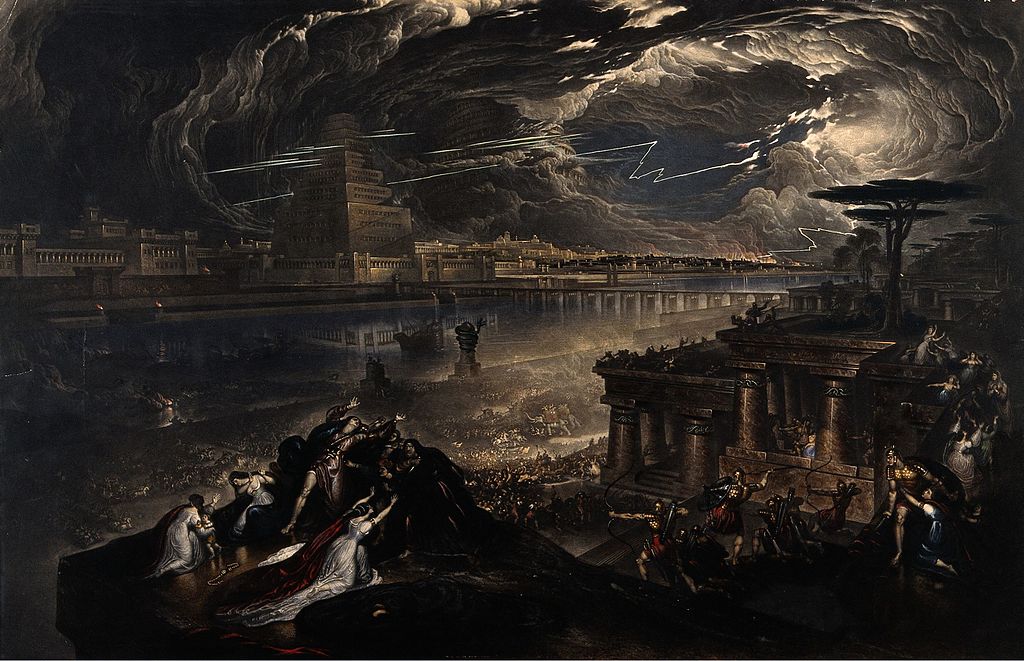
Early in his commentary on Daniel, Sinclair Ferguson offers this insight, “From one point of view (and one of which the teacher or preacher needs to be aware in the study of Daniel) there is a certain monotony about the underlying structure and theme of the succeeding chapters of this book. The scenario changes, but the plot remains the same.” Kings live and die. Kingdoms rise and fall. There is change; this is constant. But God Most High, He lives forever, His Kingdom is an everlasting kingdom and His dominion endures from generation to generation (4:3).
This is the major theme, the bass drum of the rhythm of Daniel. And the same minor themes, the toms, snares, and cymbals, keep steadily recurring as well. But this “monotony” is now amplified as the movement of Daniel 2–7 begins to turn back in on itself, making its way back through the themes it has developed. The chiasm of Daniel 2–7 has reached its center and now works its way back out again.
These chapters, all written in Aramaic, have a definite chiastic structure. A chiasm is a structuring device that has an ABCBA pattern. On the outside of this chiasm, we have Nebuchadnezzar’s dream about four kingdoms (ch. 2) and Daniel’s vision of four kingdoms (ch. 7). Further in, we have two stories of faithful Jews, first that of Shadrach, Meshach, and Abednego in chapter 3, then that of Daniel and the lion’s den in chapter 6. Then at the center, we have two stories about kings being humbled, first Nebuchadnezzar in chapter 4 then Belshazzar in chapter 5.
A Nebuchadnezzar’s Vision of Four Kingdoms (Chapter 2)

	B The Fiery Furnace (Chapter 3)

		C Nebuchadnezzar Humbled (Chapter 4)

		C' Belshazzar Humbled (Chapter 5)

	B' The Lion’s Den (Chapter 6)

A' Daniel’s Vision of Four Kingdoms (Chapter 7)
Remember also that the book of Daniel clearly falls into two halves. The first half, chapters 1–6, is comprised of six narratives. The latter half is made up four apocalyptic visions. The Aramaic section, as it draws in chapter 7, demonstrates that the message of Daniel is singular. The narratives help you interpret the visions. And here is the singular and united message of Daniel. Daniel is given to us “to the end that the living may know that the Most High rules the kingdom of men and gives it to whom he will and sets over it the lowliest of men” (Daniel 4:17).
This is the rhythm of Daniel. It is the rhythm of history. It is steady, but it is not painfully “monotonous.” It is the beat that holds history together and keeps all things marching along to His eternal purpose. The Most High rules the kingdom of men for His purposes. And this is His purpose: that the Stone might be seen to be superior to the Statue.
“The Most High rules the kingdom of men and gives it to whom he will and sets over it the lowliest of men.”
“And being found in human form, [the Christ] humbled himself by becoming obedient to the point of death, even death on a cross. Therefore God has highly exalted him and bestowed on him the name that is above every name, so that at the name of Jesus every knee should bow, in heaven and on earth and under the earth, and every tongue confess that Jesus Christ is Lord, to the glory of God the Father” (Philippians 2:8–11).
 No Other Boast