“You saw, O king, and behold, a great image. This image, mighty and of exceeding brightness, stood before you, and its appearance was frightening. The head of this image was of fine gold, its chest and arms of silver, its middle and thighs of bronze, its legs of iron, its feet partly of iron and partly of clay. As you looked, a stone was cut out by no human hand, and it struck the image on its feet of iron and clay, and broke them in pieces. Then the iron, the clay, the bronze, the silver, and the gold, all together were broken in pieces, and became like the chaff of the summer threshing floors; and the wind carried them away, so that not a trace of them could be found. But the stone that struck the image became a great mountain and filled the whole earth.”
—Daniel 2:31–35
Sometimes Nebuchadnezzar’s dream is referred to as his “dream of the great image.” Some Bibles might even have something like that as the heading for this chapter. But that is only half the dream, and it is the lesser half. There is not only a statue; there is a Stone. This is “Nebuchadnezzar’s dream of the statue and the Stone.” And if the statue is great, mighty, of exceeding brightness, and frightening in appearance, how much more awesome is this Stone?
The Stone is cut out, but not by human hand. It is a Divine Stone. There is something about the image, not only in its shape, but in its origin, that is of man. Not so with this Stone.
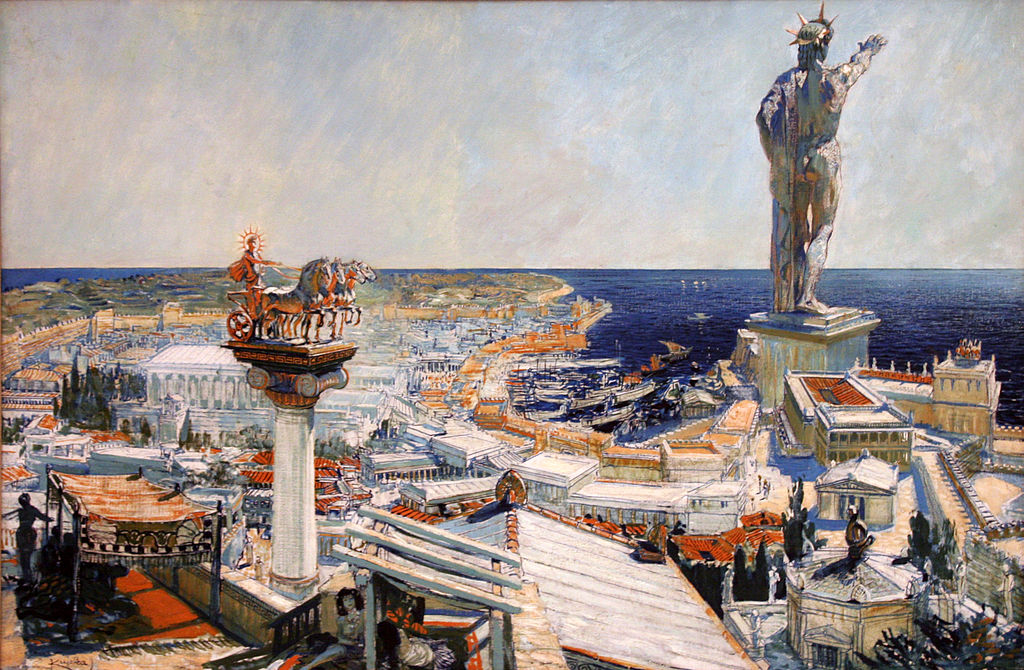
The Stone strikes the image on the feet of iron and clay. The divine clashes with the human. This doesn’t simply topple the image; it disintegrates it. When the Colossus of Rhodes fell, it was still so impressive that many continued to journey to see it until the seventh century when Arabian forces raided and broke it up for scrap. But when this great image is struck by the stone, all is broken into pieces so that is becomes like chaff and is carried off by the wind with not a trace left to be found. The Jew, reading of this vision, no doubt could not but think of the wicked being described in just this way in the first psalm. “The wicked… are like chaff that the wind drives away. Therefore the wicked will not stand in the judgment, nor sinners in the congregation of the righteous” (Psalm 1:4–5).
Not only does the Stone destroy; it dominates (v. 35b). The stone destroys the image and becomes a mountain that fills the earth. Though this dream is one of a statue and the Stone, if we are going to pick one of them to designate this dream, it should be the Stone. What is this great image in comparison to the great mountain? The image may explain part of Nebuchadnezzar’s fright, but the Stone is the superior cause.
 No Other Boast