“So he delivered him over to them to be crucified. So they took Jesus, and he went out, bearing his own cross, to the place called The Place of a Skull, which in Aramaic is called Golgotha.”
—John 19:16–17
Pilate delivers Jesus over to be crucified and the soldiers take Him, but John is also careful to tell us that Jesus “went out bearing his own cross.” The synoptics are all keen on informing us that at some point along the Via Dolorosa (sorrowful way) one Simon of Cyrene was conscripted to carry Jesus’ cross. The soldiers’ concern in this was that Jesus expire on the cross rather than on the way to the cross. The Romans used the cross for a purpose, and a premature death would subvert that purpose.
Unlike the synoptics, John simply tells us, “he went out bearing his own cross.” John’s account doesn’t conflict with the other gospels in this, rather, there is an emphasis, a theological point he wants to highlight, one he has frequently been drawing our attention to. The Savior is sovereign. The Lamb of God who takes away the sin of the world has intentionally been walking with purpose to the slaughter. Again and again as Jesus returns to Jerusalem, we have seen He does so walking obediently towards the cross. In His arrest and His trials, Jesus leads them to lead Him to the cross.
“For this reason the Father loves me,” Jesus explains, “because I lay down my life that I may take it up again. No one takes it from me, but I lay it down of my own accord. I have authority to lay it down, and I have authority to take it up again. This charge I have received from my Father” (John 10:17–18). The sovereign Savior went out bearing His own cross. The Shepherd has been struck; the sheep are scattered (Zechariah 13:7, Matthew 26:31). Jesus walks alone to the cross. He is drinking the cup that the Father has given to Him—the cup of staggering, the cup of the wrath of the Almighty (John 18:11).
Despite the reservation of many modern scholars, I believe the early church fathers were right to see an allusion here to that most striking of episodes in the life of the patriarch of Israel and his beloved son. God commanded Abraham to take his son Isaac and sacrifice him on a mountain in Moriah (the same area where 2 Chronicles 3:1 tells us the Temple would later be built). Moses records, “And Abraham took the wood of the burnt offering and laid it on Isaac his son. And he took in his hand the fire and the knife. So they went both of them together. And Isaac said to his father Abraham, ‘My father!’ And he said, ‘Here I am, my son.’ He said, ‘Behold, the fire and the wood, but where is the lamb for a burnt offering?’ Abraham said, ‘God will provide for himself the lamb for a burnt offering, my son.’ So they went both of them together” (Genesis 22:6–8).
Once more, Father and Son walk up the hill together. The Father has laid the wood on His Son’s back. The Father carries the knife and the fire. The Son obediently carries the burden. But this time, the Son goes up the hill with full knowledge that He is the sacrifice provided as a substitute. And this time, no angel will stay the hand of the Father.
John’s account of Jesus’ sentencing is written so that words of mockery become words of worship.
“Hail, King of the Jews!”
“Behold the man!”
“…the Son of God.”
“Behold your King!”
In his first letter to the Corinthians, Paul writes, “among the mature we do impart wisdom, although it is not a wisdom of this age or of the rulers of this age, who are doomed to pass away. But we impart a secret and hidden wisdom of God, which God decreed before the ages for our glory. None of the rulers of this age understood this, for if they had, they would not have crucified the Lord of glory” (1 Corinthians 2:6–8). The saints have this wisdom, a wisdom that the rulers of this age did not. It is a Spiritual wisdom, a wisdom imparted but the Spirit of God. Paul speaks of this impartation in his second letter to the Corinthians as an illumining of our hearts to give us the light of the knowledge of the glory of God in the face of Jesus Christ.
John has written this gospel so that you might see what they did not see. What the Jews, the soldiers, and Pilate laugh at as upside down, John wants you to see right side up. John has written this gospel so that by the Spirit you might receive the secret and hidden wisdom of the gospel of Christ. He has written this gospel so that you might believe that Jesus is the Christ, the Son of God. He has written this gospel so that what others think is folly, you know as wisdom. What for others is a stumbling block, to you is the Cornerstone. Their words of mockery, become your words of worship.
“Hail, King of the Jews!”
“Behold the man!”
“…the Son of God.”
“Behold your King!”
Words recorded as ridicule, you recycle with reverence.
Pilate said to them, “Take him yourselves and judge him by your own law.” The Jews said to him, “It is not lawful for us to put anyone to death.” This was to fulfill the word that Jesus had spoken to show by what kind of death he was going to die.
—John 18:31–32
The Sanhedrin no doubt think themselves so shrewd, and Pilate so practical, but it is the soon to be crucified King who rules the day. As you read this account of Jesus’ trial, do you feel more pity or awe? John wrote this gospel, he tell us, “so that you might believe that Jesus is the Christ, the Son of God” (20:30). This too is written for that purpose. John has not mistakenly lapsed into an episode contrary to his aim. If you read John’s account of Jesus’ trial as John intends you too, it is not sorrowful pity, but faith-filled awe that overwhelms you.
The Jews say Jesus deserves death because He has blasphemed (19:7). But they know this won’t fly with Rome, so they present the Jewish hope of the Messiah as their accusation against Jesus. This is why Pilate asks “Are you the King of the Jews?” With this, they don’t eradicate His claims. They establish them. The Sanhedrin is not shrewd; the Savior is sovereign. No one takes His life. He lays it down of His own accord (John 10:18). This is all so that Jesus might die just as He has said (v. 32).
“‘And I, when I am lifted up from the earth, will draw all people to myself.’ He said this to show by what kind of death he was going to die” (John 12:32–33).
Do not pity Jesus as a helpless victim of wicked men. Yes, these men were wicked, but their wickedness didn’t carry the day. Do not pity Jesus, stand in awe of Him. Believe in Him.
Pilate says He find no guilt in Jesus. That should be the end of this trial. “Not guilty.” But Pilate is not principled. He is pragmatic. He is practical. Jesus just doesn’t work for Pilate and Pilate is concerned about what works. So too are the Jews. But Pilate will lose his position. The Jews will lose their nation. Jesus will rise and rule from the right hand of the Father. “What is truth?” Pilate asks. Truth is a Who and He is bearing witness to Himself before Pilate. Deny this witness, and however things may work out for you immediately, they will not work out for you in the end.
“Why do the nations rage
	and the peoples plot in vain?
The kings of the earth set themselves,
	and the rulers take counsel together,
	against the LORD and against his Anointed, saying,
	‘Let us burst their bonds apart
	and cast away their cords from us.’
He who sits in the heavens laughs;
	the Lord holds them in derision.
Then he will speak to them in his wrath,
	and terrify them in his fury, saying,
‘As for me, I have set my King
	on Zion, my holy hill.’
I will tell of the decree:
The LORD said to me, ‘You are my Son;
	today I have begotten you.
Ask of me, and I will make the nations your heritage,
	and the ends of the earth your possession.
You shall break them with a rod of iron
	and dash them in pieces like a potter’s vessel.’
Now therefore, O kings, be wise;
	be warned, O rulers of the earth.
Serve the LORD with fear,
	and rejoice with trembling.
Kiss the Son,
	lest he be angry, and you perish in the way,
	for his wrath is quickly kindled.
Blessed are all who take refuge in him” (Psalm 2).
Yes, Jesus suffered—He suffered the worst injustice. Yes, He was innocent and sinned against violently. Yes, He was a man of sorrows. But do not pity Him. Marvel at the King who came to die not only at the hand of sinners, but also in the stead of sinners. The problem with pity is that you do not trust someone you simply pity. You do not look to them for help; you try to help them. Sinner, do not pity Jesus as a mere man who suffered wrongly, a victim of gross injustice. No, marvel at Him as God the Son incarnate, the King, come to die in the stead of sinners so that they might be counted righteous. Marvel at Him and believe and have life in His name.
18 Now the servants and officers had made a charcoal fire, because it was cold, and they were standing and warming themselves. Peter also was with them, standing and warming himself.
19 The high priest then questioned Jesus about his disciples and his teaching.
—John 18:18–19
Here we see the weakness of disciples, the wickedness of man, and the strength and righteousness of Jesus Christ. Peter’s weakness is the weakness of every disciple. Annas’ wickedness is the wickedness of every man. Peter’s weakness is set in contrast to Jesus’ strength. Annas’ wickedness is set in contrast to Jesus’ righteousness.
Peter fled, but he then followed. At a distance (Matthew 26:58; Mark 14:54, Luke 22:54). He followed but he then denied. Often, doing a little good for Jesus is just a set up to do a worse evil. Beware a little loyalty, a little obedience, a little following of Jesus.
After Peter first denies the Lord, we find him with the officers and servants of the high priest, standing by the fire, warming himself (v. 18). This hearkens back to the description given of Judas in v. 5, “Judas, who betrayed him, was standing with them.” While Jesus is being tried and stricken, Peter is denying and warming himself.
All four gospels record Peter’s denial. Mark and Luke also mention this fire. But only John adds the detail that it was a “charcoal fire.” Why is this? Just a superfluous detail? It is also only John that records Jesus appearing to seven of the disciples at Galilee and eating fish with them. In 21:9 we read, “When they got out on land, they saw a charcoal fire in place, with fish laid out on it, and bread.” These are the only two places in the New Testament where this word for “charcoal fire” is used. It is after they have eaten breakfast around this charcoal fire, that Jesus thrice asks Peter, “Do you love me?” This is not the end for Peter. Peter’s denial is ugly, but it is not ultimate. Peter’s denial is not like Judas’ betrayal. And the reason it is not is because of the very High Priest Peter has denied.
“‘Simon, Simon, behold, Satan demanded to have you, that he might sift you like wheat, but I have prayed for you that your faith may not fail. And when you have turned again, strengthen your brothers.’ Peter said to him, ‘Lord, I am ready to go with you both to prison and to death.’ Jesus said, ‘I tell you, Peter, the rooster will not crow this day, until you deny three times that you know me.’” — Luke 22:31–34
Peter denies, but Jesus keeps. See the weakness of this disciple. See the strength of Jesus. See your weakness. See Jesus’ strength. He does not lose His own. See Luther trembling after the first day of the Diet of Worms. But then, see him the next day in Christ exclaiming, “Here I stand.” Do not presume on your own strength. Trust in the Lord’s.
Annas questions Jesus. We read over that too quickly. Annas questions Jesus. The false questions the true. The shadow questions the substance. The apostate questions the faithful. The wicked questions the righteous. He questions Jesus about His disciples and His teaching. Annas is aiming to get Jesus to incriminate Himself theologically and politically—to sentence Himself to death under both Jewish and Roman law. Jesus will say nothing concerning His disciples, of whom He will not lose one, though all have fled and one lies out in the courtyard denying Him. Jesus will say that He need say nothing concerning His teaching, vv. 20–21. Jesus is exposing the injustice of these proceedings. His teaching has been public, but His arrest and trial are now private. A charge is to be established on the basis of two or three witnesses (Deuteronomy 19:15). They have already condemned Jesus (John 11:45–53). Now they are trying to reverse engineer the evidence.
They will gather false testimony, but even that will not serve their purposes (Matthew 26:59). Ultimately it will be upon the basis of the true claims of the true High Priest that they condemn Him for blasphemy. But their sin doesn’t carry the day. Annas will send Jesus to Caiaphas; Caiaphas who unwittingly prophesied that Jesus would die to gather into one the children of God (John 11:49–53). Man had predetermined to condemn. But long before that, God had predetermined to justify. Listen to God’s dissenting minority but overriding opinion on this trial as presented in the book of Acts.
“[T]his Jesus, delivered up according to the definite plan and foreknowledge of God, you crucified and killed by the hands of lawless men. God raised him up, loosing the pangs of death, because it was not possible for him to be held by it.”
“…for truly in this city there were gathered together against your holy servant Jesus, whom you anointed, both Herod and Pontius Pilate, along with the Gentiles and the peoples of Israel, to do whatever your hand and your plan had predestined to take place.” —— Acts 2:23–24, 4:27–28
Here we do see the wickedness of man in full relief, but we also see supreme over it the grace of God. The grace of God is greater that the sin of man. Man’s sin serves to establish God’s grace. God’s grace serves to erase man’s sin. The faithful High Priest is superior to this false one and He came to die, the just for the unjust. “For Christ also suffered once for sins, the righteous for the unrighteous, that he might bring us to God, being put to death in the flesh but made alive in the spirit ” (1 Peter 3:18).
Disciples are weak. Men are wicked. But Jesus is strong and righteous. He is righteous for wicked sinners and He is strong for weak disciples. Look to Him for salvation from your sin. Look to Him for sanctification in righteousness.
Ah, holy Jesus, how hast thou offended,
that we to judge thee have in hate pretended?
By foes derided, by thine own rejected,
O most afflicted!

Who was the guilty? Who brought this upon thee?
Alas, my treason, Jesus, hath undone thee!
‘Twas I, Lord Jesus, I it was denied thee;
I crucified thee.

Lo, the Good Shepherd for the sheep is offered;
the slave hath sinned, and the Son hath suffered.
For our atonement, while we nothing heeded,
God interceded.

For me, kind Jesus, was thy incarnation,
thy mortal sorrow, and thy life’s oblation;
thy death of anguish and thy bitter passion,
for my salvation.

Therefore, kind Jesus, since I cannot pay thee,
I do adore thee, and will ever pray thee,
think on thy pity and thy love unswerving,
not my deserving.

—Johann Heermann, “Ah, Holy Jesus, How Have You Offended?”
Jesus was taken to the cross, but more than this, He willingly walked there. He could not have been taken otherwise. Jesus was falsely tried, but more than this, He willingly bore judgment in the stead of sinners. He could not have been tried otherwise. Jesus was wickedly murdered, but more than this, He willingly laid His life down. He could not have been crucified otherwise. In the arrest of Jesus, we do see the sinfulness of man, but we also see a sovereign Savior. Do not do the Scriptures the injustice of reading them and being more struck with man’s rebellious sin than the Savor’s obedient suffering.
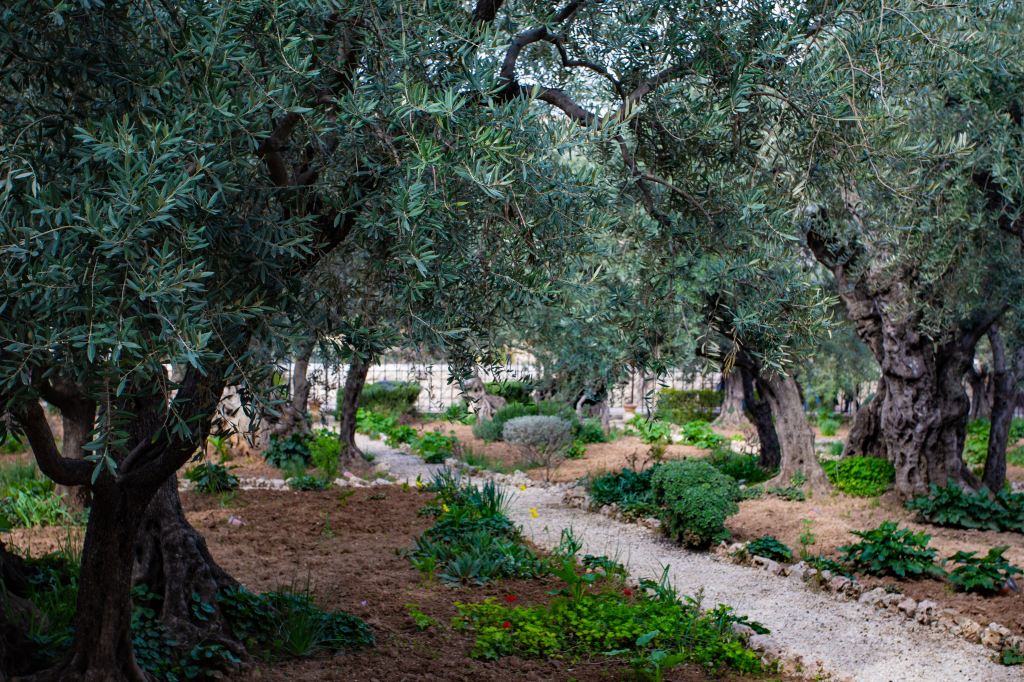
Jesus went out to the garden. Jesus went out intentionally. He He went out willingly. He went out obediently. He went out knowing. He went out according to plan. He went out with work to do. He went out with purpose. He went out on a mission. Matthew Henry comments, “Our Lord Jesus, like a bold champion, takes the field first.” The German preacher F.W. Krummacher wrote, “The voice which resounded through the Garden of Eden cried, ‘Adam, where are you?’ But Adam hid himself trembling, behind the trees of the garden. The same voice, and with a similar intention, is heard in the Garden of Gethsemane. The second Adam, however, does not withdraw from it, but proceeds to meet the High and Lofty One, who summons him before him, resolutely exclaiming, ‘Here am I!’”
In the garden, not only did the Second Adam say “Here am I” to God the Father, He said “Here is the I AM” to these sons of Adam. At this, they draw back and fall down. Jesus says two words, He says His name, the name of the Triune God, and they are laid flat. They are on holy ground. Who is in control? Who is in authority?
When Jesus then tells them to take Him and let the disciples go free, I doubt it had the air of a suggestion. It came with the force of a command. There is not a hint of debate, dissension, or disagreement. Even once Peter draws his sword and draws blood, these armed men do not pounce. Why? Because Jesus is in control and Jesus will not lose one of those given to Him by His Father. He willingly offers Himself so that the disciples may go free, fulfilling His own word as the word of God. All this recalls the answer the officers gave to the chief priests when they last failed to arrest Jesus. “No one ever spoke like this man!”
And so it is that they bind Him. This is not tragic. It is comedic. He has spoken and laid them flat and they bind His hands! Even on a superstitious level, it would have made more sense to gag Him. But there was no need to bind or gag. It is only because of Jesus’ restraint that they are allowed to restrain Him. Jesus was not taken by force. He offered Himself up in obedience to His Father and He did so to drink the cup of wrath mixed for sinners who would attempt deicide if given the opportunity. Listen to Matthew Henry again, “When the people would have forced him to a crown, and offered to make him a king in Galilee… he withdrew, and hid himself (ch. 6:15); but, when they came to force him to a cross, he offered himself; for he came to this world to suffer and went to the other world to reign.”
Perhaps few uninspired teachers have explained what is communicated here as wondrously at the 19th century Scotch minister ‘Rabbi’ John Duncan. His biographer, Alexander Moody Stuart, records the following testimony of one of his students.
“In the winter of 1864, Dr. Duncan was reading part of Isaiah with his senior class. The particular passage I cannot remember, nor does it matter, for it only served as a suggestion of the cry in ver. 1 of the 22d Psalm, ‘My God, my God, why hast thou forsaken me?’ By the time Dr. Duncan had reached that point he had left his desk and, bent nearly double, was pacing up and down in front of the students’ benches, his snuff-box and pocket-handkerchief in one hand, a huge pinch of snuff occupying the fingers of the other, but utterly forgotten in the absorbing interest of his subject, our Lord’s sufferings for sinners, which he was turning over and looking at, now on this side, now on that, but all with a loving reverence, and as one who spoke in a hall sleeping vision, when suddenly a flash went through him as if heaven had opened. He straightened himself up, his face kindled into a rapture, his hand went up and the snuff scattered itself from the unconscious fingers as he turned to the class, more as it seemed for sympathy than to teach—‘Ay, ay, d’ye know what it was dying on the cross, forsaken by His Father—d’ye know what it was? What? What?’ (as if somebody had given him a half answer which stimulated him, but which he had to clear out of his way, a very usual exclamation of his when wrapped in thought.) ‘What? What? It was damnation—and damnation taken lovingly.’ And he subsided into his chair, leaning a little to one side, his head very straight and stiff, his arms hanging down on either side beyond the arms of his chair, with the light beaming from his face and the tears trickling down his cheeks he repeated in a low intense voice that broke into a half sob, half laugh in the middle, ‘It was damnation—and he took it lovingly.’ No saying of the many I have heard from him, nothing in all his manner and expression, ever struck me like this.”



 No Other Boast